Spix's Macaw
Cyanopsitta spixii
IUCN Red List
- Range
- Endemic to northeastern Brazil
- Habitat
- Caatinga, the hot arid interior, and gallery forest along waterways
- Diet
- Nuts, seeds, and fruits
- Lifespan
- Unknown in the wild, averaging in the thirties in captivity
- Last wild bird
- Disappeared by 2000, declared Extinct in the Wild in 2019
- Reintroduction
- First releases in 2022
Overview
Range and habitat
Spix's macaws are endemic to Brazil, and were once found in the northeastern Brazilian wild. Their natural habitat consists of the hot, arid, grassy interior of Brazil, and more commonly the gallery forests* that run along its waterways. The known extent of this bird in the wild stretched across the coastal regions of east Brazil, with scattered sightings from north to south.
These distinct blue macaws have officially been deemed Extinct in the Wild under the most recent IUCN reports. However, captive care and breeding returned birds to the wild beginning in 2022, keeping the species afloat.
What we do not know
Spix's macaws depend on a heavily specialized habitat to nest within their range. Sightings have been rare since the bird's discovery, and because that habitat is so narrow and specific, human encroachment on their territory has resulted in devastating losses.
The difficulty and rarity of sighting these birds has made determining their habitat hard, and much remains uncertain about their natural, unbothered range. Extensive research only began after habitat loss was already underway, so the specifics of how far they once ranged remain vague.
Diet
As with other members of the Psittacidae, the Spix's macaw's diet consists of nuts, seeds, and fruits. The full extent of the bird's natural diet also remains a guess, since colonizer plants have been the most commonly reported food source in the observations we do have.
Social life and courtship
Spix's macaws, like many other birds, are extremely social, and typically travel in small family groups or monogamous pairs. They perform elaborate courtship rituals with their partner during the winter mating season, and form strong, compassionate bonds.
Their courtship consists of acrobatic movement and habitual choreography displayed in an energetic, playful sequence. These birds are full of life, and they are extremely loyal to their partners, reinforcing the relationship regularly through feeding and other rituals.
Nesting
These birds' specific nesting practices in the wild remain vague, but canopy nests have been studied where the birds lay one to seven eggs per clutch. Incubation under attentive maternal care takes around a month, and chicks fledge within three months.
Appearance
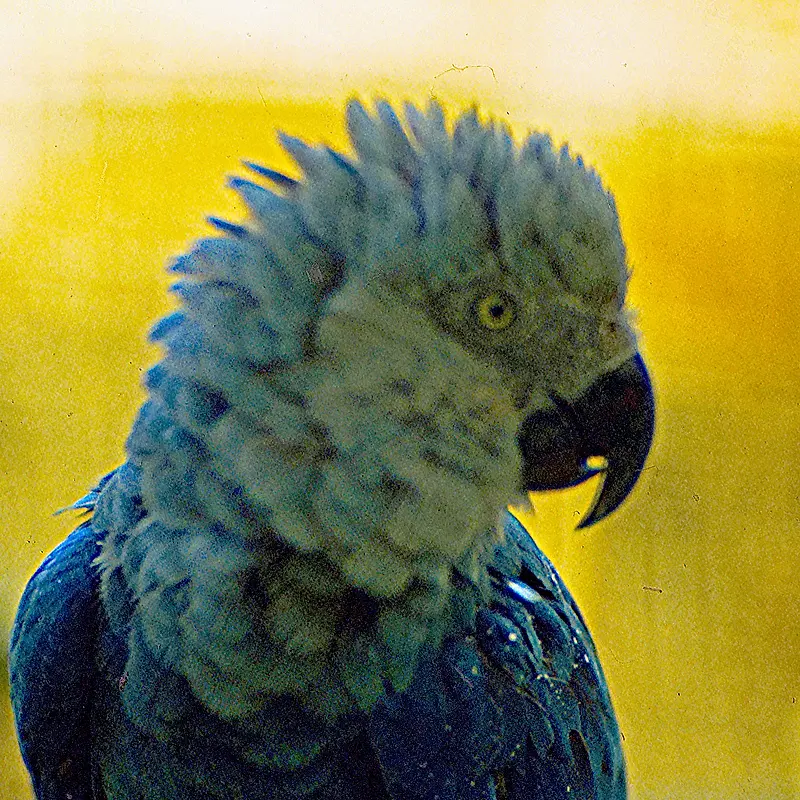
These easily identifiable, vibrant blue birds are among the smaller members of their family. They have light grey coverage around the face, and brilliant blue plumage covering all 56 cm (1 ft 10 in) of the body. Wing length reaches only around 25 cm (10 in), which results in a high wing loading*.
Sexual differences are indeterminate. Juveniles look much like adults apart from a white stripe along the beak. These birds typically have black hooked beaks and long tails. Wild lifespan is unknown, but in captivity their longevity averages in the thirties.
Threats
Already rare before we knew it
Deemed Extinct in the Wild, Spix's macaws now depend on extreme conservation efforts to keep the species alive. At the time of the bird's discovery it was already rare. Extensive burning and logging had destroyed the majority of habitable zones before anyone was counting. Because the discovery of this bird came so late into rapid human development, the true extent of its natural occurrence is unknown and hard to reconstruct.
Deforestation and development
Constant deforestation and human development across the northeastern regions of Brazil attacked the highly specific habitat these macaws depend on. The narrow, specific range of that habitat made any expansion of human development devastating.
Invasive species
Already battling extreme habitat loss through deforestation, these birds also had to compete with the anthropogenic* introduction of invasive species. Direct predation by rats, cats, and non-native monkeys thinned the numbers of the birds' eggs and young. Indirectly, the introduction of domestic livestock stunted the regenerative growth of the bird's habitat, and demanded more agricultural land at the cost of natural woodland.
A habitat that cannot regrow
The wooded areas destroyed by induced fires and clear cutting consisted of trees hundreds of years old, and those areas have seen barely any regenerative growth in the last 50 years, which makes reintroduction difficult. The area of reclaimable habitat is further limited by climate change patterns and by land already colonized. These habitats suffer extreme desertification* that is irreversible and difficult to adapt to. The effects of climate change put even more pressure on the living opportunity available to these birds, and make reintroduction harder still.
The utter destruction of the Caatinga* ecosystem over the years has caused severe habitat loss for every species within it. The unique conditions of the Caatinga call for highly specialized species, so significant destruction of this region sends ripples of death through countless others.
Damming and the gallery forests
Because the rare gallery forests were one of the bird's main habitable zones, river damming wiped out thousands of kilometers of them. Being the only reliable source of water and fertile soil in an otherwise arid region, gallery forests also enabled extreme agricultural expansion. Cattle ranching in the same regions competed with and pushed out these birds, and demand for timber in these arid lands stripped thousands of trees from the region, taking away the bird's natural protection and food source at once.
The pet trade
On top of devastating human encroachment in Brazil, Spix's macaws also suffered from the pet trade, sought after as a status pet. These already rare birds were taken out of their natural habitat and into people's homes.
Their small population size made any additional pressure a potential catastrophe. The loss of even a few birds to the pet trade reduced the genetic diversity available and made reproduction harder to achieve, so a handful of removals could affect the entire population.
The bottleneck in captivity
Constant pressure and endless demand for deforestation in east Brazil pushed, thinned, and finally wiped out the wild Spix's macaw population. The last known wild bird disappeared by 2000, and the IUCN officially declared the species Extinct in the Wild in 2019. Conservation efforts had begun in the 1980s, once it became apparent the species was almost guaranteed to go extinct, but the captive breeding program was founded on only seven birds.
Through extensive conservation work there are now over 360 Spix's macaws in captivity, with the majority held in breeding programs. Unfortunately, because of the bottleneck effect, genetic defects from captive inbreeding have been shown to increase infertility. These macaws are extremely hard to reproduce given those issues, and embryo death and infertility make captive breeding a long process.
The macaws' own mating habits make it harder. Captive breeding is difficult and untrue to the bird's nature, since forced pairings are hard to convince into mating and years may pass before reproduction occurs. New developments in artificial insemination have assisted with the speed and success of reproduction.
Why they matter
Seed dispersers of the Caatinga
Spix's macaws have struggled greatly in the wild, almost purely because of human interaction. After gaining independence in the 1800s, Brazil saw rapid increases in agricultural demand and capitalized on the resources it had. With all that need for land, these habitats and ecosystems were destroyed. Today, the effort to both restore the land and reintroduce the macaws has been trending successfully.
Being seed dispersers, these macaws help propagate* local flora across their tight-knit ecosystem. Their diet of nuts, seeds, and fruit moves undigested seeds across the landscape and naturally restores and expands it.
Restoring the habitat first
The effort to restore and protect Caatinga habitat is extremely important to the process of reintroducing these birds. By creating more naturally flourishing regions, these ecosystems can thrive and support every species within them, while also helping these stunning birds soar freely again.
Multiple good organizations dedicate their time and resources to giving these birds a second chance in the wild. Reintroduction programs are prioritized in the region, and the attention they bring has produced important research that helps us understand the bird.
Reintroduction matters for more reasons than just saving one species. It promotes biodiversity across these struggling, unique ecosystems and supports natural regeneration. The Caatinga needs to become self-sustaining for the region to survive, and Spix's macaws are one of the most important factors in that, which is exactly why they are needed in the wild.
A bird the public already knows
These movie star birds, featured in the 2011 film Rio, have gained significant attention and awareness since their extinction in the wild. By bringing attention to these birds and returning them to the wild, reintroduction efforts also help prevent future habitat loss through the voice of everyone involved.
Efforts to rebound this bird's population, combined with its place in pop culture, can bring far more attention and understanding to the issues of deforestation and unethical, unregulated agricultural expansion. Creating a connection between the general public and these birds is the single biggest tool available during the slow rebuilding process.
What the recovery proves
The innovation and development of more sophisticated breeding programs is central to conservation here, and new technology like artificial insemination can speed the process up while keeping the population healthier. Unfortunately, funding for new conservation technology is low, so upgrades are slow and often overlooked.
Even though the species was declared extinct in the wild, the strong efforts of passionate people saved it from total extinction, and the grueling work to grow the population has made real progress in recent years. These beautiful, extremely unique birds show the power of conservation practice, and what the future of conservation can be. Their fun, playful, elaborate rituals and their acrobatic courtship with loyal partners should be cherished and protected for years to come.
Glossary
- Anthropogenic
- caused by or resulting from human activity
- Desertification
- land becoming more arid and desert-like as a result of climate change and land use
- Propagate
- to spread or reproduce
- Gallery forest
- a strip of forest growing along a river or wetland through otherwise open country
- Caatinga
- the semi-arid thorn forest and scrubland biome of northeastern Brazil, found nowhere else on earth
- Wing loading
- the ratio of a bird's body weight to its wing area, where a higher figure means more effort is needed to stay airborne
Sources
- Wikipedia, Spix's macaw
- Blue Macaws, The habitat and status of Spix's macaw
- World Parrot Trust, Spix's Macaw encyclopedia entry
- World Parrot Trust, Spix's Macaw, Finding the Last Wild Bird
- Mongabay, For 'extinct' Spix's macaw, successful comeback is overshadowed by uncertainty
- Earth Play Studios, Spix's Macaw
- Purchase et al., Reintroduction of the Extinct-in-the-Wild Spix's Macaw in the Caatinga Forest Domain of Brazil, Diversity 16(2), 2024
- Bird Conservation International, On the brink again, the critical role of annual releases in saving Spix's Macaw