African Grey Parrot
Psittacus erithacus
IUCN Red List
- Range
- Equatorial Africa, from the Ivory Coast to Kenya
- Habitat
- Dense rainforest, forest edges, gallery forest
- Diet
- Primarily frugivore, fruits, seeds, and nuts
- Lifespan
- Around 30 years wild, up to 60 in captivity
- Population
- Difficult to survey, with declines of 90 to 99 percent in some regions
- Primary threat
- The international pet trade
Overview
Range and habitat
The African grey parrot is a parrot native to equatorial Africa. Living in the tropical regions of the continent, from the Ivory Coast to Kenya, these birds favor dense rainforests, forest edges, and some more sparse vegetation types such as gallery forests*.
Flocks and roosting
These birds spend their nights high in forest canopies, usually in large numbers. African greys can be found roosting together in trees in groups of 100 to 1,000 or more individuals. They communicate through high-pitched sounds similar to a whistle. During the day the flock navigates the forest together, searching for food.
Diet and foraging
African greys are primarily frugivores*, moving through the forest in flocks looking for fruits, seeds, and nuts. Like many other parrots, they have very strong beaks that allow them to break through nuts and dig through bark. Their eating habits consist mostly of ground feeding and branch to branch foraging. Their favorite foods include oil palm nuts and berries from plants such as Cola tragacantha.
Nesting and family life
These birds are monogamous breeders who typically nest in smaller tree imperfections and holes. The hen lays up to five eggs at a time, which she incubates while the male defends the nest and provides food. Both parents give equal care, tending their chicks until around five weeks, when the chicks have fledged. At around 12 weeks the young leave the nest and move on from their parents' care.
Intelligence
African grey parrots are among the most intelligent species in the world. According to a paper written by Irene Pepperberg and Susan Carey, African grey parrots can perform cognitive tasks at the level of a five year old human child. These birds specifically excel at abstract thinking, problem solving, and emotional intelligence and recognition.
Vocal mimicry
On the subject of their intelligence, African grey parrots are exceptionally good at vocal mimicry. These parrots can comprehend and understand human speech, and understand that it is a source of communication. Parrots are able to recreate human sounds not through a larynx, but through the syrinx*. These parrots attempt to communicate and to learn human communication, and their ability to recreate sound through the syrinx lets them play that learning back and demonstrate their understanding.
Having complex vocalizations, these parrots normally hold in-depth communication with their peers and flocks to signal danger, movement, or other necessary information. Being able to vocalize human communication is thought to be a cultural acquisition. These birds learn quickly, and adapting their communication to their surroundings is key to their survival.
Appearance
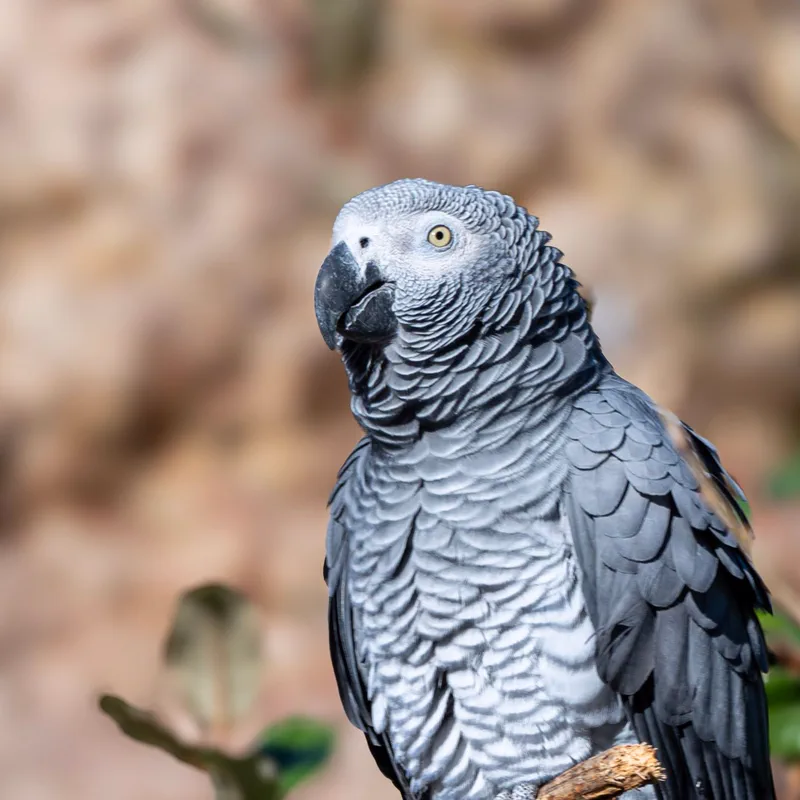
African grey parrots are the largest of the African parrots. They have a distinguishing light grey plumage with darker wing tips, and their most noticeable feature is the bird's stark, contrasting red tail feathers. They are lighter around the face, almost white near the eyes, with a dark grey to black beak. They can be as long as 33 cm (1 ft 1 in) with a 50 cm (1 ft 8 in) wingspan.
There is little to no sexual dimorphism, which leaves imprecise factors such as size and coloration as the only way to tell males and females apart. These birds have a lifespan of around 30 years in the wild, and up to 60 in captivity. There is little funding and research directed at these animals, which has left their courtship behavior largely undocumented.
Threats
A species that is hard to count
Under the IUCN Red List, the African grey parrot has a population count that is hard to determine. Due to a lack of funding and research in central African regions, and civil instability across the area, African grey parrots are difficult to survey and to gain an accurate census on. Severely rapid declines across the bird's range have placed the species on the Endangered list. Many native habitats across central Africa, such as Ghana, have seen near elimination, with some regions experiencing population declines of 90 to 99 percent.
Deforestation
Recurringly seen across many endangered species, African greys are experiencing rapid habitat loss throughout their range. Deforestation has been a huge factor in declining populations in central Africa. Ghana, one of the fastest deforesting nations in the world, has seen the most notable loss of the parrot's habitat. Through the destruction of large canopied forests and clear cutting for agricultural needs, prime African grey habitat is lost.
Being a hub for in-demand agricultural products, nutrient rich soils, and precious metals, central Africa deforests at extreme rates to make way for cocoa production, mining, and logging. Between the output demanded from these major plantations and the harsh reality of an impoverished region, more ethical and more expensive ways of producing are overlooked. The east and west sides of tropical Africa have seen an almost complete loss of African grey parrot populations, which are now condensed centrally and still under pressure.
The pet trade
The more significant impact on African grey populations, and the better known one, comes through the international pet trade. The wildlife trade is a multi-billion dollar industry affecting far more than just these parrots, and African grey parrots are one of the most commonly traded birds within it. Over one million wild African grey parrots have been traded in the last few decades. Because of their "amusing" mimicry and their intelligence, these birds became a hot commodity as pets.
Between 1994 and 2003, approximately 21 percent of the wild population was being harvested every year. Of those captured, nearly 70 percent would die before ever reaching a consumer, due to the poor care given during transport.
How they were captured
The capture of these birds is heavily unregulated in these countries, whether through a lack of funding for enforcement or through corruption and civil unrest. Those capturing them often used cruel, unethical methods.
Glue traps set at common roosting spots would hold the bird in place and allow collectors to harvest them in large numbers. Collectors would also sometimes keep a feticheur*, a bird whose wings had been dislocated or whose feathers had been cut off so that it could act as a tamed decoy and signal to others. This live feticheur would be used to lure hundreds of other African grey parrots into capture. Nets, cages, and the easier capture of young birds also contributed to the large collection of these animals.
None of these methods were regulated or enforced, so the treatment of the bird was very poor. Wings and legs would be broken during collection and during transport, and the care given in transit provided no food, water, or other necessities.
After the ban
Up until 2016, owning an African grey parrot as a pet was legal without a permit, which left people who knew little about the animal free to buy one with little remorse. CITES* then placed the bird under the highest level of protection in international trade. Trade out of African countries is now restricted under CITES Appendix I*, making commercial trade illegal, but it does not end there.
Although the trade is banned in African countries, that has not stopped poachers, who now see more value in the bird than before. Still using the same cruel methods of capture, poachers continue to take and illegally trade these parrots, as well as hunt them for use in traditional medicine.
Why they matter
Gardeners of the forest
African grey parrots are very important to tropical ecosystems because of their seed dispersal capabilities. By digesting and carrying fruits, nuts, and seeds, parrots help move seeds to different places across the forest, allowing for expansion and the healthy movement of plant life. Parrots consuming seeds also prune* the forest floor, easing competition in areas where seeds are highly concentrated and allowing specific flora to flourish.
By flying great distances and carrying seeds with them, these birds help regenerate regions damaged by fire, disease, or human activity. Seed dispersal is key to maintaining plant diversity in an ecosystem, and in turn to keeping that ecosystem healthy and functional. By eating fruit these birds also move pollen more quickly and efficiently between plants, aiding plant reproduction and effectively continuing the growth of the forest.
Why they should not be pets
Creatures with this level of intelligence should be cherished, and protected well enough that we can continue to research and understand them. By keeping populations healthy, these birds stay easier to find in the wild and observe from a distance, which is how we learn more about how they work and what makes them so smart.
More importantly, anyone considering owning an African grey, or any parrot, should do extensive research on the animal before even entertaining the idea. Knowing how to actually care for this animal is non-negotiable, because poorly treated parrots under ownership often become unreleasable back into the wild. These birds demand enormous attention and can live for over 50 years in captivity, which makes them a huge responsibility.
If an owner is not able to commit to those demands, the bird is often given away to a rehabilitation facility, and by that point it is either very difficult or outright impossible to reintroduce it to the wild, because it never learned the survival skills it would need. African grey parrots are very common in rehabilitation facilities for exactly this reason, because of how much of an undertaking they are as pets, and because people either donate or abandon them. Failing to uphold the responsibility of this animal puts significant pressure on already underfunded rehabilitation facilities where space and resources may be hard to provide.
Simply put, these animals should not be pets. They are wild creatures and should not be under ownership without serious research and planning. You should only ever inquire about owning one from a trusted breeder working in ethical captivity, or from a rescue, and only where you know you can responsibly tend this animal for its entire life.
What is working
Through the difficulty of surveying and enforcing across central Africa, poaching will remain an issue, but more policies have recently been put in place around the trapping of birds in Africa. The Congo is also serving a pivotal role in the rehabilitation of these birds through two new facilities, which have released over 900 African grey parrots in their time.
Giving to ethical rehabilitation facilities is the best course of action if you do not know how to responsibly handle an African grey parrot for its whole life. Unfortunately, a parrot that was previously a pet most likely will not be able to be reintroduced to the wild, because of the survival skills it never had the chance to learn.
Glossary
- Roost
- a place for birds to perch and rest
- Ground feeder
- an animal that forages for food through soil and ground litter in open, flat areas
- CITES
- the Convention on International Trade in Endangered Species of Wild Fauna and Flora, a conservation treaty aimed at ensuring that international trade in species does not threaten their survival
- CITES Appendix I
- the list of the world's most endangered plants and animals, for which commercial trade is prohibited
- Prune
- the selective removal of unwanted parts to improve the health of another
- Frugivore
- an animal whose diet consists mainly of fruit
- Fledge
- the point at which a young bird has grown the feathers it needs to fly
- Syrinx
- the vocal organ of a bird, located where the windpipe splits, used in place of a larynx to produce sound
- Gallery forest
- a strip of forest growing along a river or wetland through otherwise open country
- Feticheur
- a captive decoy bird, deliberately maimed so it cannot fly, used to lure wild flocks within reach of trappers
Sources
- Rainforest Alliance, African Grey Parrot
- Wikipedia, Grey parrot
- Birds of the World, Grey Parrot introduction
- The Bird House, Ground feeding birds
- Harvard Gazette, Harvard study shows parrots can pass classic test of intelligence
- ExoticDirect, How and why do parrots talk
- Northern Parrots, Do parrots know what they say
- Mongabay, Catastrophic decline, nearly 99 percent of Ghana's African grey parrots wiped out
- The Conversation, Ghana's forests are being wiped out, what's behind this and why attempts to stop it aren't working
- The Dodo, African grey parrot pet trade