Carpet Python
Morelia spilota
IUCN Red List, population decreasing
- Range
- Australia, New Guinea, and surrounding archipelagos
- Habitat
- Tropics and rainforest, river woodland, arid islands, dry temperate grassland
- Diet
- Carnivore, whole prey, small mammals, birds, and lizards
- Typical length
- Around 2 m (6 ft 8 in)
- Lifespan
- Up to 20 years wild, around 30 in captivity
- Primary threats
- Habitat loss and the exotic pet trade
Overview
Range and habitat
Carpet pythons are non-venomous snakes native to Oceania and Southeast Asia. They can be found throughout many Oceanic nations, primarily Australia, New Guinea, and the surrounding archipelagos*. Carpet pythons inhabit a wide variety of biomes, including Australian tropics and rainforests, river woodlands, arid islands, and dry, temperate grasslands.
Activity and movement
Carpet pythons are generally active through both day and night, though some subspecies are noted as primarily nocturnal. They are semi-arboreal*, and like most snake species they are also excellent and willing swimmers. Carpet pythons are a rather common sight in inhabited areas and are frequently found around man-made structures.
Hunting and diet
Being a python, this snake is a non-venomous constrictor*, subduing prey by coiling around it and tightening its grip. It eats a purely carnivorous, whole-prey diet.
The carpet python's diet consists of smaller animals, usually no larger than the widest part of its own body, which it swallows whole. These are commonly small mammals such as mice, rats, and even possums. Carpet pythons also tend to take some smaller bird and lizard species.
Shedding
As with many other snakes, carpet pythons shed more frequently in their younger years, and tend to shed only around three times a year in later life stages. The shedding process itself takes nearly two weeks. Snake sheds are often crunchy, dry, paper-like skin that is extremely brittle.
Breeding
These snakes prefer solitary lives and converge only to breed. Like most species of snake, carpet pythons are oviparous*, and can lay 10 to 50 eggs in a single clutch*.
There is little information on the carpet python's exact mating system, but breeding tends to occur in the late winter months. As with typical pythons, egg care is purely maternal. The female coils around her clutch and performs muscular contractions to generate heat and incubate the eggs, a process that takes just over a month. Snakelets become reproductively mature at around three years old.
Appearance and size
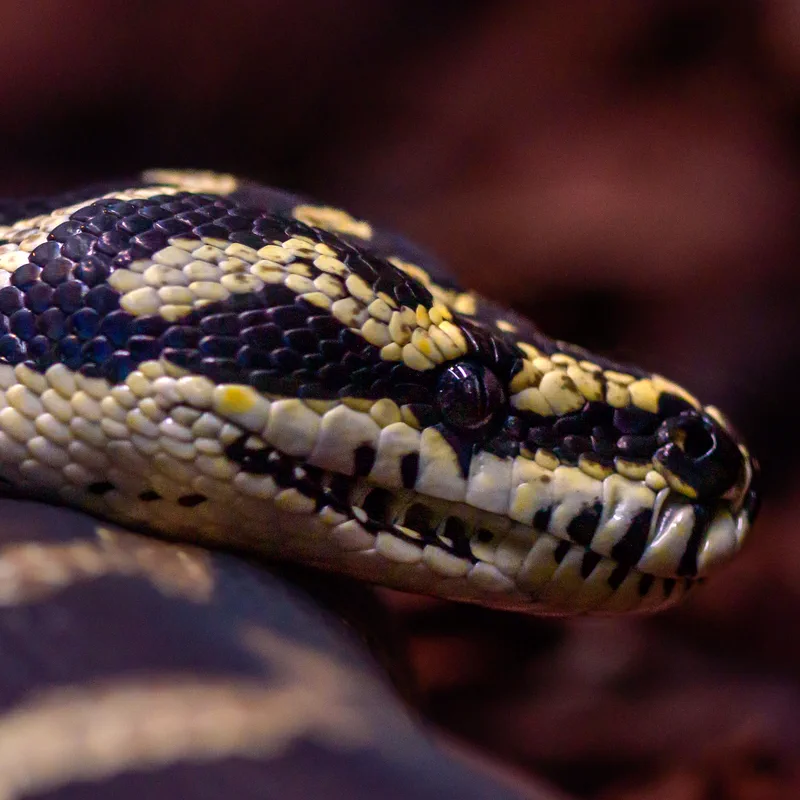
Carpet pythons reach a typical length of 2 m (6 ft 8 in), which makes them one of the larger predators in their local ecological community. Their natural coloring and patterning varies from light creamy gold through to dark olive. Carpet pythons sometimes carry majestic, intricate, diamond-shaped patterns, which is exactly what makes them desirable in the exotic pet trade.
Females tend to be significantly larger and heavier than males, but the degree of difference is highly region specific. Western populations show females reaching up to ten times the mass of males, while eastern regions see a difference of only around 30 percent. Carpet pythons can live up to 20 years in the wild, and around 30 in captivity.
Threats
Habitat loss
Carpet pythons are listed as a decreasing population within the IUCN's Least Concern category. Being a beautiful and docile* reptile, they carry a heavy burden from both the exotic pet trade and habitat loss, and regional subspecies have suffered massive declines from collection and from rapid habitat destruction.
The carpet python's largest threat is habitat loss caused by human intervention. Rapid urbanization across Australian regions has made suitable ambush conditions difficult to find. As a result, carpet pythons, along with many other snakes, have been seeking shelter in man-made structures including homes and businesses, where proper measures are usually not taken when the animal is handled. Although these snakes are able to survive and find food in those places, many people attempt to kill them or to take them personally, so the snake ends up severely punished for a habitat loss it did not cause.
Roads and agriculture
Agricultural expansion across all inhabited regions also threatens carpet pythons, through the clear cutting of natural hunting territory and through increased human contact. Road development is another major cause of decline, reducing natural living space while increasing roadkill.
Because of rapid urbanization, the Australian region near Victoria has seen a decline of nearly 70 percent in carpet python populations. This has pushed populations further inland and driven some subspecies into region-specific near extinction.
The exotic pet trade
The biggest problem facing carpet pythons stems from the exotic pet trade. While it does not always harm wild populations directly, carpet pythons are often bred for magnificent and desirable colors and patterns, and during that process the snakes usually end up with defects and incurable problems. Breeding for color in these snakes, much like in many other common pets, can cause severe health issues.
Crossbreeding and inbreeding certain carpet python subspecies produces the colors the pet trade wants, but brings genetic defects in return.
The jaguar wobble
The clearest example is the Jaguar carpet python, a carpet python morph*. The same gene that changes the color and pattern of the snake also alters a neurological process, causing the snake to develop what is known as a "wobble." This wobble can appear at any point in the snake's life. It affects the animal's balance and coordination, causing mild to severe symptoms including erratic flailing, twisting, and head tilt. These effects trigger stress in the snake and, in general, give it a very uncomfortable and troubled life.
That is only one of the many issues that arise from breeding for color. If you attempt to breed two jaguar snakes together, the offspring is a striking white snake that usually dies in the egg or shortly after hatching.
Pet trade morphs can come with a range of issues that prevent reintroduction into the wild, so many owners who cannot handle them end up leaving them to die, or handing them to a rehabilitation center that has no way to release them.
Skin harvesting
In some cases, the skin of these snakes is also harvested for cosmetic purposes.
Why they matter
Pest control and the food web
Carpet pythons are extremely important to their native ecosystems and act as a vital middle-order predator. They are natural pest control across many Oceanic regions, and they serve as prey for native birds of prey. Snakes like these pythons are extremely important in maintaining a stable food web and healthy biodiversity in their native regions.
By stunting the overpopulation of rodents in a given region, carpet pythons prevent agricultural pest damage and limit the spread of rodent-transmitted disease. Snakes are key to the natural food chain and provide one of the main food sources for aerial predators. Being such a central part of that chain, carpet pythons are also good indicators of ecosystem health.
Living alongside people
By living in human-inhabited regions these snakes control pests in those areas, and at the same time they are constantly interrupted by us. People should either leave the snake completely alone, or report it to a trusted wildlife care facility in the area. Do not try to kill or keep the animal. They are not invading your space, you took theirs.
Snakes are misunderstood
Carpet pythons are calm around humans and almost never harmful to them. A smaller constrictor like the carpet python will not attempt to constrict a person, and beyond a nippy phase when young that is quickly outgrown, it rarely bites at all. When a bite does happen it does very little damage to a human. It is comparable to being poked by needles, and the wound will bleed a fair amount because of the structure of the snake's teeth, but cleaning and properly caring for the wound is generally all it takes.
Of the thousands of snake species in the world, only around 15 percent are venomous, and only about 5 percent of all snakes can deliver a bite capable of killing a human. Snakes are severely misunderstood, and they have no intent to kill people. A snake that is spooked or made nervous by a human will usually flee, and only bite in some cases. Snakes are otherwise rather calm around people, and are even trainable. Many venomous snakes have an antivenom available, and they should not be feared nearly as much as they are, especially constrictors like the wonderful carpet python.
Owning one responsibly
Along with their colors and patterns, this snake's docile, non-venomous nature is exactly what makes it appealing to exotic pet owners. You should not plan on owning a snake like this unless you understand the importance and the commitment it deserves in order to live an enriched, full life. Responsibility when owning a carpet python is crucial, from what you feed it to the ethical quality of the environment you provide.
People tend to buy color-specific morphs that carry severe health issues caused by the pet trade, and then assume they can simply release the snake into the wild or hand it to a rehabilitation center once they no longer want it. These morphs are near impossible to release and lack the survival skills they would need.
Knowledge and research come first, alongside responsibility and awareness. Although carpet pythons are very well bred in captivity in secure numbers, direct capture from the wild still occurs and can be labelled as farm bred. Knowing your breeder matters. It is best to buy from a trusted captive breeder, never a wild-caught animal, and to choose a natural morph without genetic defects. Avoid buying snake skin cosmetics, as that trade directly impacts populations of carpet pythons and many species like them.
Why Least Concern is not the end of it
Although these snakes have large populations, that will never make the issues of the pet trade and habitat destruction void. These issues are serious and they negatively affect thousands of these snakes regularly. Regional population declines send ripples through local ecosystems and cause far more harm than is directly visible. The pet trade in snakes specifically ruins thousands of lives and puts continuous pressure on rehabilitation centers.
Extensive knowledge of whatever pet you are considering is extremely important, and you must be able to uphold that responsibility for the animal's entire life. Given good care, this animal is capable of living a full 30 enriched years in captivity.
Glossary
- Archipelago
- a chain or cluster of islands
- Arboreal
- a creature that traverses trees and branches
- Oviparous
- reproducing by laying eggs
- Docile
- not aggressive in nature toward another being
- Constrictor
- a snake that subdues its prey by coiling around it and tightening its grip
- Clutch
- the full set of eggs laid at one time
- Morph
- a color and pattern variant of a species, in the pet trade usually produced through selective breeding
Sources
- Wikipedia, Morelia spilota
- IUCN Red List, Morelia spilota
- ReptiFiles, Carpet Python Care Sheet
- Animalia, Carpet Python
- HowStuffWorks, Carpet Snake
- Government of South Australia, Department for Environment and Water, Carpet Python bioregion fact sheet
- PubMed, study reference
- MorphMarket Community, Carpet morph question