Lar Gibbon
Hylobates lar
IUCN Red List, population decreasing
- Range
- Indonesia, Laos, Malaysia, Thailand, and Sumatra, extirpated in southern China
- Habitat
- Semi-tropical evergreen, deciduous bamboo, dipterocarp, and submontane forest
- Diet
- Frugivore, with fruit making up about half the diet, plus plants and insects
- Home range
- Around 0.5 km² (0.19 mi²)
- Lifespan
- Around 30 years wild, nearly 50 in captivity
- Population
- Around 80,000, after roughly 90 percent of the original range was destroyed
Overview
Range and habitat
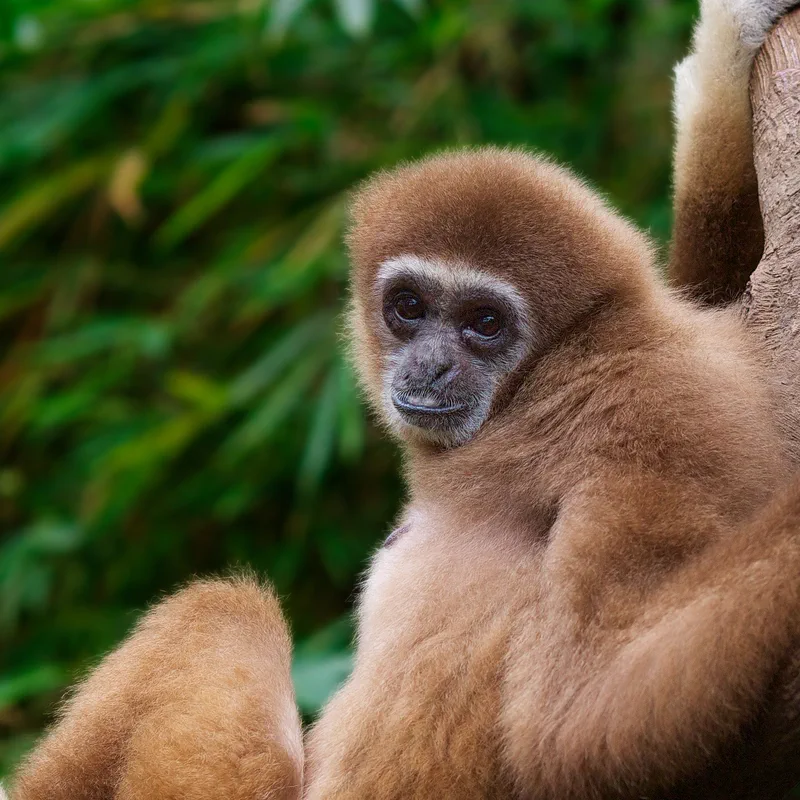
Part of the primate order, Lar gibbons are among the more commonly known gibbons. Also called the white-handed gibbon, the Lar gibbon is an Endangered primate with a decreasing wild population, and it is one of the most commonly kept gibbon species in captivity.
Lar gibbons are native to many Southeast Asian nations, spanning Indonesia, Laos, Malaysia, Thailand, and into China, along with the island of Sumatra, though their exact distribution is hard to verify. Across these regions they are commonly found in high rainfall, humid areas such as semi-tropical evergreen forest, deciduous bamboo forest, dipterocarp forest, and submontane forest, but not usually higher than 1,200 m (3,900 ft) above sea level.
Because the gibbon family is highly allopatric*, the Lar gibbon occupies a tight, narrow north to south range across Southeast Asia, typically sectioned off by rivers. In the northernmost part of that range, in southern China, the species has been extirpated*.
Life in the canopy
Lar gibbons are an arboreal species like many other gibbons, which heavily favors their densely wooded, intertwining habitat. They are diurnal*, and they sleep up among the trees, which makes it rare for them to come to the ground at all.
Where mountains meet dense jungle, the Lar gibbon's habitat plays a perfect role for its extreme agility and its brachiating. These humid evergreen forests with extremely diverse flora suit Lar gibbons and other primates, which typically live sympatrically and share the abundance of canopy travel routes and food sources. The gibbon's remarkable adaptation for navigating the canopy keeps it safe while giving it easy access to everything it needs to feed.
Diet and water
Lar gibbons are frugivorous primates, with a diet consisting, in order, of fruit, plants, and sometimes insects. In the wild their habitat offers a wide array of food to choose from, with fruit such as figs making up half the diet. Fruit is more typical in the wet season, and insects become more common when fruit is less available in the summer.
Being the social creatures they are, Lar gibbons will often share food with one another to reduce social tension and maintain the cohesion of the family group. To hydrate while staying safe, these gibbons use their hands to scoop water from tree holes and wet leaves.
Predators
That behavioral adaptation keeps them away from ground predators such as Sunda clouded leopards, Sumatran tigers, and python species. They are still prone to predation from grey-headed fish eagles. Living arboreally also keeps them in a common feeding space they can navigate efficiently and with less competition.
Family groups and home range
Lar gibbon social structure consists of small monogamous, and sometimes polyandrous, family groups made up of parents and offspring. They are an intelligent species with very good geographical awareness, which aids their foraging success in competition with other primates in the area.
Family groups travel together through a small home range of around 0.5 km² (0.19 mi²), with a daily travel distance of around 1.4 km (0.87 mi). Coordinated family movements after feeding often lead the group to an unpredictable spot in a larger tree, where they sleep and avoid predation.
Breeding
Mating in Lar gibbons occurs in every month of the year, but most conceptions occur during the dry season, with births most common in the late rainy season. Gestation takes around six months and usually yields a single young.
Appearance and brachiation
Lar gibbons are nearly identical in build, color, and size from male to female, and young tend to match the pelage* of whichever parent carries the dominant gene. They have a dichromatic pelage that lands on deep black, a sandy color, or anything in between. A white ring of hair lines their black face.
Being a true brachiator, these gibbons have very long, strong arms for propelling themselves off branches as they swing through their environment. Those specialized arms make swinging effortless. A Lar gibbon can move at up to 56 km/h (35 mph), with each swing reaching up to 15 m (49 ft). This mode of transportation is supported by curved, elongated fingers and relatively short legs, though those legs contribute a great deal to balance and branch navigation.
Unlike other apes, Lar gibbons have a bony padding on the rear known as a sitting pad, which allows them to rest on branches comfortably. It is a trait they share with Old World monkeys rather than with their fellow apes. In the wild, Lar gibbons typically live to around 30 years, while in captivity they can reach nearly 50.
Threats
Decline and range collapse
As of 2008, the Lar gibbon has been deemed Endangered on the IUCN Red List. The species is considered endangered throughout its habitable zone, and in its northernmost range in southern China it has been extirpated entirely. Its range formerly extended deep into eastern Thailand, but it seems to have shifted to the southern side of the country, where it is unclear whether the species is native at all.
Lar gibbon populations are undergoing extreme decline, with an estimated 50 percent decrease over the last three generations. The Lar gibbon's specialization demands specific habitat within its range, and with roughly 90 percent of its original range destroyed, only 80,000 Lar gibbons remain.
Deforestation
Rampant deforestation and overhunting have thinned Lar gibbon numbers to an alarming degree. A recurring theme in habitat loss is the expansion of agricultural and commercial industry, and the habitat of the Lar gibbon is no exception. Rapid growth of human populations in Southeast Asia has demanded extreme amounts of food and consumer goods.
Deforestation, driven by more than just logging, has wiped out thousands of kilometers of the trees Lar gibbons used to inhabit. Without trees, Lar gibbons are extremely prone to predation and have almost no protection. On top of that, every food source they rely on is in those trees, so when the trees go, the distance required to find food becomes dramatic, across land they are not specialized to travel on.
Lar gibbons are pushed into smaller and smaller habitats as trees are felled, where competition over space and food with other primates is far greater. Habitats become separated by anthropogenic* expansion, and the options for diverse breeding become harder to find in these tighter regions.
Palm oil
One of the most significant detriments to Lar gibbon habitat comes from the leading cause of deforestation, palm oil plantations, which require enormous expanses of clear cut or burned land in exactly the climate thousands of species depend on.
These plantations grow thousands of small palm trees that cover, shade, and dominate the land they grow on. By covering that land they prevent sunlight from reaching any other vegetation, which creates extreme, large-scale monoculture regions that are unlivable for most native species.
Roads and hunting
Habitat loss through road and railway creation poses a significant threat as well, especially because it gives hunters deeper access. Lar gibbons are extremely vulnerable to hunting, and their decreasing populations show the result of it. These gibbons are often hunted for meat used in local consumption, and targeted for use in local traditional medicines.
The pet trade
Beyond hunting for resources, mothers are often shot down from the trees so that their young can be captured more easily and traded into the cruel illegal pet trade across Southeast Asia.
Weak enforcement
Lar gibbons are protected from trade under CITES Appendix I, yet poaching and illegal trade still occur because of poorly managed and inadequate enforcement in these regions. High rates of rural poverty and a lack of education or awareness about the threats facing Lar gibbons contribute further to the lack of protection. That unawareness is not only local, it is largely international.
Why they matter
Seed dispersers
Lar gibbons are an extremely important species for their ecosystems. Like many other primates, they are crucial seed dispersers that help keep an ecosystem biodiverse. Seed dispersal also provides significant help in the regrowth of damaged regions and in the biological expansion of specific plant species, which is vital to a healthy, thriving, self-sustaining ecosystem.
Gibbons disperse seeds by feeding on plants, fruits, or seeds that are then digested and deposited in a new area the animal has swung to. Gibbon waste also provides a nutrient rich, decomposable deposit that creates perfect conditions for those seeds and the surrounding plants to grow from. It is a vital link between the feeding cycle and the regrowth cycle within a food chain.
Conservation that barely exists
Conservation often lacks power at an educational level, as seen with these gibbons, which go widely unknown and dismissed. Spreading knowledge about the habitat abuse facing this species and thousands of others is what brings attention to loosely followed policy.
Conservation action for the Lar gibbon is rather overlooked, largely because of underfunding and unawareness in the region. Specific recovery plans and area-based management do not exist beyond international breeding programs. Despite the conservation efforts that do exist, Lar gibbon populations are still decreasing through a lack of funding and through failed attempts to protect them in regions that disregard policy.
Direct efforts to conserve the Lar gibbon start on the ground in its native range, but they are currently limited to already protected areas and national parks focused on preserving and providing habitat the species can thrive in. Unfortunately, these on-site protected areas, which hold the large majority of wild Lar gibbon populations, are seriously under-patrolled, which makes poaching and illegal forest use more common. Local involvement in protection policy is urgently needed to prevent illegal forest use, poaching, and undermanagement.
Zoos and the Species Survival Plan
Conservation efforts also need to be noticed internationally through zoos and rehabilitation facilities, which can make significant contributions. In accredited zoos and rehabilitation facilities, Lar gibbons are properly and ethically bred through the Species Survival Plan, which helps increase both captive and wild populations and supports reintroduction.
The palm oil problem
Lar gibbon habitat being overrun by agricultural plantations, palm oil above all, is one of the main things needing attention if the species is to be conserved. No matter how much breeding and reintroduction happens, the source of the destruction is rapid agricultural expansion, and without preventing that, conservation efforts get overwhelmed.
Palm oil production is one of the most significant causes of habitat loss in tropical regions worldwide. Present in nearly 50 percent of packaged products on supermarket shelves, palm oil production runs rampant at enormous scale with very little validation or credible practice behind it. These plantations prevent biodiversity across significant expanses of land, practically killing off thousands of species in a given area.
On top of habitat loss, working conditions on palm oil plantations and plantations like them are extremely poor. Many reports of child labor and overwork come out of palm oil plantations, and these sites also see many fatalities, because unregulated and unsupervised working conditions create perfect conditions for encounters with lethal snakes and other animals.
Furthermore, palm oil plantations often clear large deposits of carbon rich peat soils, and discarding those soils releases mass amounts of greenhouse gases, making it one of the leading contributors to climate change.
What you can do
Education and awareness of the issues driving the loss of the world's most important species is the biggest step toward conservation. Avoiding palm oil, supporting trusted conservation movements, raising awareness to enforce policy, reducing poaching, opposing the illegal pet trade, and helping land preservation agencies is crucial to saving thousands of species in these regions, including the incredible Lar gibbon, whose population decreases every single day.
Glossary
- Allopatric
- genetic differentiation in a species caused by the separation of geographic areas
- Diurnal
- active during daylight hours
- Brachiate
- a form of arboreal locomotion involving swinging from branch to branch
- Sympatric
- related species living in the same geographic area and frequently encountering each other
- Extirpated
- completely removed from a particular area, while surviving elsewhere
- Species Survival Plan (SSP)
- a policy driven program to ethically breed endangered species, moving animals between groups regularly to avoid inbreeding, designed to ensure long-term sustainable populations and genetic diversity under human care
- Anthropogenic
- caused by or resulting from human activity
- Pelage
- the coat of hair or fur covering a mammal
- Frugivore
- an animal whose diet consists mainly of fruit
Sources
- Wikipedia, Lar gibbon
- IUCN Red List, Hylobates lar
- New England Primate Conservancy, White-handed Gibbon
- Primate Info Net, University of Wisconsin, Lar Gibbon factsheet
- Animal Diversity Web, Hylobates lar
- Oakland Zoo, White-handed Gibbon
- WWF UK, 8 things to know about palm oil
- Gibbon Conservation Alliance, Threats