Asian Elephant
Elephas maximus
IUCN Red List, population decreasing
- Range
- Across Asia, from India to Nepal and Vietnam to Borneo
- Habitat
- Semi-tropical forest, dry deciduous and evergreen forest, dry grassland, scrubland
- Diet
- Herbivore, grasses, bark, roots, leaves, and fruit
- Home range
- Around 500 km² (193 mi²)
- Lifespan
- Up to 70 years wild, only around 50 in captivity
- Population
- Around 50,000 wild, around 25,000 in captivity
Overview
Range and habitat
Over 50,000 wild Asian elephants can be found across many Asian regions, from India to Nepal and from Vietnam to Borneo. These elephants are the largest terrestrial mammal in Asia and the second largest of the living elephant species.
Although they are found across most of Asia, they are typically found in semi-tropical forest, dry deciduous and evergreen forest, dry grassland, and scrubland. They have been recorded from elevations of 3,000 m in the Himalayas down to sea level, though their natural preference is difficult to determine because of how heavily humans have intervened in their habitat.
Diet and home range
Asian elephants have large area requirements because they are megaherbivores*. They tend to spend 75 percent of the day eating, consuming up to 150 kg (330 lb) of food. These elephants are crepuscular*, so their feeding and travel rarely happen during the middle of the day.
Asian elephants are primarily grazers, but they also browse on over 112 different plant species, and they shift toward a browsing diet in the dry season with bark as a major source. Being a hindgut fermenter*, the Asian elephant needs significant amounts of food to sustain its long travel distances. These elephants have to constantly fuel their movement within a home range of around 500 km² (193 mi²), an area they remain loyal to.
Intelligence and social life
Asian elephants are an extremely intelligent, social species that has been studied and observed to grieve, learn, greet, and form friendships with other elephants. Their intelligence and cognitive abilities are comparable to those of the great apes.
Cows and calves form small groups of fewer than 10 to travel, feed, and alloparent* together, while bulls past adolescence become solitary or join bachelor groups.
Breeding
Bulls meet with family groups during the mating season and temporarily tag along, with pheromones serving as the primary signal of a receiving cow's reproductive status. During the mating season, bulls undergo a significant increase in testosterone which makes them naturally more aggressive, and as a result bulls will fight among themselves to win an oestrus* cow.
A cow gives birth after a 20 month gestation period, almost always to a single calf and rarely to twins. Being strictly matriarchal, the young are raised by the mother while the bull returns to living alone. A mother will not signal reproductive readiness again until her young are weaned, which results in a four year birth interval. Female young stay in the group, while males are chased out once they mature.
Appearance
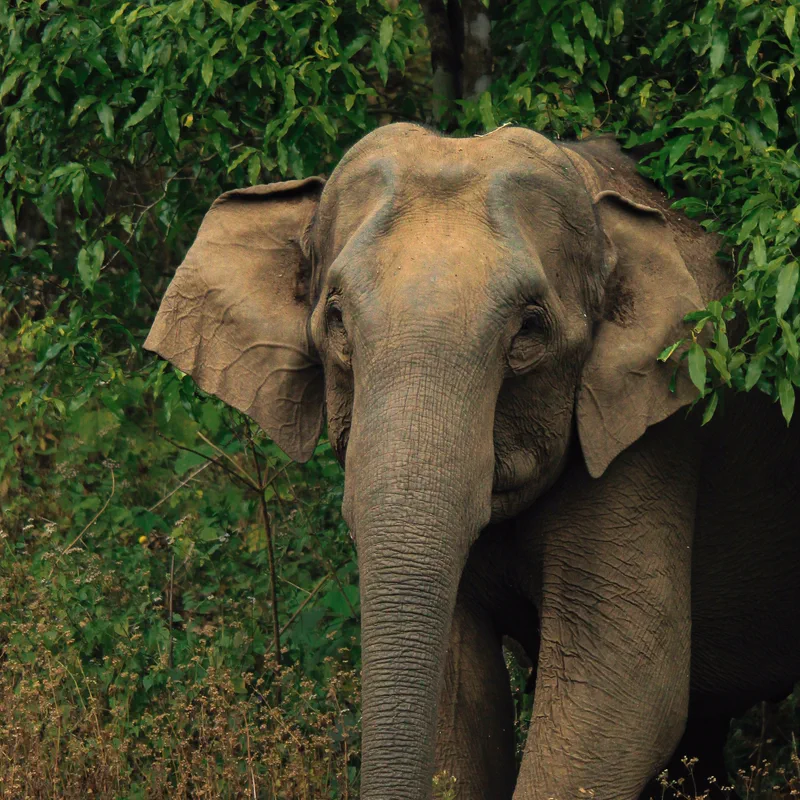
Asian elephants tend to be the smaller of the two elephant types, and unlike the African elephant they carry two recognizable hemispherical bulges on the head. A long, single-pointed trunk allows for easier wrapping of food, compared to the African elephant which grasps food with a dual-pointed trunk. Asian elephants also have significantly more muscle coordination, which allows them to perform more complex actions.
Their smooth, tough skin is usually grey and carries thin, light hairs, and wallowing can leave the animal looking discolored. Males have significantly larger and more prominent tusks that reach up to 2.5 m (8 ft 2 in), and are generally larger overall than females. Bulls average around 3 m (9 ft 10 in) tall and 6 m (20 ft) long, and weigh about 4 tons. Cows come in around 20 percent smaller than bulls. These elephants tend to weigh 100 kg (220 lb) at birth. Asian elephants can live up to 70 years in the wild, and only around 50 years in captivity.
Threats
Habitat loss and fragmentation
Asian elephants are experiencing rapidly thinning wild numbers and are officially listed as Endangered. With only around 50,000 wild and 25,000 captive elephants, the species' habitable range has seen significant reductions over the last three generations. Asian elephants are in constant conflict with humans over both habitable land and poaching.
Severe habitat loss is seen across many Asian regions through deforestation and human intervention. Rapid deforestation to make room for urban development in the world's fastest growing human regions, along with demand for commercial and industrial space, has wiped out significant portions of elephant habitat. Because these elephants live within a memorized, tailored home range of around 500 km², any degradation of that habitat is significant to their lives.
Because of poor government outlook and unregulated expansion, conservation of wild habitat is often ignored in these regions, leading to rapid declines not only in elephant populations but across thousands of other affected species. The rate of human growth in Asia is the largest in the world, which also calls for significant land clearing for agricultural use. That clearing fragments the land these elephants can thrive on and increases the chance of contact between elephants and people.
Large monoculture plantations reduce biodiversity in habitable zones, leaving fewer food sources across affected regions. Farming, mining, logging, and transportation routes have pushed and displaced thousands of Asian elephants out of more tropical, humid regions and into drier grasslands that are not estimated to be a naturally habitable zone for them. The elephants are becoming desperate for land, and food has become scarcer.
Human and elephant conflict
Human and elephant conflict is a threat in itself. As humans encroach on habitable land, elephants become territorial and aggressive toward them. Asian elephants can behave unpredictably and aggressively around people because they are often caught off guard or startled by loud man-made things such as vehicles.
It is estimated that, because of this conflict, more than 1,150 humans and 370 elephants died between 1980 and 2003. On top of that, these elephants damage thousands of acres of farmland each year, which has driven a significant increase in poaching. Even though it was humans who encroached on elephant territory, many farmers and others have poached these elephants to save their crops.
Poaching for ivory
Poaching does not stop at crop protection. Poachers often hunt these elephants for the lucrative demand for ivory, and as ivory demand rose, elephant populations plummeted. Although the demand for and sale of ivory has decreased since 2000, a significant black market for elephant tusks persists throughout East Asia.
Poaching for skin
It does not stop there either. Poachers also target elephants for their skin, which is used in traditional medicines, decorative beads, and even some luxury cosmetic products. China issues licenses for pharmaceutical products containing elephant skin, which in turn drives a rapid increase in demand and in poaching.
Asian elephants are often found dead and skinned in the wild, with the body largely intact apart from the skin and tusks, and the rest left to rot.
Why they matter
Flagship, umbrella, and keystone
The Asian elephant sits within CITES Appendix I as a flagship species*, chosen to help raise awareness of the persisting issues across Asia. It is also an umbrella species*, because of its significant contributions to the ecosystems it lives in, and a keystone species*, because of the ecological role it plays.
Because they occupy such large areas, thousands of species and individual organisms benefit from these elephants. But through habitat loss and fragmentation, those ecosystems receive less and less natural diversity. Biodiversity matters in these regions because it protects an ecosystem against the rapid spread of disease and against sudden species loss. Each species has a highly specific job, and where there is plenty of biodiversity the ecosystem is more resilient to problematic events, so the flow of the system can stay functional and efficient.
Ecosystem engineers
Asian elephants are a vital part of every ecosystem they are involved in. Their size and their ability to travel from ecosystem to ecosystem lets them shape everything around them, and their presence indicates a healthy, functioning ecosystem with flourishing, sustainable flora.
Their size and feeding capability forges the landscape by regulating plant populations, making room for new species of plants, and creating large amounts of nutrient rich waste. Consuming as much as they do in a day, elephants leave broken-down food across large areas of land, mow ground down into more accessible growth, and open migratory paths that other animals use.
Another significant advantage of their size is the importance of their footprints. Herds of elephants create depressions in the land capable of capturing fresh water, which forms micro ecosystems where birds and insects thrive, ultimately increasing the natural flow of the whole system.
Seed dispersers
Their ecological range and their contact with thousands of plant species also makes them excellent seed dispersers. Through consumption and through their waste, plant seeds travel hundreds of kilometers with these elephants, then populate and enrich a new region while promoting biodiversity.
Why captivity fails them
Being a highly intelligent species that is extremely social and active, captive Asian elephants are extremely hard and expensive to care for properly. Captive elephants experience high stress from solitude and a lack of social interaction, and they often do not get enough active hours moving long distances across diverse food sources. Because of those high demands and their large area requirements, captive elephants see a significantly lower lifespan through stress and inactivity.
What conservation needs
Asian elephants face significant declines from poaching and habitat loss, and conservation efforts for them remain underappreciated. Awareness of the elephant's importance is crucial to supporting that work.
Anti-poaching effort is of the utmost importance. Reducing demand for luxury hide cosmetics, ivory products, and traditional medicines removes the reason to poach in the first place. Significant unregulated habitat destruction goes unnoticed while causing severe damage across thousands of ecosystems. Conservation work to reduce human and elephant contact along roads and railways has saved dozens of elephant and human lives, yet these regions remain significantly underfunded.
By conserving and protecting natural habitat while slowing rapid expansion into elephant territory, the wild Asian elephant population will have room to grow and thrive, and hopefully to rise out of endangerment. The endangerment of Asian elephants means far more than the loss of one species. Thousands of reliant species would be affected, and ecosystems across Asia would struggle without their largest mammal. Conservation efforts are crucial for an animal like this, and for the prospering ecosystems that depend on it.
Glossary
- Oestrus
- the point of prime reproductive status, when an animal is ready to mate
- Crepuscular
- active during the cooler hours of dawn and dusk, resting for large parts of the day
- Hindgut fermenter
- a herbivore such as a horse, elephant, or rabbit that digests plant cellulose after the stomach, resulting in slower processing
- Alloparent
- to help raise another individual's young
- Flagship species
- a species chosen to raise awareness and support for a conservation effort
- Umbrella species
- a species whose protection indirectly protects dozens of others alongside it
- Keystone species
- a species an ecosystem disproportionately depends on, whose loss changes the entire system
- Megaherbivore
- a plant-eating animal weighing over roughly 1,000 kg