Lappet-faced Vulture
Torgos tracheliotus
IUCN Red List, population decreasing
- Range
- Africa, most concentrated in the east and south, extending through the Middle East
- Habitat
- Arid savanna, dry grassland, desert, open woodland and shrubland, steppe
- Diet
- Obligate scavenger, primarily carrion
- Lifespan
- Up to 25 years wild, up to 50 in captivity
- Population
- Fewer than 10,000 worldwide
- Primary threat
- Poisoning
Overview
Range and habitat
The Lappet*-faced vulture is an Old World vulture, a group native to Africa, Europe, and Asia. Its distribution is patchy across those regions, but the species is most heavily concentrated in East and Southern Africa. Its habitat consists of arid savannas, dry grasslands, deserts, open woodland and shrubland, and steppes. Open country is essential for these vultures. It lets them forage efficiently and, more importantly, spot decaying carcasses from a great height and distance.
Built to soar
The warm, arid, sparsely vegetated expanses found in East Africa create strong thermal updrafts. Vultures have a low wing loading, meaning their wingspan of 2.9 m (9 ft 6 in) is significantly greater relative to their body length of 115 cm (3 ft 9 in). Similar to gliders, these vultures can stay airborne for hours using those updrafts, constantly surveying the ground for food or prey.
Feeding and dominance
Lappet-faced vultures are primarily obligate scavengers*, meaning they rely mainly on animal carcasses, which they find by searching from the air and by watching the movements of other scavengers. Being the strongest of the African vultures, they are usually the first to open a carcass, tearing through carrion* and through hard to penetrate material such as hide, tendon, and bone that smaller species cannot get past. Other scavengers will usually cede to the Lappet-faced vulture because of its dominance and its solitary, aggressive eating habits. Lappet-faced vultures have also been reported to ambush smaller live prey in a single vicious impact, tearing the animal apart.
Nesting and family life
These vultures are generally solitary birds, but they find real social benefit when searching for food or feeding at a carcass. They tend to build large nest platforms placed neatly on top of taller trees standing in otherwise open ground. Because they nest in isolation, very few nests are found per kilometer, though in rarer cases a small cluster of nests can be found in one area. They are monogamous* creatures, and usually uniparous*, although a single clutch can occasionally yield two eggs. Parenting is mostly balanced between both birds. The parents remain close until the nestling is around two months old, at which point they begin foraging further out and returning to feed their young through regurgitation. After five months of significant, thoughtful care, the young vulture is able to become independent.
Appearance
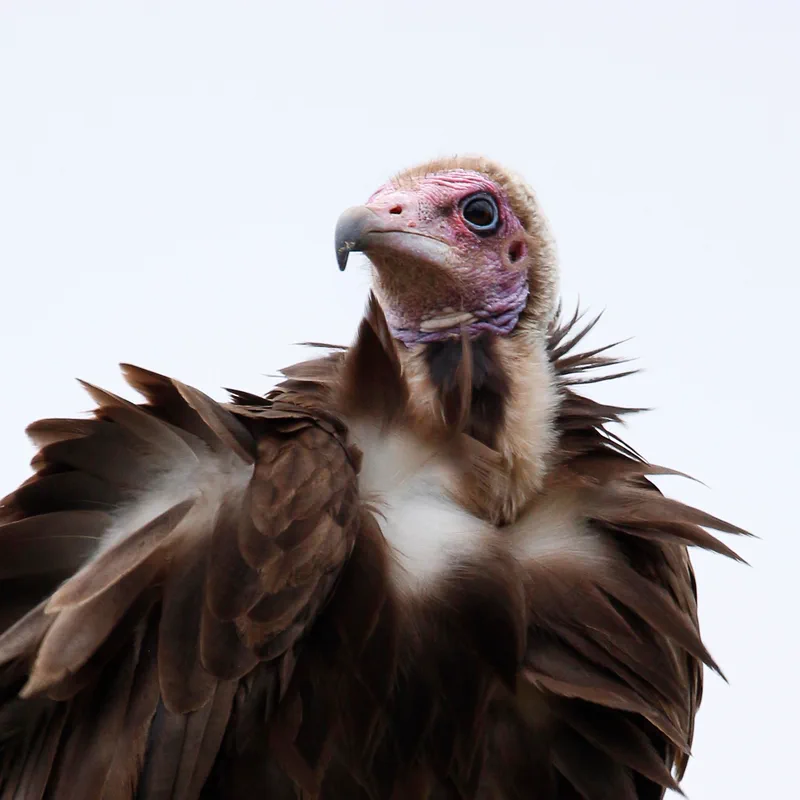
Lappet-faced vultures take their common name from the distinct reddish pink lappets, the folds of loose skin that hang on either side of the head. Like most other vultures, they have little to no interrupting head feathers, which makes digging through a carcass easier and cleaner. Their plumage* is a stunning brown streaked with bright white feathers. Despite the work they do, these birds are rather clean and well kept, using their beaks to preen*. There is little sexual dimorphism, and males and females are almost identical. Wild lifespan can reach up to 25 years, and in captivity, up to 50.
Threats
Habitat loss
Lappet-faced vultures are listed as Endangered on the IUCN Red List. The species is currently declining in many parts of Southern and Western Africa, while a small but stable population persists from Eastern Africa through the Middle East. These declines are almost purely due to human activity.
Populations have seen a rapid decrease through habitat destruction for agriculture, cultivation, and urbanization. Disturbance to habitat significantly reduces the already specific nesting niche these vultures depend on, which relies on sparse, isolated trees. Given their isolationist nesting habits and their need for wide expanses, the loss of these nesting sites forces the birds out of their roughly 15 km hunting radius and into different territories, closer to other birds, which creates more competition across a more limited hunting space.
Habitat loss from agriculture also poses a significant threat to the availability of food itself. Farmland that once served as able hunting ground now far less commonly leaves dead livestock out for the vultures to feed on, which effectively reduces the total feeding area by a significant margin.
Poisoning
The extent of their suffering does not stop at habitat destruction. The primary cause of mortality for Lappet-faced vultures is poisoning, both unintentional and intentional.
Pest control used by farmers injects harmful and sometimes lethal pesticides and chemicals into the food chain of the surrounding area, and scavengers take the brunt of the issue. Whether it is the biomagnification* of pesticides or a mistargeted poison left in a carcass, a scavenger like the Lappet-faced vulture feeds on these lethal substances entirely unaware. The sources vary: livestock carcasses deliberately poisoned to fend predators off farmland, veterinary medication still present in an animal's body after death, bullet fragments left in unrecovered game, and rodenticides from pest control.
Intentional poisoning also occurs through poaching. Poachers lace a carcass with the specific intent of killing any scavenger that feeds on it, including the Lappet-faced vulture, in the hope that circling birds will not draw authorities to their illegal kills.
Population today
There are estimated to be fewer than 10,000 Lappet-faced vultures worldwide.
Why they matter
Nature's clean-up crew
Lappet-faced vultures, and vultures in general, are a keystone species* that prevents serious outbreaks of disease within an ecosystem. Keeping an ecosystem clean is infinitely important to preserving the lives of everything inside it. Having a creature that naturally cleans up at the end of the food chain is crucial, and it is the biggest reason the conservation of these aerial scavengers is so underappreciated.
Scavengers, among every other type of hunter species, have a very important role in the ecosystem, and a scavenger like the Lappet-faced vulture is nature's clean-up crew. Vultures are able to break open, break down, and feed on decaying, rotten flesh. By stripping a 45 kg (100 lb) rotting carcass within minutes, vultures help prevent the spread of disease through an ecosystem. Vultures have extreme stomach acid, sitting near zero on the pH scale, strong enough to break down pathogens like anthrax, tuberculosis, cholera, salmonella, botulism, and rabies. By destroying that disease at the carcass, they effectively stop the rapid spread of pests. Consuming rotting carcasses does not only clean up the ecosystem, it also breaks a large body down into decaying matter that detritivores* can turn into healthy, nutrient rich soil.
What happens when vultures disappear
Vultures are generally overlooked and often placed into a category of dirty, lowly creatures. India shows exactly what that assumption costs.
When Indian vulture populations crashed after feeding on the remains of animals treated with the veterinary drug diclofenac, the collapse nearly caused a public health catastrophe. With no scavengers left to clear carcasses, the feral dog population leapt by 7 million animals over 11 years, reaching 29 million, and generated an additional 38.5 million dog bites. Deaths from rabies are believed to have increased by nearly 50,000 in that time, and the cost to the Indian government of fighting the spread has been put at $34 billion.
What has to change
The act of poaching these animals by poisoning dead carcasses, and poaching in general, needs to be seriously cracked down on to prevent the mass killing of scavengers. Pesticides, harmful chemicals, runoff, and uncontrolled veterinary medication leach into the environment quicker and more easily than we think. Biomagnification hurts far more than just these vultures, and when a farm uses harmful chemical pesticides, the whole ecosystem is hurt.
Rapid urbanization and the careless expansion of land and agriculture significantly reduce the viable living area for scavengers, especially where no attempt is made to maintain existing habitat elements such as the isolated trees these birds nest in.
There is a practical case as well. The natural disposal of carcasses by scavengers reduces the need for human resources, from transport trucks and their emissions to the labor and process of disposing of large numbers of corpses safely and with disease in mind.
Glossary
- Carrion
- decaying flesh
- Uniparous
- laying a single egg per clutch
- Plumage
- a bird's typical feather color and pattern
- Preen
- to groom one's feathers
- Detritivore
- an organism that obtains nutrients from detritus, breaking matter down into smaller pieces
- Monogamous
- to have one partner at a time in raising young
- Lappet
- a fold of loose, hanging skin, in this case on either side of the vulture's head
- Keystone species
- a species an ecosystem disproportionately depends on, whose loss changes the entire system
- Obligate scavenger
- an animal that relies on carrion for nearly all of its food
- Biomagnification
- the increasing concentration of a toxin as it moves up the food chain
Sources
- Wikipedia, Lappet-faced vulture
- The Peregrine Fund, Lappet-faced Vulture
- Aviation Stack Exchange, Over which types of ground surfaces do we have more updraught
- Quora, How long can vultures fly without flapping
- Vulture Conservation Foundation, How do vultures contribute to our environment
- Audubon, How Vultures Can Eat Rotten Meat Without Getting Sick
- EDGE of Existence, Lappet-faced Vulture
- San Diego Zoo Wildlife Alliance, Vultures: The Gastronic Marvel