Arroyo Toad
Anaxyrus californicus
IUCN Red List, population decreasing
- Range
- Endemic to California, extending down into Baja California, Mexico
- Habitat
- Semi-arid arroyos, riparian corridors, dry washes, sandy creek banks, pine-oak forest in Mexico
- Diet
- Microbes as larvae, insects as adults
- Activity
- Nocturnal
- Clutch
- Up to around 5,000 eggs
- Range lost
- Extirpated from roughly 75 percent of its former range in the United States
Overview
Range and habitat
The Arroyo* toad, endemic to California, is one of the United States' most threatened toad species. It has been extirpated* from roughly 75 percent of its former range across the country. That range consisted heavily of semi-arid arroyos and inland riparian* ecosystems.
The toad's current range extends along the coastal side of Southern California and down into Baja California, Mexico. Its primary habitat is the dry washes of arid regions, where these toads inhabit the banks of those creeks. Arroyo toads often burrow into sandy soil for protection, which makes these regions, along with the pine-oak forests in Mexico, essential to the species.
Diet and feeding
In early life during the larval stage*, microbes in the toad's aquatic surroundings are its primary food source. Once grown, its diet shifts to many types of insects, and sometimes even to other Arroyo toad larvae.
These toads feed by walking through their home range of roughly 3 km, or by leaping around at night, lunging at food or using their sticky tongue to capture prey.
Daily life
Arroyo toads are nocturnal, so most of the day is spent inside their body-sized burrows, with the exception of the mating season. During the night, adults leave those burrows to feed and to wet their skin, which keeps them hydrated and lets them absorb nutrients and oxygen.
Breeding
In late winter and early spring, adult toads become more active for the breeding season. A male will present himself on a riverbank and perform a unique, music-like mating call to attract a female.
Females lay their eggs near the water in long, row-like strings, approaching 5,000 individual eggs. Egg placement is crucial, keeping the eggs moist against the water while avoiding predation within the water source itself. Eggs hatch within a week, releasing thousands of larvae into the ecosystem, where they metamorphose* in around three months. Arroyo toads are otherwise solitary with no parental rearing, and the mating season is the only exception to that.
Appearance and skin
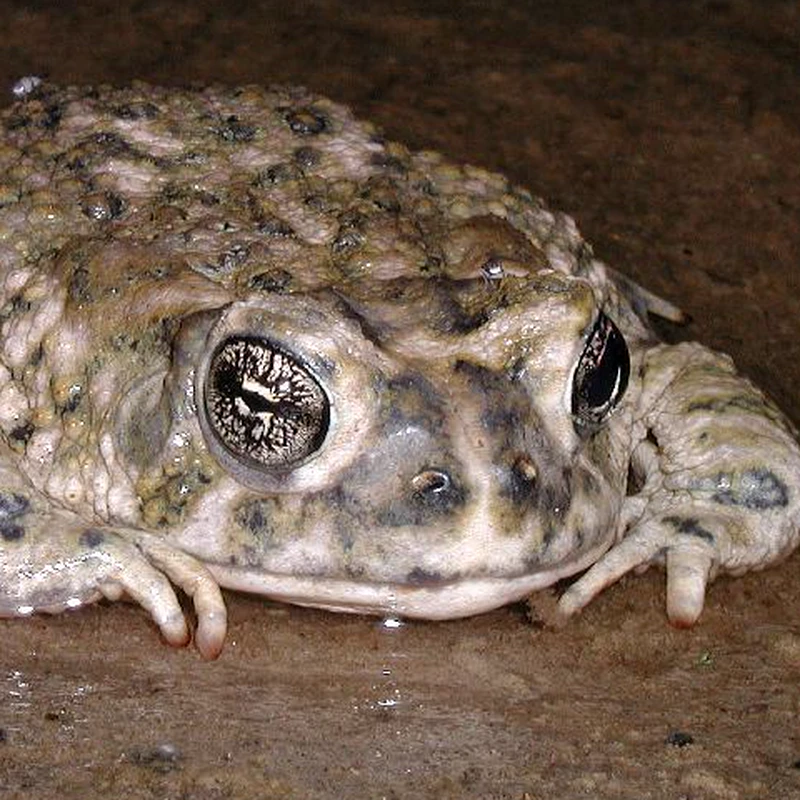
The Arroyo toad is a flat, wide, warty-skinned species averaging 6 cm (2.4 in) long, often with a blunt snout. These toads show a dark olive and grey coloring across moist, permeable skin, and they have horizontal pupils set in greyish eyes.
That skin is their most unique adaptation. Common among frogs and toads, it allows them to absorb nutrients and oxygen while secreting toxins as a defense against natural predators. Females tend to be significantly larger than males, while coloring stays about the same between them.
Threats
Urban expansion
Arroyo toads are considered Endangered and their population is currently decreasing. Their range formerly covered far more of California, but extensive habitat loss from urban and commercial expansion has thinned it further still.
Because of how specific their habitat is, urban development has been one of the most prominent factors in the decline of Arroyo toad populations. The continuing urbanization of California pressures natural toad breeding grounds, and safe locations for reproduction are becoming scarce. These toads are rapidly being forced into areas more prone to predation, or displaced from a typical breeding ground entirely.
Damming
Another significant detriment to these toads, and to many other amphibians, is the demand for hydropower. Damming in California has wiped out nearly 40 percent of this species' original range by drying out significant breeding grounds.
Invasive species
The introduction of invasive plant and animal species has taken a significant toll on the Arroyo toad. American bullfrogs, a common invasive frog species introduced for pest control and human consumption, pose a significant threat to the much smaller Arroyo toad, because they often feed on its larvae and even on adults. Competition from invasive species makes survival harder than it already is. Non-native fish species also consume thousands of toad eggs, which makes reproduction extremely difficult.
Chytrid fungus
On top of these threats, another extreme impact on the Arroyo toad population is the presence of chytrid fungus*, which has spread rapidly through amphibian populations and harmed or killed them in extensive numbers.
Drought and climate change
Climate change is causing extreme droughts across this region, which is another significant reason for reduced toad numbers. The sudden decrease in habitable breeding zones makes reproduction extremely difficult, and the lack of water directly impacts the toad by reducing its opportunity to moisten its skin and absorb what it needs while staying safe from predators.
Pollution and permeable skin
Because this species, like many other amphibians, has permeable skin, these toads are extremely prone to disease, infection, and toxins. Toads and frogs absorb through their skin in order to breathe and stay moist, so where pollutants are present they easily take chemicals into their body that they have no natural way to fight off.
Pollution entering local water sources does significant damage to this species and often causes death. Increased use of local agricultural pesticides can also run off into these ecosystems and be absorbed by these toads, which not only harms the toad but magnifies outward through the ecosystem.
Expansion and commercialization across California and the surrounding areas poses a significant threat to this species, and extinction is possible in the near future. Some conservation efforts do exist, such as habitat management and protection, but many of the threats facing this species remain present even inside protected areas, including the effects of climate change and airborne pollutants.
Why they matter
Natural pest control
Land conservation efforts for Arroyo toads are unfortunately minimal compared to the overpowering urbanization of their range, and the number of threats stacked on top of that makes the continued existence of these toads genuinely concerning.
Toads like the Arroyo toad are extremely important to their local ecosystems because they act as natural pest control. Arroyo toads help balance the insect population within an ecosystem thanks to their large feeding capacity. Amphibians are some of the most important regulators of insect populations, and the absence of these toads would cause a severe imbalance across biodiversity and ecological systems.
Indicators of ecosystem health
Toads are also important indicators of ecosystem health because of their unique skin absorption properties. Being highly susceptible to toxins and pollutants, Arroyo toad populations directly indicate the health of an ecosystem and the quality of its water, although external factors driving population decline can skew that reading.
How pollution travels
With permeable skin, these toads are extremely susceptible to agricultural runoff and can absorb significant amounts of pesticides and harmful chemicals. That does not only harm the toad directly and potentially kill it. That toad's thousands of offspring can also carry the presence of the same pesticide.
Reproduction while carrying harmful chemicals also increases genetic alterations and defects, effectively killing or hindering the lives of the offspring. The absorption of chemicals and pollutants does not stop there either. Through biomagnification*, the aquatic and terrestrial predators that feed on the Arroyo toad suffer greatly from those same pollutants indirectly. Entire ecosystems can be harmed by the slight introduction of chemical pollutants that no species within them is able to defend against.
Chytrid and the pet trade
Chytrid fungus still runs rampant through many amphibian populations, and local spread is often caused by unsanitized human activity moving between ecosystems. The global trade in amphibians is also a primary spread factor for this fungus, and that includes the pet trade.
Amphibian pets are extremely demanding and their care is meticulous, which often leads to abandonment that can seriously affect whichever ecosystem the animal is released into. The specialized permeability of a toad's skin is not adapted to human or invasive factors, which voids its natural defensive mechanism and threatens its life.
What you can do
Unfortunately, the urban scale of California makes the future survival of this toad near impossible without serious conservation effort, and educational insight is the first step. Land preservation and restoration matters, but it can be easily negated by the other issues the toad faces. Educating local populations about species like this one can prevent excess pollution entering local ecosystems, and reducing invasive species is extremely important to the survival of many native species. Habitat loss from drought, damming, and urban expansion remains a constant threat, and conservation work is difficult in a region that never stops growing.
Regular, everyday human products such as oils, moisturizers, and soaps can quickly poison a toad and put its life at risk. Reducing litter and the spread of pollutants is crucial to supporting these animals, as is the correct recycling, reuse, and disposal of products such as oils. Any foreign item that is not native to the toad's ecosystem can pose a serious threat through absorption, while the animal is simply trying to breathe or hydrate.
Glossary
- Arroyo
- a dry creek or streambed in an arid region that carries water only after rainfall
- Riparian
- relating to the bank of a river, stream, or other body of water, and the distinct habitat found there
- Larval stage
- the early aquatic stage of an amphibian's life, before it develops into its adult form
- Metamorphose
- to change from one physical form to another, as a tadpole does when becoming a toad
- Chytrid fungus
- a fungal pathogen that infects amphibian skin and has driven population collapses worldwide
- Biomagnification
- the increasing concentration of a toxin as it moves up the food chain
- Extirpated
- completely removed from a particular area, while surviving elsewhere