American Bison
Bison bison
IUCN Red List
- Range
- Endemic to North America
- Habitat
- River valleys, prairies, plains, semi-open grassland, lightly wooded and semi-arid land
- Diet
- Ruminant herbivore, around 90 percent grasses and sedges
- Lifespan
- Around 15 years wild, 25 in captivity
- Population
- Around 400,000 total, only about 15,000 considered wild and free-ranging
- Historic low
- 400 individuals by 1889
Overview
Range and habitat
The American bison is a species endemic* to North America, and the largest land mammal on the continent. Population estimates from 2010 put the total at around 400,000 individuals, with only about 15,000 of those considered wild, free-ranging bison. Their habitat consists of vast river valleys, prairies, plains, semi-open grasslands, lightly wooded regions, and semi-arid land. Bison can also be found in mountainous regions.
Herds and migration
Bison are naturally migratory herbivores that tend to move in large herds of up to 400 in the wild, and in significantly larger numbers in commercial herds. These migration patterns call for daily movement in the summer between foraging sites, typically around higher elevation meadows and open grasslands. In the winter they move to lower elevations near rivers and valleys.
Diet
Bison are ruminants*. Grasses and sedges make up around 90 percent of their diet.
Social structure and breeding
Bison move in maternal and bachelor herds, meaning a maternal herd holds all of the females and their offspring, while a bachelor herd holds the males. At around three years old, males leave the maternal herd to join a bachelor herd or to live on their own. These herds and individuals do not intersect until the mating season in the summer.
Bison are polygynous*, and a bull will mate with dozens of cows during the mating season. Bulls usually challenge other males and guard specific cows, using a simple bellowing courtship to induce mating. Male bison play no part in rearing young, and calves are weaned* by the end of their first year. Bison display a hierarchical system based on dominance, usually determined by the particular bison's date of birth.
Behavior
In late spring and through the summer, bison take part in horning*, which helps deter insects. They also wallow*, which lets them more easily shed their winter guard hairs and reduces skin irritation from insects.
Bison can be hunted by bears or by wolf packs when singled out from the herd, although their size and power can often get them out of these situations.
Appearance
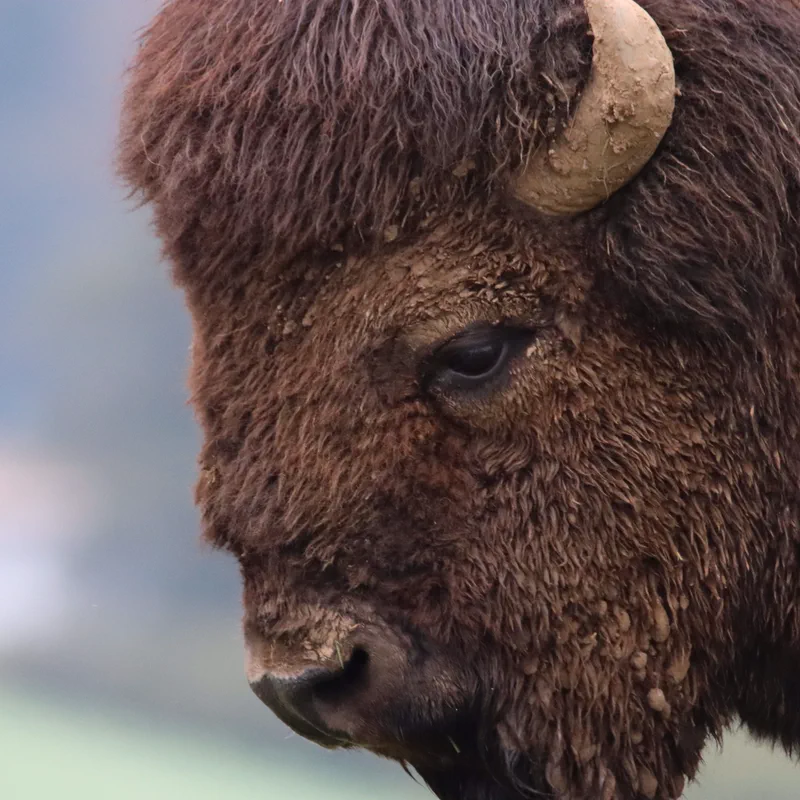
American bison wear a long brown coat of fur in the winter and typically shed into a lighter, shorter coat in the summer. They can reach 3.5 m (11 ft 6 in) long and around 2 m (6 ft 7 in) tall. As the largest terrestrial mammal in North America, they can reach up to 1,200 kg (2,645 lb).
The noticeable sexual dimorphism in American bison is the sheer size of the bull compared to his cow counterpart, along with more robust, significant horns. American bison have a lifespan of around 15 years in the wild and 25 in captivity.
Threats
From 60 million to 400
American bison are considered a Near Threatened species on the IUCN Red List. The species suffered a collapse in population from an estimated 60,000,000 individuals down to a shocking 400 by 1889. Recovery efforts have since brought the population back to a stable figure of around 400,000 across wild, captive, and commercial herds.
American bison populations were hindered significantly by an array of issues: overhunting, the fur trade, disease, and the introduction of domestic livestock alongside habitat loss.
The slaughter campaign
In the early 19th century the bison faced its largest decline, and it happened precisely because the animal was the primary food source and hunting priority of Native Americans. Early settlers' desire to conquer the American west introduced policies designed to reduce the Native American food supply, in the hope of pushing them out of the territory and colonizing the west more easily. Targeting the American bison, the Native Americans' primary source of food, the US Army launched a vast campaign of slaughter to wipe out the bison population and control the Native Americans.
On top of the mass killings, the army did not even use a significant amount of the bison it killed. Most were left to rot after being skinned for their fur. Native Americans, by contrast, used more than 150 different parts of every bison they hunted, making use of the whole animal in a way that stands in stark contrast to the lackluster care shown during the overhunting of the 1800s. Indigenous communities experienced severe famine and profound spiritual loss as a result.
The fur trade
The fur trade further encouraged the killing of these bison. As the industry boomed, demand for bison fur grew with it, and the animals were killed to meet it.
Habitat loss
On top of overhunting, bison were also affected by the habitat loss that came with western colonization. As railways and farmland expanded westward, grazing fields for bison were quickly converted into livestock pasture and farm fields, interrupting bison migration routes and cutting off important feeding grounds.
The genetic bottleneck
The fall to near extinction caused an event called a population bottleneck*. With numbers so low, reproduction in herds as small as seven members caused a plethora of genetic issues stemming from inbreeding.
Fortunately, bison are very good at reproducing in large numbers. But today American bison still suffer from a lack of genetic diversity, which creates problems with disease susceptibility, shortened lifespan, weaker reproductive ability, and a higher mortality rate.
Why they matter
Grassland engineers
American bison are great grassland grazers, able to reach many different types of grass at many different heights across America. Mass grazing helps promote plant growth, increase biodiversity, and aerate soil. Because of their size, bison churn the ground easily and in large quantities, which helps move nutrients across the land.
Wallows as microecosystems
Bison wallowing sites also allow microecosystems to flourish. By creating an indentation in the ground, the bison gives highly specific species of plants a new opportunity to thrive. These indentations also collect water, providing a watering hole for many small animals that would otherwise have to rely on larger, more centralized water sources.
Winter highways
The mass migratory movement of bison creates winter "highways" that help other animals navigate terrain more easily and follow the route to food or water. Bison also open up areas of food that would otherwise be unreachable under deep snow.
A species tied to people
The significant spiritual connection between American bison and the Indigenous Peoples of America is just as important. Acting as a main source of food, and of many other materials, bison are an important species not only to ecosystems but to humans as well. The overhunting of bison sent, and would still send, significant ripples through ecosystems, causing harm far beyond the animal itself.
A conservation success story
Efforts to preserve and regrow bison populations have been on a successful incline, from the measly 400 remaining in the 19th century to nearly 400,000 today. Movements to protect and conserve wild populations, breeding programs in captivity for reintroduction, and reduced demand for bison fur have together proven what conservation can do, and have brought a nearly extinct species back to a growing population listed as Near Threatened.
Glossary
- Endemic
- native to, and found only in, one particular place
- Ruminant
- a grazing ungulate that digests plant matter in a multi-chambered stomach, chewing it a second time as cud
- Polygynous
- one male mating with many females
- Weaned
- no longer reliant on parental feeding
- Horning
- rubbing the horns against trees, rocks, or the ground
- Wallow
- to roll in a dirt or dust depression, and the name for the depression itself
- Population bottleneck
- a sharp reduction in population size that permanently narrows the genetic diversity of everything that follows