Why Do I Blank on Tests When I Know the Material?
Blanking is usually a memory built the wrong way, not a memory that vanished. What makes recall survive exam stress, and the ten minute intervention almost nobody tells students about.
Because stress eats the working memory you need to retrieve things, and because the way most people study builds memories that do not survive that. The material has not disappeared. It was stored in a way that only works under calm conditions, and an exam room is not calm conditions. Both halves of that are fixable, and one of the fixes takes ten minutes.
What is actually happening when you blank
Working memory is the small mental workspace you hold things in while you use them. It is where you keep the question, the half-remembered formula, and the step you are on, all at the same time. It is also sharply limited.
Sian Beilock's research on choking under pressure describes what high-stakes situations do to that workspace. Worry is not a vague feeling sitting off to the side. It occupies the same limited capacity you need for the task. The thought "I am going to fail this" is using the exact resource required to retrieve the answer.
So blanking is rarely the memory being gone. It is the retrieval process being crowded out by everything else running at once.
That explains the moment. It does not explain why it happens to you on material you genuinely studied, and that part is more interesting.
The real culprit is how you studied
In 2016, researchers at Tufts ran a study published in Science that should be far better known than it is.
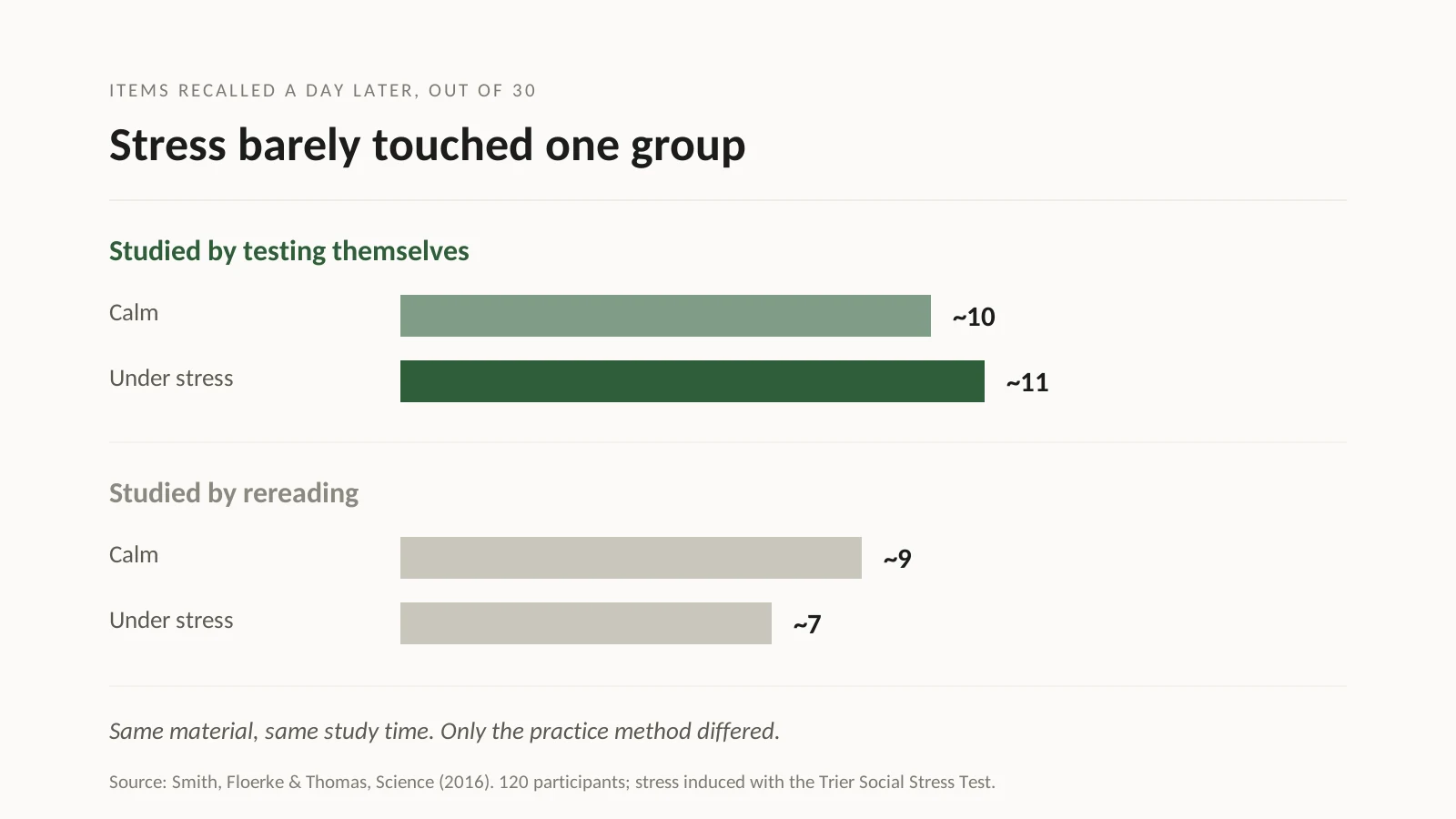
They had 120 students learn 30 words and 30 images. Half then practised by taking free recall tests. The other half practised by restudying the material in timed study periods. Same material, same time, different method.
A day later, half of each group was put under real acute stress: an impromptu speech and mental arithmetic in front of two judges, three peers and a camera. Heart rate monitors confirmed it worked.
Then everyone was tested.
The restudy group under stress recalled about 7 items out of 30. The restudy group with no stress recalled a little under 9. Stress cost them.
The retrieval practice group recalled about 11 items under stress, and about 10 without it. In other words, their performance did not drop at all. As one of the researchers put it, it was as if stress had no effect on their memory.
That is the finding that reframes this whole problem. Retrieval practice does not just build stronger memory. It builds memory that holds up when you are frightened, which is the only condition that actually matters on exam day.
If you studied by rereading your notes until they felt familiar, you built the fragile kind. It will feel solid at your desk on Sunday and come apart on Thursday morning, and that is not a character flaw. It is the predictable result of the method.
More on why rereading feels so convincing in why do I feel like I studied for hours but remember nothing.
The ten minute thing nobody tells you
This one sounds like nonsense and is not.
In 2011, Gerardo Ramirez and Sian Beilock published a study in Science testing a strange intervention: having students write about their feelings about the upcoming exam, for about ten minutes, right before taking it.
In the lab portion, students took a maths test, then took a second one after being deliberately stressed with money on the line, a team supposedly depending on them, and a camera. The group who sat quietly beforehand dropped 12 percent in accuracy. The group who wrote expressively for ten minutes improved by 5 percent.
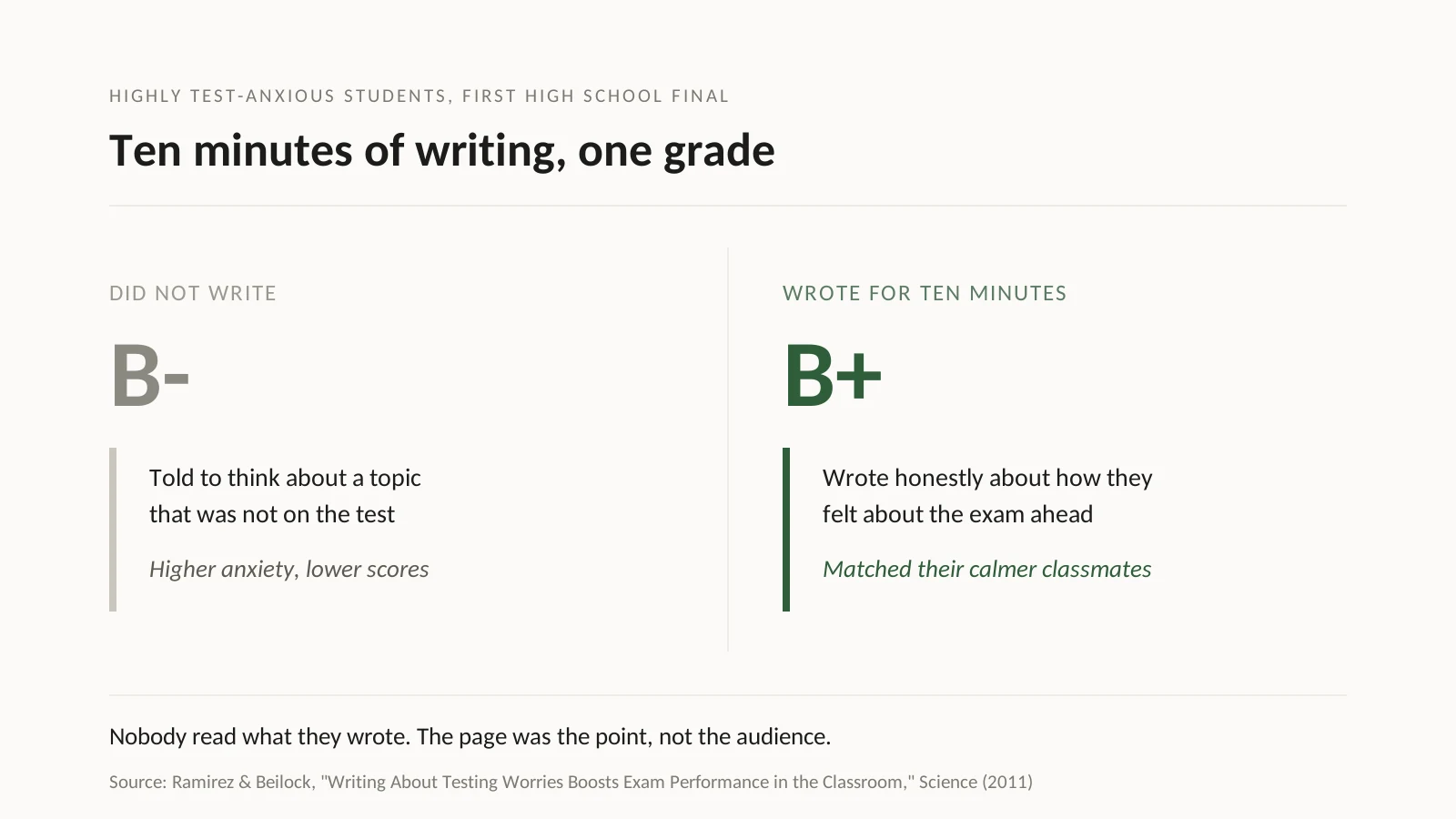
They then ran it in real classrooms with ninth graders sitting their first high school final. Students got an envelope before the exam telling them either to write about how they felt about the test, or to think about something unrelated.
Among the students who came in with high test anxiety, those who wrote averaged a B+. The equally anxious students who did not write averaged a B-. The writing group performed about as well as their less anxious classmates, even after accounting for their grades across the year.
The proposed mechanism fits everything above. Worries occupy working memory. Writing them down offloads them, which gives the capacity back to the task. The researchers did not measure working memory directly in these studies, so treat that as the explanation rather than a proven step, but the effect itself showed up in a real classroom on a real final.
Ten minutes, a blank page, nobody reads it. It is the cheapest thing on this list by a wide margin.
What to do in the weeks before
Study by producing, not reviewing. Close the book and write out what you remember before checking. Every time you successfully drag something out of your own head, you are building the version that survives pressure.
Make your practice feel like the test. Timed, closed book, in order, no notes. Context matters, and practice that looks nothing like the exam prepares you for conditions you will not face.
Do past papers under real conditions at least once. Not with the answers open. Not stopping halfway. The first time you experience exam conditions should not be the exam.
Spread it out. Three sessions across a week beat one long night, and the material you have retrieved repeatedly over time is the material that holds. See does cramming actually work.
Mix problem types. If telling two kinds of question apart is part of the exam, practise them mixed rather than in blocks, or you will have skipped the hardest step.
What to do in the room
Write for ten minutes beforehand. About how you feel about the exam, honestly, with no audience. The research above is the reason.
Start with a question you can definitely answer. Getting something on the page interrupts the spiral and frees up the workspace.
If you blank, move on and come back. Staring harder recruits more of the capacity you are already short on. Something later in the paper will usually cue it.
Dump what you know on the margin as soon as you start. Formulas, a framework, dates. Getting it out of working memory and onto paper means you are no longer paying to hold it there.
Breathe out longer than you breathe in. A slow exhale is a reasonable, low-cost way to bring physical arousal down a notch.
If test anxiety is severe, persistent, or affecting your life outside exams, that is worth raising with your university's counselling service rather than solving with study technique.
How Weila handles this
The research above points at one thing, and it is the thing Weila's recall system is built around.
The daily recall drill makes you produce answers. It asks you to retrieve rather than review, which is the exact practice the Tufts study found protects memory under stress.
Spaced repetition brings material back when you are about to forget it. That means you keep retrieving things with effort instead of recognising them while they are still fresh, and effortful retrieval is what makes a memory durable.
Decks and quizzes from your own material. Build them from what you are actually being examined on, so your practice is closed-book production of the real content rather than passive review of it.
A short warm-up before a session. A few questions before you start, which doubles as one more rep of retrieval on material you have already seen.
None of this is anxiety treatment. It is the half of the problem that is a study-method problem, and it is the half you can fix weeks in advance.
Common questions
Why do I forget everything during a test but remember it after?
Because the memory was never gone. Stress consumed the working memory you needed to retrieve it, and once you leave the room and the pressure drops, retrieval works again. It is a access problem under load, not a storage problem.
Does writing about test anxiety really help?
In the published research, yes. Ninth graders with high test anxiety who wrote about their feelings for about ten minutes before a final averaged a B+, against a B- for equally anxious students who did not.
How do I stop blanking on exams?
Change the practice, not just the mindset. Study by testing yourself under conditions resembling the exam, spread over weeks. Research found that people who practised by retrieving showed essentially no drop in recall under acute stress, while people who practised by restudying did.
Is blanking a sign I did not study enough?
Not necessarily. It is more often a sign of how you studied. Hours of rereading build familiarity that feels like knowledge and does not hold up under pressure.
Should I do practice exams or just review my notes?
Practice exams, by a wide margin, and especially under timed closed-book conditions. Reviewing notes is the method that performed worst under stress in the research.
The short version
- Blanking is usually retrieval failing under load, not the memory being gone.
- Worry occupies the same limited working memory you need to recall things.
- People who studied by testing themselves showed essentially no drop in recall under acute stress. People who studied by rereading dropped hard.
- Writing about your exam worries for ten minutes beforehand moved highly anxious students from a B- to a B+ in a real classroom study.
- Practise by producing answers under conditions that resemble the exam, spread over weeks.
Weila is a study app with spaced repetition, daily recall practice, and contribution points that fund vetted conservation work. See how it works.