Does Cramming Actually Work?
Yes, for tomorrow. Almost not at all for the final. Here is what the spacing research says, the timing rule most study guides get backwards, and how to cram properly if you have no choice.

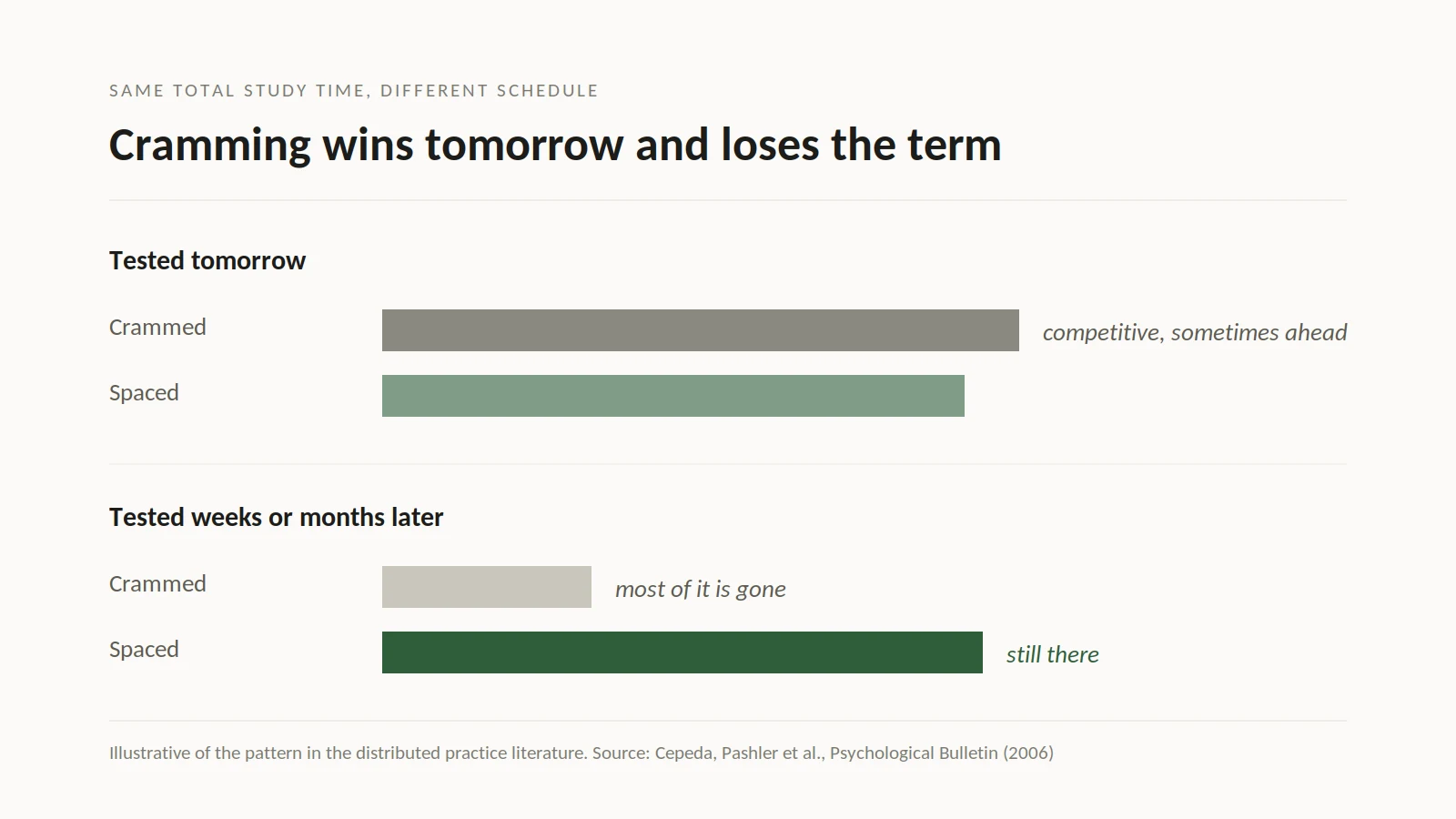
Cramming works for tomorrow and fails for the final. That is the honest answer, and it is more useful than the usual flat "no." Massed study can genuinely produce better performance on an immediate test than the same hours spread out. What it does not do is leave anything behind, which is why the material you crammed in October is gone by the cumulative in December.
Why it works at all
Most study advice treats cramming as pure self-sabotage, and students correctly notice that it does not match their experience. They cram, they pass, the advice looks wrong.
It is not wrong, it is just answering a different question. Research comparing massed and spaced practice has repeatedly found that massed study can come out ahead when the test is immediate. Everything is fresh, nothing has had time to fade, and you have just spent six hours with it. For a quiz tomorrow morning, cramming is a defensible strategy.
The catch is that almost nothing you study is actually for tomorrow. It is for the midterm, the final, the licensing exam, the job. On that timescale the picture inverts completely.
What happens after the test
The spacing effect is one of the oldest findings in psychology. Hermann Ebbinghaus documented it on himself in 1885, and it has been replicated more thoroughly than almost anything else in the field.
The definitive synthesis is a 2006 meta-analysis by Nicholas Cepeda, Harold Pashler and colleagues, which pooled 839 assessments of distributed practice drawn from 317 experiments across 184 articles. The conclusion was not subtle. Spreading study across separate sessions reliably beat cramming the same total time into one block, and the advantage was substantial rather than marginal.
The mechanism is roughly this: when you study something again immediately, it is still sitting in memory, so retrieving it takes no effort and strengthens it very little. When you come back after a gap and have to genuinely dig for it, that effort is what makes it stick. Cramming systematically removes the effort that makes learning durable.
So the trade is real and it is specific. Cramming buys you tomorrow at the cost of everything after it.
The timing rule most guides get backwards
Here is where it gets genuinely useful, and where most study articles are quietly wrong.
You will often see the advice that the gap between study sessions should be around 10 to 20 percent of how long you need to remember something. That is close to right for short horizons and wrong for long ones.
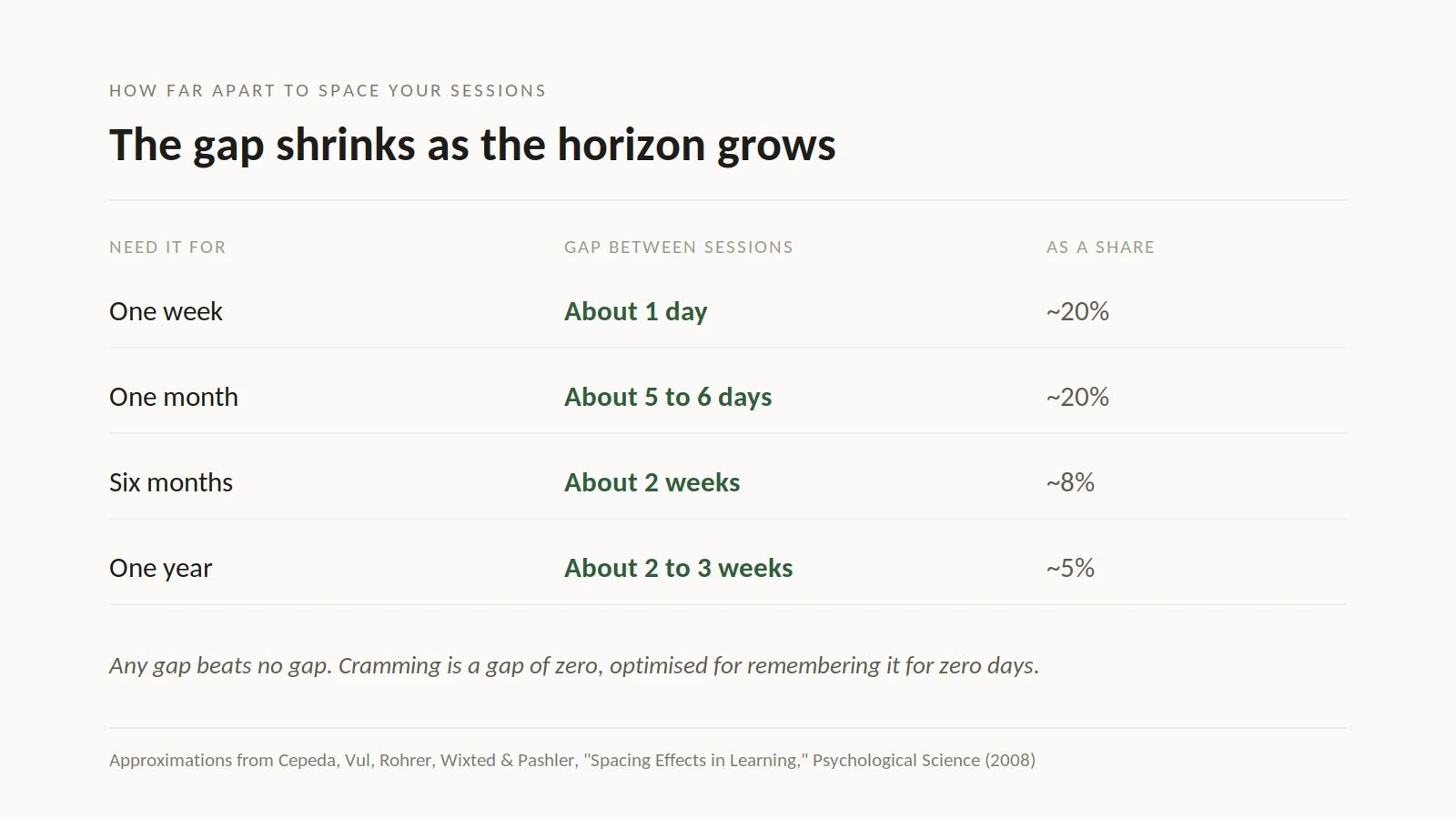
The actual finding comes from a 2008 study by Cepeda and colleagues, who taught over 1,350 people a set of facts, brought them back for review after gaps of up to three and a half months, then tested them up to a year later. What they found was that the optimal gap does not stay a fixed percentage. It shrinks as the retention interval grows.
For a test a few weeks out, the best gap was around 20 percent of the delay. For a test a year out, it fell to about 5 percent.
That is counterintuitive and it matters. It means that for long-term retention you do not need enormous gaps between reviews. You need reviews that keep coming, at intervals that are modest relative to how far away the payoff is.
What that looks like in practice
| You need to remember it for | Roughly optimal gap between sessions |
|---|---|
| One week | About 1 day |
| One month | About 5 to 6 days |
| Six months | About 2 weeks |
| One year | About 2 to 3 weeks |
These are approximations from the research rather than precise prescriptions, and the exact number matters far less than the principle. Any gap beats no gap. The difference between a one-day gap and a two-day gap is small. The difference between a one-day gap and no gap at all is enormous.
Three sessions of ninety minutes across a week will beat one four-and-a-half-hour session, using the same total time, on any test more than a day away.
If you have to cram tonight
Sometimes the schedule is what it is. Cram, but cram well.
Test yourself rather than reread. Even inside a single night, retrieval beats rereading. Close the notes and try to produce the answer before checking. This is the highest-value change you can make with zero extra time.
Break it into blocks with real gaps. Even a night can be spaced. Four 45 minute blocks with proper breaks between them beats three unbroken hours, partly because memory consolidates during the quiet and partly because you will still be functional at hour four.
Prioritise ruthlessly. You cannot learn everything tonight, so decide what is most likely to be tested and accept the gaps. Trying to cover everything at equal depth means covering nothing well.
Sleep. This is the one people trade away first and it is the worst trade available. Memory consolidates during sleep, so an all-nighter removes the process that converts your studying into something you can retrieve. You will feel like you covered more and remember less of it.
Then space the review afterwards. If the material comes back on a cumulative final, do not treat the exam as the end. Two short reviews over the following fortnight will save you from relearning it from scratch in December.
How Weila handles this
Weila is built around the spacing side of this rather than the cramming side.
Spaced repetition, scheduled for you. Flashcards resurface when you are on the edge of forgetting them rather than on a fixed schedule, which is the whole point of the research above. You do not have to calculate gaps or maintain a review calendar. The material comes back when it should.
Daily active recall. A short drill built around retrieval rather than review, because testing yourself is what makes a gap productive. It also counts toward your streak, so the habit that produces long-term retention is the one the app rewards.
Decks and quizzes from your own material. Build them from what you are actually studying, then let the system handle when each card comes back.
Session structures for the night you do have to grind. Six presets, including longer blocks built for sustained work, so a cram session is at least shaped rather than a single unbroken slog.
More on why retrieval beats rereading in why do I feel like I studied for hours but remember nothing.
Common questions
Is cramming better than not studying at all?
Yes, clearly. Cramming beats nothing for an immediate test. The comparison that matters is against the same hours spread out, and there cramming loses badly on anything beyond the next day.
How long before an exam should I start studying?
Long enough to get at least two or three separate sessions in with real gaps between them. For a test a month out, starting a week ahead with sessions every five or six days beats a single marathon the night before.
Does cramming damage your memory?
Not damage, but it fails to build. The information does not consolidate into durable memory the way spaced study does, so it fades quickly rather than degrading something you already had.
Is it better to cram or to sleep?
Sleep. Consolidation during sleep is what turns the evening's studying into recallable memory, so trading sleep for extra hours removes the step that makes those hours count.
Does spaced repetition work for maths and problem solving?
Yes, and mixing problem types rather than doing them in blocks tends to help further. The spacing effect has been demonstrated across a wide range of material, not just vocabulary and facts.
The short version
- Cramming genuinely works for an immediate test. That is why it feels effective.
- On anything past tomorrow, the same hours spread out win by a large margin.
- The optimal gap shrinks as a proportion as the retention target grows: roughly 20 percent for weeks, around 5 percent for a year.
- Any gap beats no gap. Three sessions across a week beat one long night.
- If you must cram: test yourself, break it into blocks, prioritise hard, and do not skip sleep.
Weila is a study app with spaced repetition, active recall, and contribution points that fund vetted conservation work. See how it works.