Why Do I Feel Like I Studied for Hours but Remember Nothing?
Rereading feels like learning and mostly isn't. What the research says about the fluency illusion, why breaks are part of the work rather than a reward for it, and what to do instead.
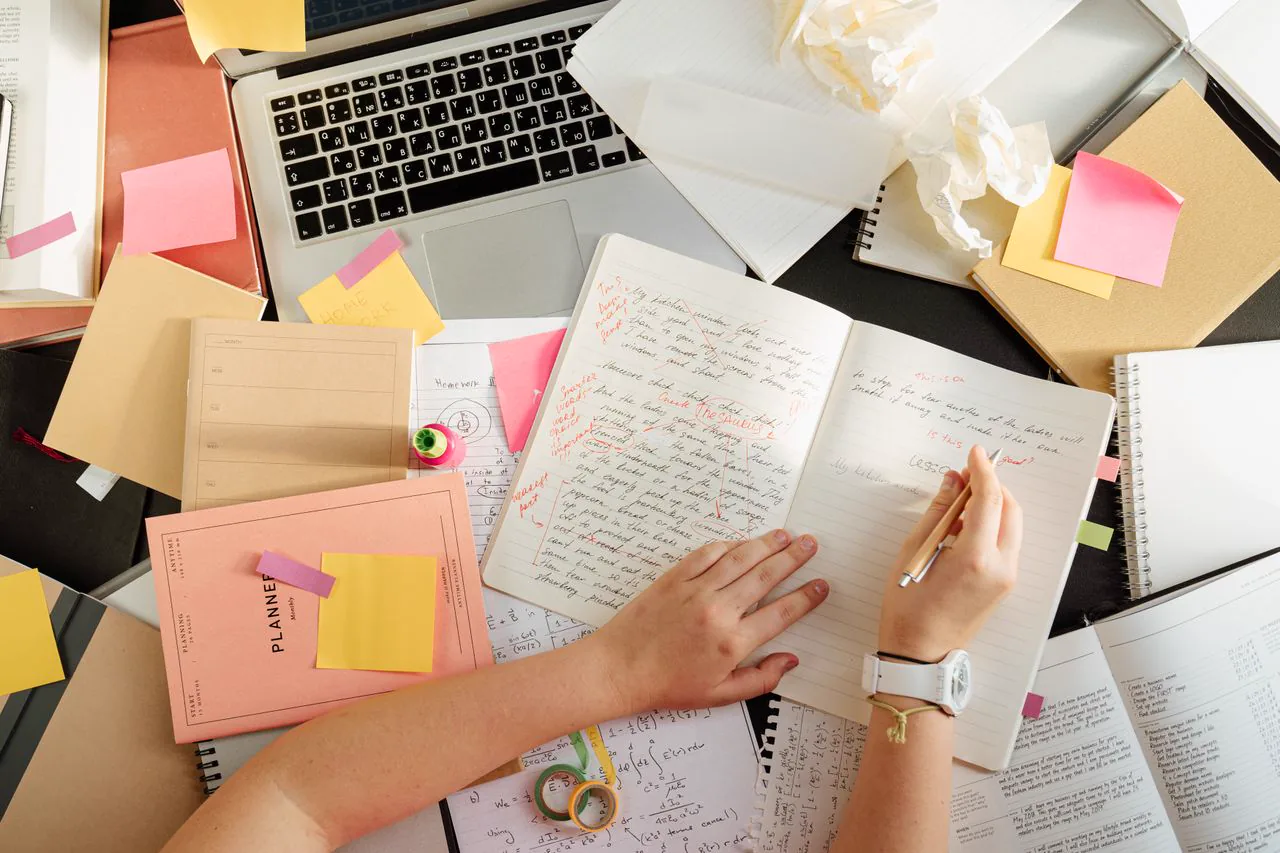
Because hours are a measurement of time, not of learning. Rereading and highlighting feel productive for a specific reason: each pass makes the material easier to process, and your brain misreads that ease as knowing it. Psychologists call this the fluency illusion, and it is the single most common reason a long study session leaves nothing behind.
The problem is that studying feels good and remembering feels bad
Here is the uncomfortable shape of it. The methods that feel most effective while you are doing them are mostly the least effective, and the ones that work best feel like failing.
Rereading a chapter is smooth. The sentences are familiar, nothing snags, you finish feeling like you have it. Closing the book and trying to write down what was in it is unpleasant. You blank, you get things wrong, you have to go back and check. It feels like you are doing worse.
You are not. That struggle is the mechanism.
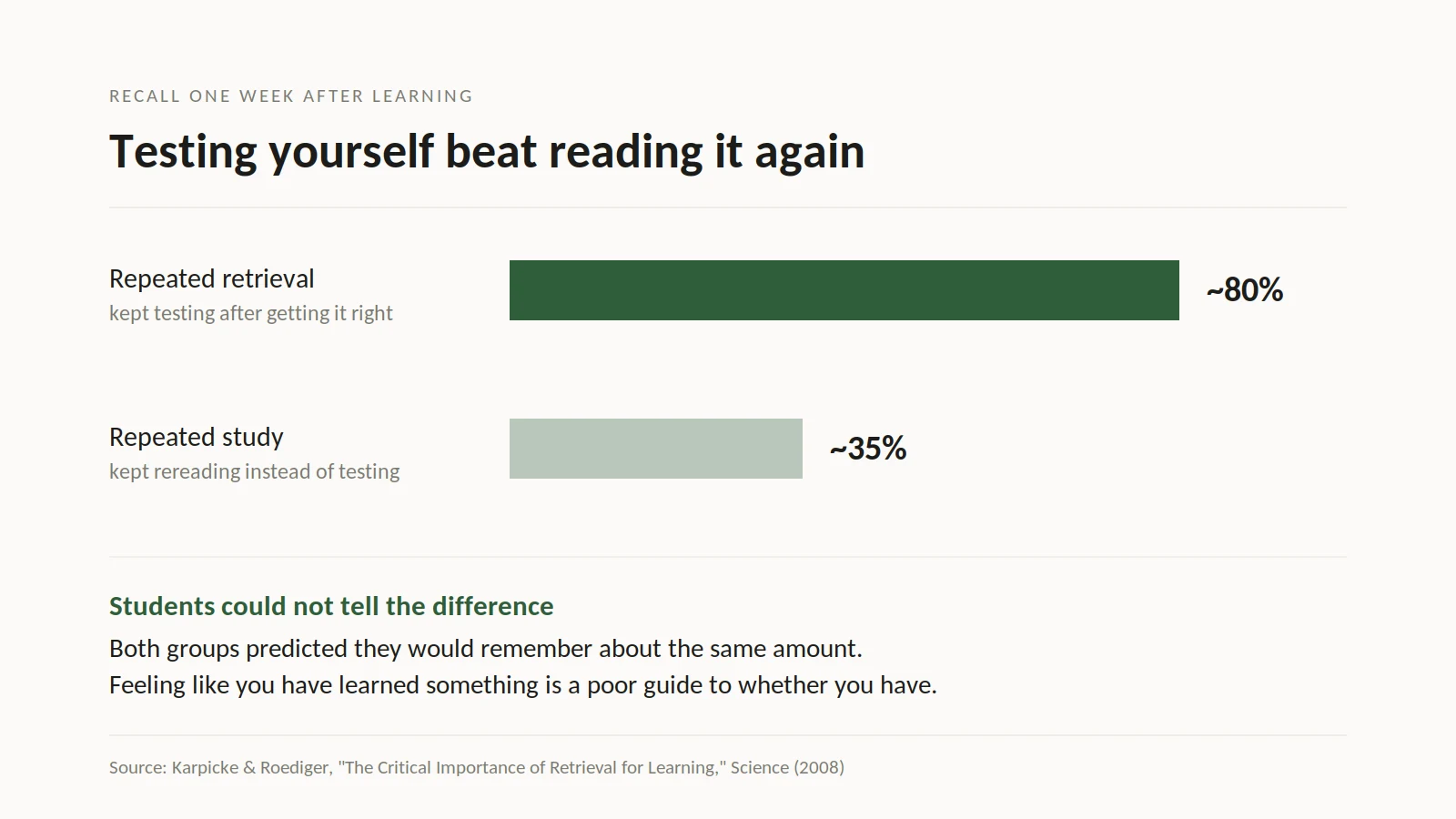
The clearest demonstration comes from Jeffrey Karpicke and Henry Roediger, published in Science in 2008. Students learned foreign vocabulary pairs under different conditions. Some kept restudying items they had already got right. Others kept being tested on them. A week later, the repeated-retrieval group recalled roughly 80 percent of the material. The group that kept restudying instead of testing landed around 35 percent.
The part that matters most for you is what the students predicted. Their confidence about how much they would remember was similar across conditions. They could not tell which method was working. The feeling of learning and the fact of learning had come apart completely, and the students trusted the feeling.
What the evidence actually ranks highly
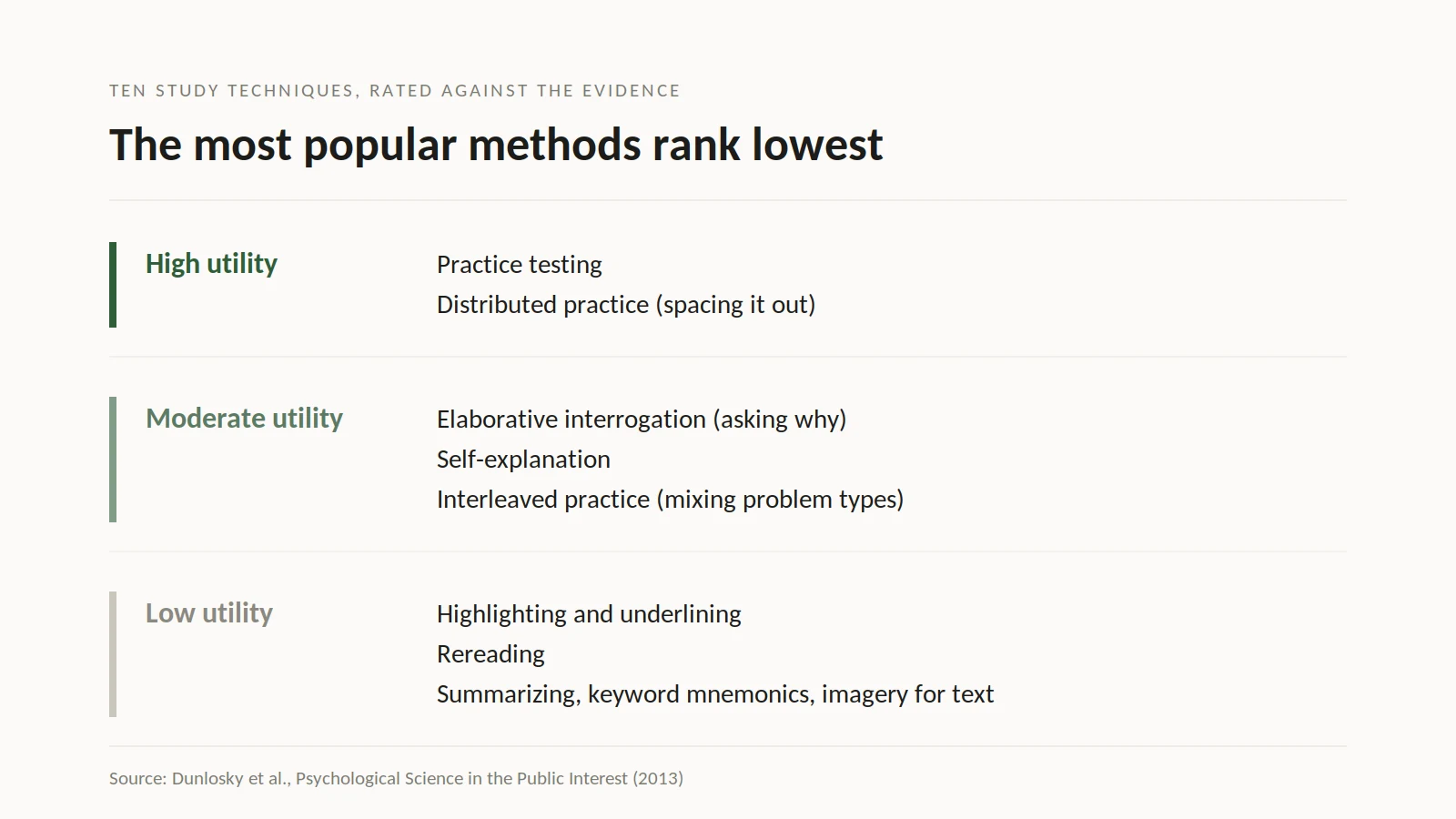
In 2013, John Dunlosky and colleagues published a review in Psychological Science in the Public Interest that assessed ten common study techniques against the research and rated each for utility. It remains one of the most useful things a student can read.
Rated high utility: practice testing and distributed practice, which is spacing your study out over time rather than compressing it.
Rated moderate: elaborative interrogation (asking yourself why a fact is true), self-explanation, and interleaved practice (mixing problem types rather than blocking them).
Rated low utility: summarizing, highlighting and underlining, keyword mnemonics, imagery for text, and rereading.
Look at that last group. Highlighting and rereading are, by a wide margin, the two things students do most. They are also close to the bottom of the evidence. That is not because students are lazy. It is because those methods produce the strongest feeling of productivity per minute spent, and feeling is the only signal most people have.
Breaks are part of the learning, not a reward for it
This is the part that gets skipped, and it is why grinding for four hours straight can genuinely leave you with less than two focused hours would have.
Your brain does not finish forming a memory at the moment you encounter the information. Consolidation continues afterward, and it needs relatively quiet conditions to happen.
Michaela Dewar and colleagues at Edinburgh tested this directly in a 2012 study. Participants heard stories and then either rested quietly with their eyes closed for ten minutes or played a spot-the-difference game for the same ten minutes. The quiet rest group remembered significantly more, both shortly after and, in that study, seven days later.
Worth flagging honestly: some later attempts to replicate the seven-day effect found it and others did not, so treat the long-term size of it as unsettled. The short-term benefit and the underlying idea, that new memories need quiet time to stabilise, are on much firmer ground.
The practical consequence is specific and slightly annoying. A break spent scrolling is not a break in the sense that matters here. You have swapped one stream of incoming information for another, and the quiet your brain needed to consolidate never arrived. Standing up, walking, staring out a window, doing nothing in particular: these look like less and do more.
And then there is sleep, which does most of the work
If breaks are the small version of this, sleep is the large one.
During sleep, particularly deep slow-wave sleep, the brain replays and stabilises what you learned during the day, moving material toward more durable storage. This is one of the better-established findings in memory research, and it has an unglamorous implication that most students already suspect and ignore.
The all-nighter is not a neutral trade of sleep for study hours. You are removing the process that turns the studying into memory. You will feel like you covered a lot, because you did, and much less of it will be there.
Spacing your study across several days works partly for this reason. Three sessions over three days include two nights of consolidation. One session of the same total length includes none.
What to do instead
Five things, in rough order of how much difference they make.
Close the book and try to produce it. After a section, write down what you remember before checking. Blanking is not wasted time, it is the specific moment where the memory gets strengthened when you then look it up.
Turn everything into questions. Headings, bolded terms, lecture slides. Then answer them from memory rather than rereading them.
Spread it out. Four thirty-minute sessions across a week beat one two-hour session, and the gap between them is doing real work.
Take breaks that are actually quiet. Away from the screen, away from the feed. Ten minutes of nothing beats ten minutes of scrolling by a meaningful margin.
Stop counting hours. It is the easiest metric to collect and the one least connected to the outcome. What matters is how many times you retrieved something, how spread out those attempts were, and whether you slept.
How Weila handles this
Two separate parts of Weila map onto this, and they do different jobs.
Sessions are scored on quality, not length. Weila gives each study session a focus score based on the shape of the session rather than how long you sat there. Long unbroken blocks of real work count for more than fragmented ones, with somewhere in the 30 to 60 minute range coming out strongest. Interruptions and distractions pull it down. Taking no breaks at all on a long session pulls it down too, as do breaks that are far too short or that eat most of the session. Roughly one break per 45 minutes of work, lasting somewhere between a tenth and a fifth of your study time, is what the scoring treats as healthy.
That last part is deliberate, and it follows directly from the consolidation research above. A tool that rewarded pure endurance would be rewarding the thing that does not work.
Your focus score is yours. It does not appear on any leaderboard, and clubs and rankings run on contribution points instead. Nobody sees it unless you choose to share a session.
Retrieval is its own system. Separately from sessions, Weila has a daily active recall drill, spaced-repetition flashcards that resurface material when you are about to forget it, and decks and quizzes you can build from what you are studying. This is the part that addresses the actual problem in this post. Answering recall questions counts toward your streak and earns contribution points, which means the app is nudging you toward the thing that works rather than toward sitting still for longer.
If you want the related argument about matching session length to the work in front of you, that is in Pomodoro doesn't work for me, what should I use instead.
Common questions
Why do I forget everything right after studying?
Usually because the session involved recognising material rather than retrieving it. Rereading builds familiarity, which feels like knowledge and disappears under exam conditions. Testing yourself builds the thing you actually need.
Is rereading a waste of time?
Not entirely, but it is rated low utility in the research and it is almost always the wrong default. One pass to understand, then switch to retrieval. Additional passes give sharply diminishing returns.
How long should I study without a break?
Somewhere in the 30 to 60 minute range suits most work, longer if the task takes a while to get into. The more important part is that the break is genuinely restful rather than another screen.
Does sleep really affect what I remember?
Yes, substantially. Memory consolidation during sleep is one of the better-established findings in the field, which is why an all-nighter tends to trade away the process that would have made the studying stick.
Why does active recall feel so much harder than reading?
Because it is harder, and that is the point. The effort of retrieving something is what strengthens it. Ease during study is a poor predictor of memory later.
The short version
- Fluency is not knowledge. Material feeling easy means you have seen it, not that you can produce it.
- Repeated retrieval beat repeated study by a wide margin, and students could not tell the difference.
- Highlighting and rereading are the most common study methods and among the least effective.
- Breaks and sleep are when memories consolidate. Skipping them removes the part that makes studying count.
- Hours studied is the easiest thing to measure and the least connected to what you will remember.
Weila is a study app with quality-scored sessions, spaced-repetition recall, and contribution points that will fund vetted conservation work. See how it works.