Pomodoro Doesn't Work for Me. What Should I Use Instead?
The 25 minute timer is one option, not a law. Where each popular interval actually came from, why none of them are optimal, and how to find the block length that fits your work.

If the 25 minute timer keeps cutting you off right when the work starts flowing, nothing is wrong with you. The interval was picked by one student in the 1980s using a kitchen timer, and it was never optimised for anything. Longer blocks of 45 to 90 minutes suit deep or sustained work, shorter ones suit low energy days and fragmented tasks, and the whole point is that the block length should match the work.
Where 25 minutes actually came from
Francesco Cirillo was a university student in Italy in the late 1980s, struggling to focus while preparing for exams. He grabbed a tomato shaped kitchen timer, set it, and worked until it rang. Pomodoro is Italian for tomato. That is the origin story, and it is a good one.
What it is not is a research finding. Cirillo settled on 25 minutes because it worked for him with the timer he happened to own. There was no experiment comparing it against 20 or 40. No study established that 25 is where attention peaks. The number is arbitrary in the most literal sense, and Cirillo has never claimed otherwise.
The technique itself is genuinely useful. Breaking work into timed blocks with real breaks beats the alternative of grinding until you burn out. But somewhere between the kitchen timer and the hundreds of apps that copied it, "one guy's interval" quietly became "the correct interval," and now people who find it disruptive assume the failure is theirs.
It usually is not. If your work takes fifteen minutes to warm into, a timer that rings at twenty five is interrupting you at the worst possible moment, every single time.
The 52/17 rule is not what you think either
The other number people quote is 52 minutes of work followed by a 17 minute break. It gets described as scientifically proven surprisingly often.
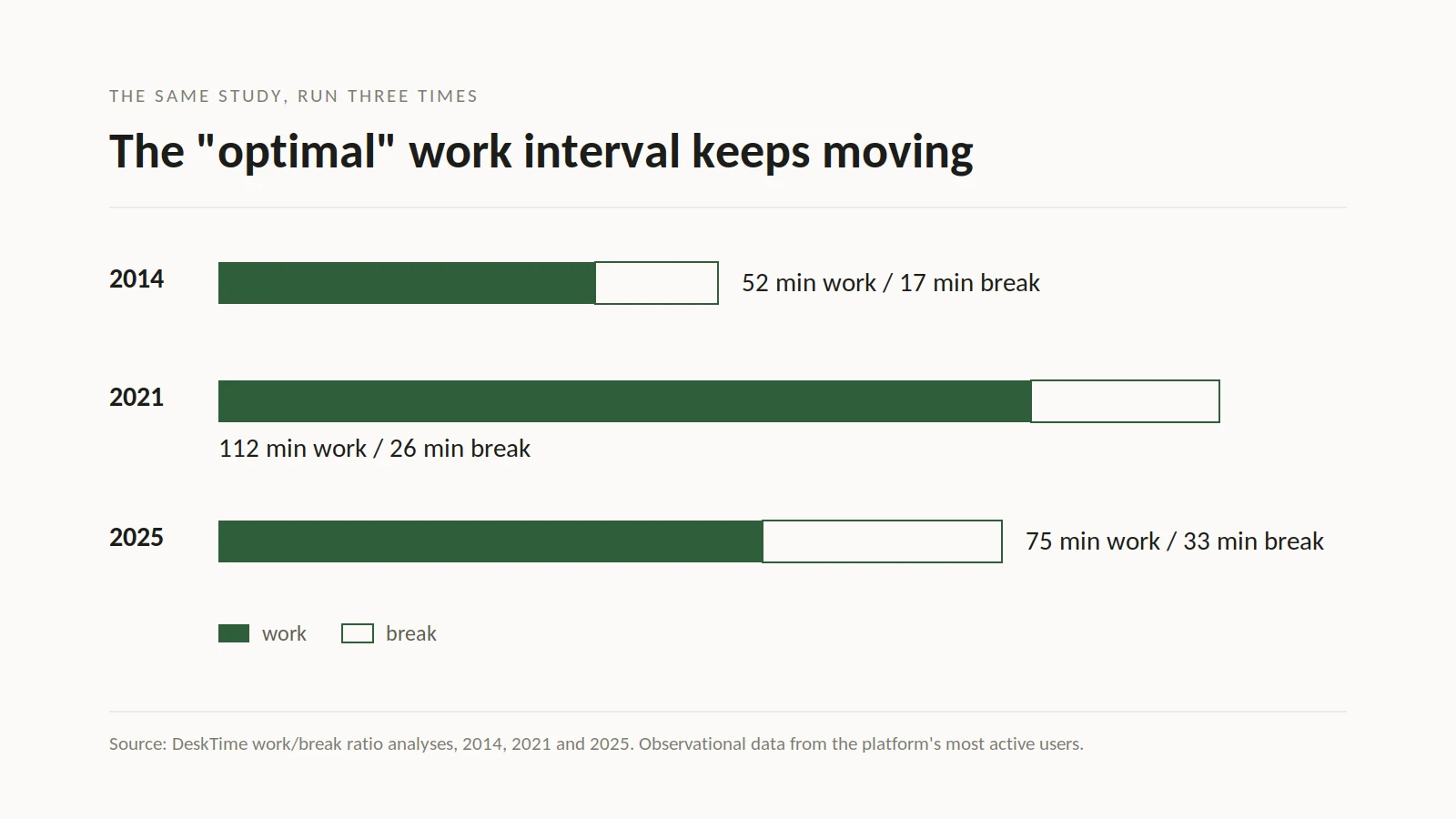
Here is what it actually is. In 2014, a time tracking company called DeskTime looked at its own user data, isolated the most productive ten percent by their internal productivity rating, and found those users averaged roughly 52 minutes of work and 17 minutes of break. The Muse published it, Inc. and Business Insider and Lifehacker picked it up, and the 52/17 rule was born.
It is real data. It is also observational data from one company's software users, measuring app usage rather than learning, with no control group and no causal claim. Productive people happened to work that way. Nobody demonstrated that working that way makes you productive.
And then the number moved. DeskTime ran the same analysis again in 2021 and got 112 minutes of work to 26 of break. They ran it again on 2024 data and got 75 and 33. Same company, same method, same platform, three different answers over a decade, tracking changes in how and where people were working.
That is not a criticism of DeskTime. Their data is what it is. But it should end the idea that any of these ratios is a fixed property of human attention. If the optimal interval changes when people start working from home, it was never optimal in the first place. It was a snapshot.
What the research does support
Take away the specific numbers and something solid remains.
Sustained attention degrades over time on task. This is one of the most replicated findings in attention research, and it is why you can feel yourself getting worse at something after a long stretch without noticing when it started.
Brief breaks counteract it. Work by Atsunori Ariga and Alejandro Lleras at the University of Illinois, published in Cognition in 2011, found that participants given brief diversions during a long task maintained their performance, while those working straight through declined steadily. Deactivating and reactivating your goal, in their framing, is what keeps it sharp.
Switching tasks is expensive. Research on task switching consistently finds a measurable cost every time you change what you are doing. This is the part that matters most for anyone who finds Pomodoro disruptive: if a timer pulls you out of deep work every 25 minutes, you are paying that cost repeatedly for no gain.
So the defensible version is: work in blocks, take real breaks, do not grind indefinitely. The specific length is yours to choose, and the correct choice depends on what you are doing.
How to pick a block length
Four questions, roughly in order of usefulness.
How long does this work take to get into? Some tasks are immediate. Flashcards, past paper questions, rewriting notes. Others need a runway: essays, proofs, code, anything where you have to load a lot of context before you can produce anything. If your warm-up is fifteen minutes, a 25 minute block gives you ten minutes of actual work.
How is your energy right now? On a bad day, a 90 minute block is a commitment you will avoid making, and you will do nothing instead. Fifteen minutes is easy to say yes to. The best block length is sometimes just the one you will actually start.
Is the task naturally chunked? Twenty practice problems split cleanly. A single long essay does not. Fighting the shape of the work is how breaks end up landing mid-sentence.
What actually happens when the timer rings? Pay attention to this one. If you consistently feel relieved, the block is too long. If you consistently feel yanked out of something, it is too short. That reaction is better information than any published ratio.
How Weila handles this
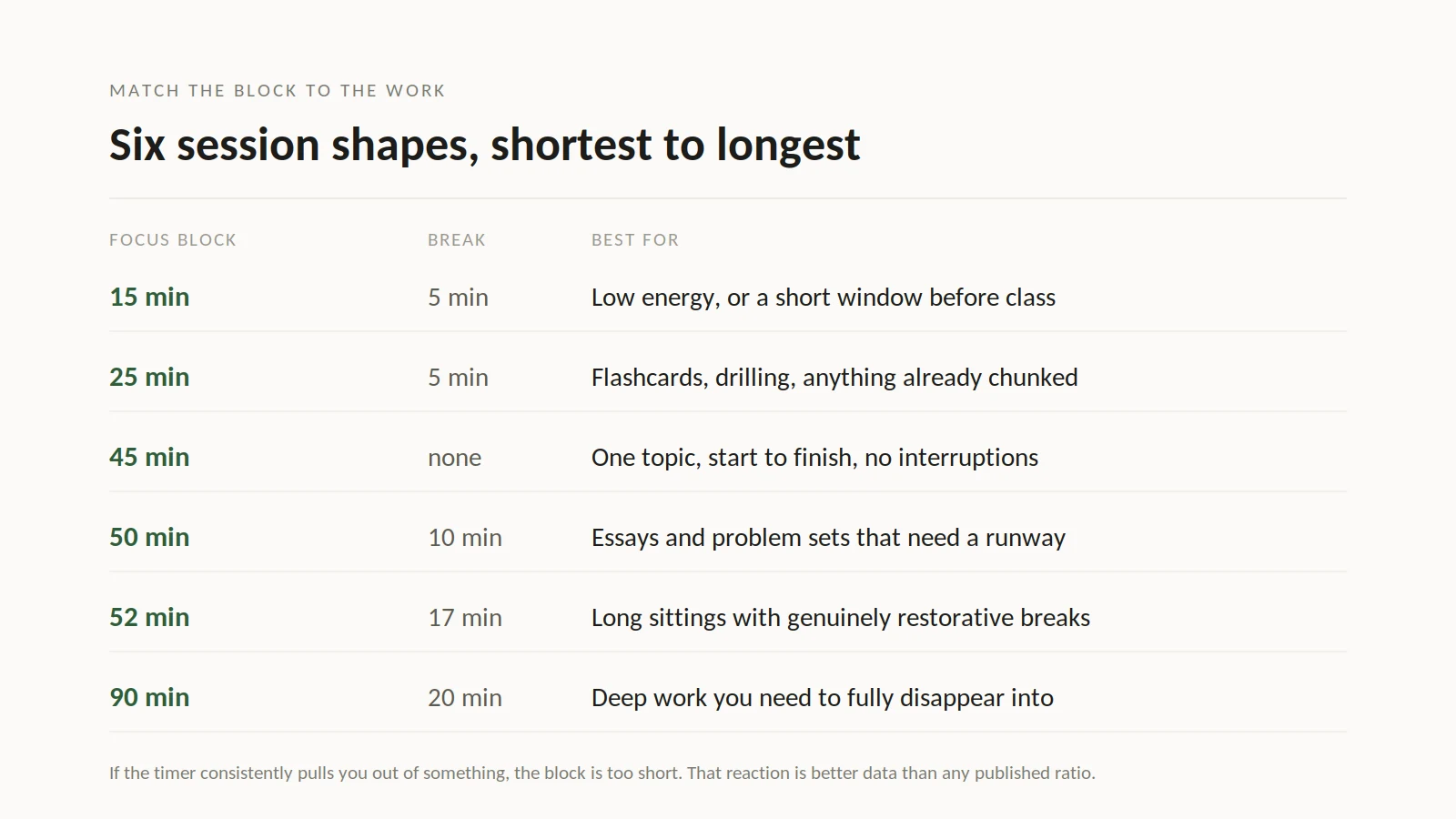
Weila ships six built-in structures rather than one timer, and all six are free. The point is that you pick the shape that fits the work in front of you.
- The Sprint. One 45 minute block, no breaks. One topic, done in under an hour.
- The Quick Burn. 15 minutes on, 5 off, four rounds. For low energy days or a short window.
- The Classic. 25 on, 5 off, four rounds. The familiar one, and a reasonable starting point if you are new to structured sessions.
- The Deep Dive. 50 on, 10 off, four rounds. Built for essays, problem sets, anything that needs a long runway.
- The 52/17 Method. 52 on, 17 off, three rounds.
- The Ultradian Rhythm. 90 on, 20 off, two rounds. The longest blocks, for deep sustained work.
A few things worth knowing about how they behave, because the details are where most timer apps get annoying.
You do not have to use one at all. There is an open-ended stopwatch that just counts up, and a plain countdown if you want to set your own length. Structures are optional.
Breaks arrive on their own. You get a chime about a minute out, a short countdown, and then the break starts. No dialog to dismiss, no decision to make while you are still mid-thought.
Sessions do not cut you off. When the clock runs out, the session rolls into overtime and keeps counting until you end it. This is the specific thing that makes rigid timers frustrating, and we deliberately did not build it that way. If you are in flow at minute 46 of a 45 minute sprint, keep going.
After a session, Weila may suggest a different structure. It looks at the shape of what you actually did, the focus score breakdown and how consistent your blocks were, and recommends one of the six with a short reason. Sometimes that is formalising a pattern you already fell into naturally. Sometimes it is a correction for something that went wrong. You can ignore it.
If you want the broader argument about why any of this holds up over a semester, that is in why you stop studying and what brings you back.
Common questions
Is the Pomodoro Technique scientifically proven?
The general principle of working in blocks with real breaks has research behind it. The specific 25 minute interval does not. It came from a kitchen timer in the late 1980s and was never tested against alternatives.
What is the best study interval?
There isn't one. Match the block to the work: short blocks for fragmented tasks and low energy, longer blocks of 45 to 90 minutes for work that takes time to get into.
Why does the Pomodoro timer break my concentration?
Because 25 minutes is short relative to how long deep work takes to enter. If your task needs a fifteen minute runway, the timer is interrupting you almost immediately after you arrive. Try 50 or 90 minute blocks instead.
Is 52/17 better than 25/5?
Not inherently. It came from observational data about one software company's most active users, and that same company's later analyses produced 112/26 and then 75/33. Treat all of them as options rather than answers.
How long should my breaks be?
Long enough to genuinely disengage, which usually means standing up and leaving the screen. Most of the common structures land somewhere between a fifth and a third of the work block, which is a reasonable place to start.
The short version
- The 25 minute interval was one student's kitchen timer, not a research finding.
- 52/17 was observational data, and the same company later measured 112/26 and 75/33.
- What does hold up: attention fades over time, brief breaks counteract it, and switching costs are real.
- Pick your block length by how long the work takes to get into, not by what an app defaults to.
- If the timer consistently yanks you out of something, it is too short. That feeling is data.
Weila is a study app with six built-in session structures, live Study Together sessions, and contribution points that will fund vetted conservation work. See how it works.
This post is not affiliated with, associated with, or endorsed by Francesco Cirillo.