How Many Hours a Day Should I Study?
There is no correct number, and the research on study hours and grades is weaker than you would expect. What actually predicted results, and the unit you should count instead.

Fewer than you think, and counted differently. There is no magic number of hours, and when researchers have looked for a relationship between total study time and grades, they have had a hard time finding one. What shows up instead is how the time is spent: focused, undistracted, planned, and repeated at regular times. Three good hours beats six at a desk.
The hours question has a disappointing answer
Everybody wants a number. Four hours? Six? The honest answer is that the number is not the variable doing the work.
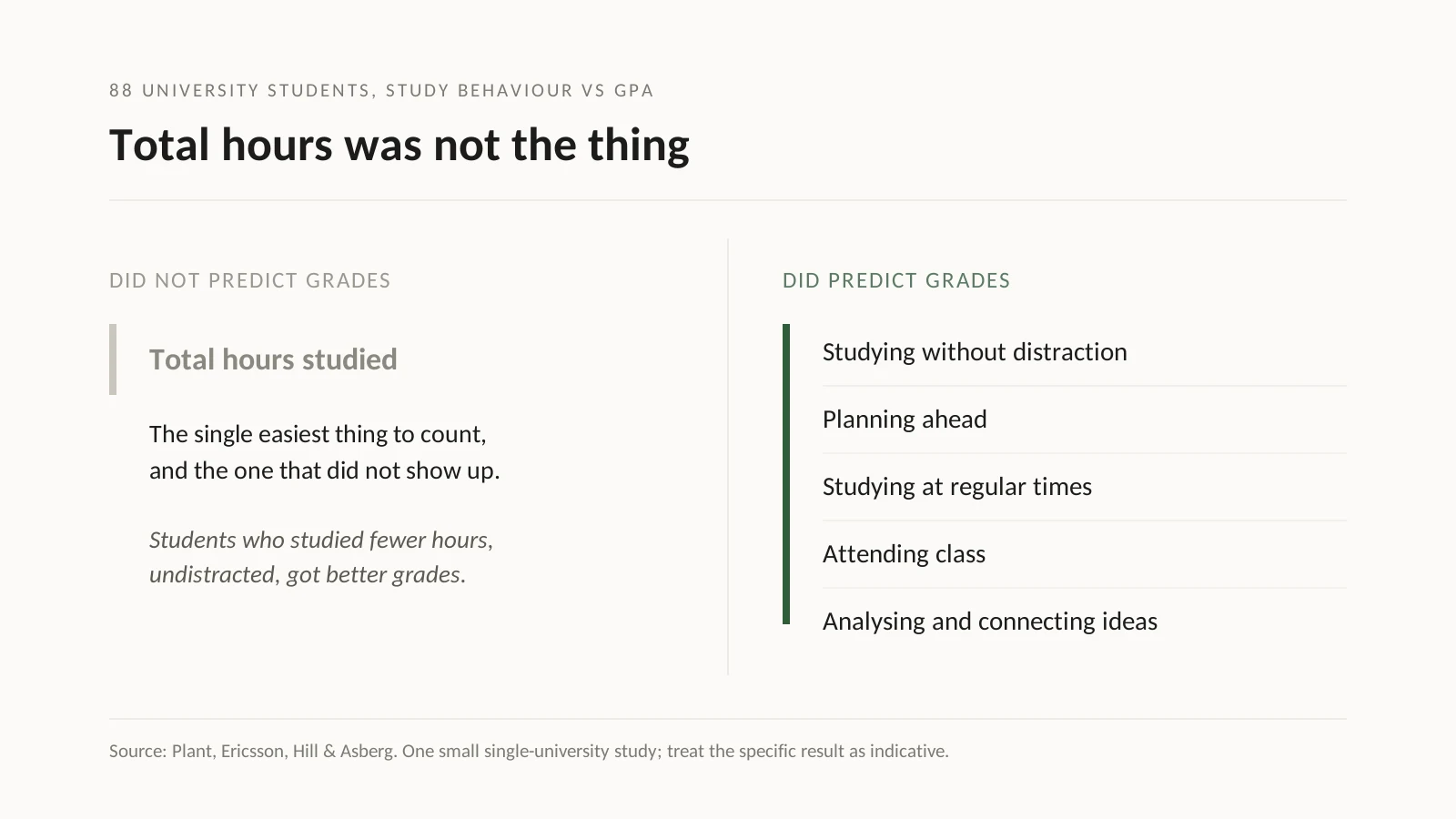
In a study by Plant, Ericsson, Hill and Asberg, researchers tracked the study behaviour of 88 university students and compared it against their grades. Total study time did not predict GPA.
What did show up was everything around the hours. Students who studied without distraction, no television, no music player, no friends in the room, got better grades while studying fewer hours. Planning ahead and studying at regular times tracked with higher GPA. So did attending class. Deep engagement with the material, analysing and connecting ideas rather than reading passively, tracked better than simply putting in time.
That is one small study at one university, so hold the specific result loosely. But it points the same direction as the rest of the evidence in this area, and it matches something most students already suspect: the person in the library for nine hours is not reliably outperforming the person who did three real ones.
Why total hours is a bad unit
Hours at a desk measures presence. It is the easiest thing to count and the furthest from what matters.
An hour can contain forty-five minutes of genuine work, or it can contain twelve minutes of work and a long scroll with a textbook open nearby. Both log as one hour. If hours are your metric, you will optimise for the thing that is easy to produce, which is sitting still.
There is also a real ceiling on sustained hard cognitive work. Research into deliberate practice across demanding fields has repeatedly found that people at the top do not grind endlessly. They do a few hours of genuinely effortful, focused work per day and then stop, because that kind of effort cannot be sustained for eight hours no matter who you are.
So the realistic daily range for most students is something like two to four hours of genuinely focused study, plus whatever lighter review, reading or admin the day needs. If you are routinely claiming eight hours, some of it is not what you think it is.
Count blocks, not hours
The useful change is to stop counting time and start counting completed units of real work.
A block is one uninterrupted stretch on one task, long enough to get into it and short enough to stay sharp. Somewhere between 30 and 90 minutes suits most work, depending on how long it takes you to warm up. Interrupted does not count. Phone out, notifications off, one thing at a time.
Then set a daily target in blocks rather than hours. Three solid blocks is a strong day for most students during term. Four or five is a heavy revision day. If you hit your blocks by 3pm, you are done, and that is not cheating.
This does two useful things. It makes the target honest, because you cannot pad a block the way you can pad an hour. And it ends the day cleanly, which matters more than people expect, since a vague target of "study as much as possible" turns every evening into guilt.
What to do with the hours you are not studying
The second half of the Plant findings is worth saying plainly: both working long hours and partying heavily tracked with lower GPAs. Study time is not competing with nothing. It is competing with everything else in your week, and some of that is not optional.
The practical version is that a shorter, protected, genuinely focused study block is more compatible with the rest of a student's life than a vague all-day commitment that never quite happens. Three hours you actually protect beats eight you nominally intend.
If your hours keep failing to produce anything, that is usually a method problem rather than a quantity problem. Why do I feel like I studied for hours but remember nothing covers that directly.
How Weila handles this
Weila is built on exactly this distinction, which is why it does not put a total-hours counter at the centre.
Sessions are scored on shape, not length. A focus score reflects how the session was structured: long unbroken stretches of real work count for more, interruptions and constant pausing count against you, and grinding a long session with no breaks costs you too. A tool that rewarded raw hours would be rewarding the thing that does not work.
Six session structures. From a single 45 minute sprint up to 90 minute blocks, so you can pick a shape that fits the work instead of forcing everything through one timer. More on choosing between them in Pomodoro doesn't work for me, what should I use instead.
Consistency with your own rhythm counts. Studying near your usual time and your usual session length earns credit, which lines up with the finding that regular study times tracked with better results.
Your score is private. It is not on any leaderboard, so a rough day is information for you rather than something to perform.
Common questions
Is 2 hours of studying a day enough?
For most students during normal term time, two to three genuinely focused hours is a reasonable daily load, alongside classes. The quality of those hours matters far more than the count, and total study time has been a poor predictor of grades in the research.
How many hours a day should I study for finals?
More than during term, but not endlessly. Four to five focused blocks is a heavy day and about the practical ceiling for sustained hard work. Spreading that across more days beats compressing it into fewer.
Why am I studying so much and still doing badly?
Usually method rather than volume. Rereading and highlighting feel productive and perform poorly. Self-testing, spaced out over days, is what produces retention.
Does studying longer actually help?
Up to a point, and with sharply diminishing returns. Past a few hours of genuinely effortful work, additional time tends to be lower quality, and it competes with sleep, which is doing real work of its own.
How do I know if an hour of study actually counted?
Ask whether you produced anything from memory. If the hour was spent recognising material you already had in front of you, it probably did less than it felt like.
The short version
- In one study of 88 students, total study time did not predict GPA. Studying undistracted, planning ahead and regular times did.
- Hours at a desk measure presence, which is the easiest thing to fake and the least connected to results.
- Two to four hours of genuinely focused work is the realistic daily range for most students.
- Count completed blocks rather than hours, and let the day end when you hit the target.
- If the hours are not producing anything, change the method before adding more hours.
Weila is a study app that scores sessions on focus quality rather than hours, with contribution points that fund vetted conservation work. See how it works.