What Does a Wildlife Rehabilitation Center Actually Do?
About half the animals that come in go back out. Here is what actually arrives at the door, what happens to it, and the mistake that sends over a thousand healthy babies a year into care.
They take in sick, injured and orphaned wild animals, treat them, and return as many as possible to the wild. In practice that means a lot of triage, a lot of feeding schedules, and a roughly even split between animals that make it back out and animals that do not. Most of what arrives got there because of something a human did, directly or indirectly.
What actually comes through the door
The clearest picture comes from New York, where researchers compiled a full census of licensed wildlife rehabilitation across the state. Over three years, 703 rehabilitators handled 59,370 animals.
Birds were just over half of all admissions at 52.6 percent, mammals made up 42.9 percent, and reptiles and amphibians accounted for the small remainder.
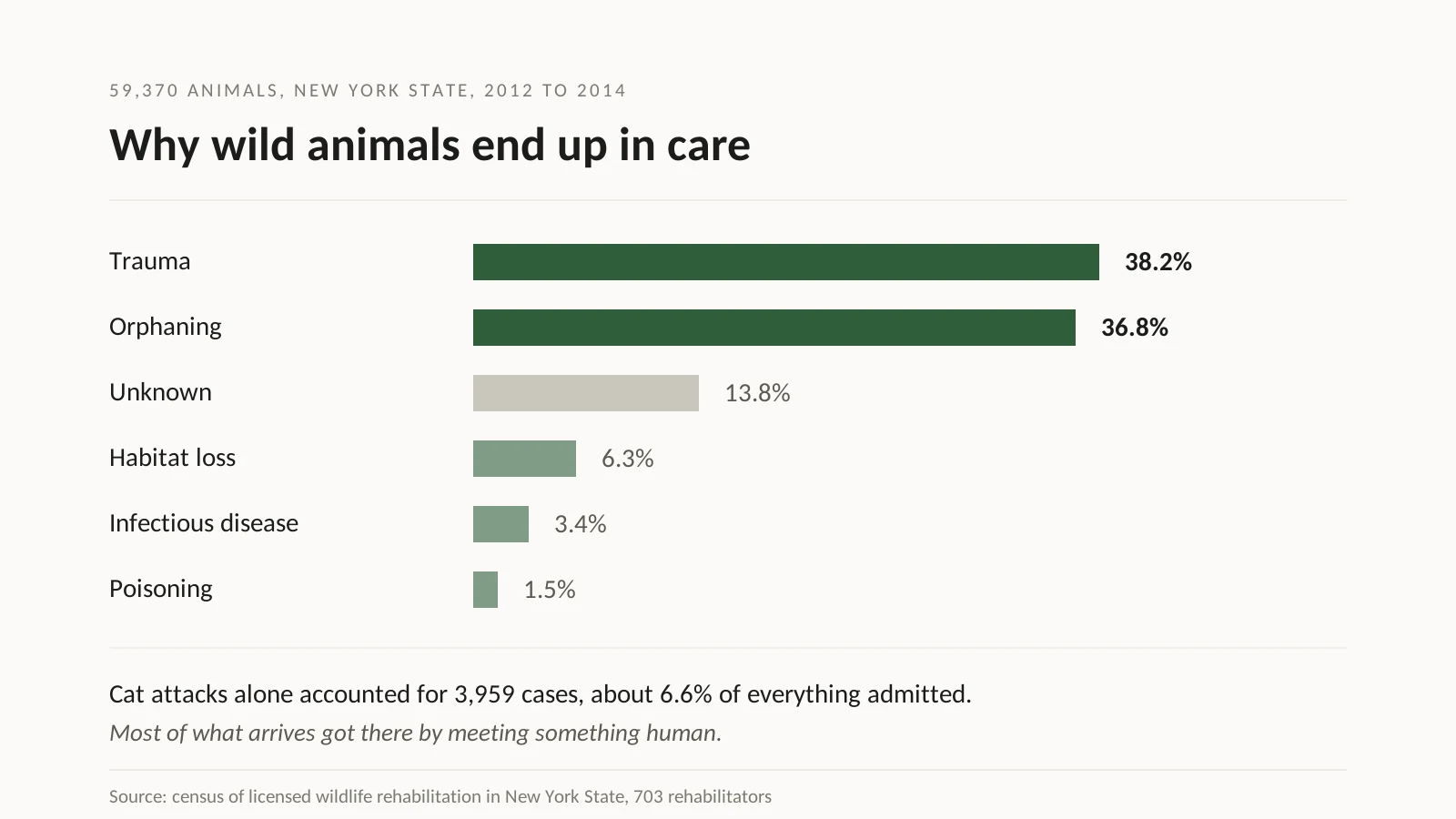
The reasons animals arrived are the interesting part:
- Trauma, 38.2 percent
- Orphaning, 36.8 percent
- Habitat loss, 6.3 percent
- Infectious disease, 3.4 percent
- Poisoning or toxins, 1.5 percent
- Unknown, 13.8 percent
Those top two categories are overwhelmingly human-adjacent. Cars, windows, fences, power lines, lawnmowers, tree felling during nesting season. And pets: domestic cat attacks alone accounted for 3,959 cases, about 6.6 percent of everything admitted, with dog attacks responsible for another 2,068.
This is not a story about nature being harsh. It is mostly a story about animals meeting infrastructure.
About half go back
Of the cases with a recorded outcome, 50.2 percent were released. Around 45.4 percent either died or were euthanised, a small number remained permanently non-releasable, and the rest were still in care.
Half can sound like failure. It is not. Many animals arrive with injuries that were never survivable, and a large share of the deaths happen in the first forty-eight hours. Animals that survived longer than two days were released at a rate of 70.8 percent, against 15.7 percent for those in care two days or less. Once an animal is stable, the odds are genuinely good.
It is also worth noting that the release rate has improved over time. The equivalent figure in New York in 1989 was 44.4 percent.
A real part of the job is deciding which animals cannot be saved and ending their suffering quickly. Rehabilitators do not usually describe that as the hard part because it is unpleasant. They describe it as the hard part because they have to be right.
The mistake that fills the nursery every spring
If you ask rehabilitators what they most want the public to know, this is usually it: most baby animals people bring in were not orphaned.
In that same New York dataset, more than a thousand animals a year were orphaned by unnecessary human intervention. Someone found a fawn lying alone in long grass, or a fledgling hopping on the ground, assumed it had been abandoned, and picked it up.
Both of those are normal. Deer leave fawns alone for hours because the mother's presence attracts predators. Fledgling birds spend days on the ground learning to fly while their parents feed them from nearby. Rabbit mothers visit the nest roughly twice a day, at dawn and dusk, and are nowhere to be seen the rest of the time.
Taking those animals in is well-meant and it is usually the worst outcome available. A healthy wild animal gets removed from a functioning parent and handed to a facility that is already at capacity, where its odds are considerably worse than they were in the grass.
The rule rehabbers repeat: if it is not visibly injured, not covered in flies or ants, not cold and limp, and not in immediate danger, leave it and watch from a distance for a few hours first.
Is rehabilitation actually conservation?
Worth being straight about, because the honest answer is more interesting than the easy one.
For common species, mostly no. Treating fifty thousand individual robins does not measurably change robin populations. The scale is wrong and nobody serious claims otherwise. That work is animal welfare, which is a legitimate thing to care about on its own terms and should not need to be dressed up as something else.
Where it genuinely crosses into conservation is narrower and real. For endangered species with tiny populations, individual animals matter at the population level, and rehabilitation can be a meaningful part of recovery. Admissions data is also a serious disease and toxin surveillance network: rehabilitators are often the first to notice a cluster of poisonings or an outbreak moving through a region. And the public education side is not trivial, since a centre that handles thousands of cat-attack admissions a year has unusually concrete things to say about keeping cats indoors.
So: mostly welfare, sometimes conservation, consistently a source of data nobody else collects. All three are worth funding.
If you are weighing where to give more broadly, where does your money actually go when you donate to conservation covers how to evaluate an organisation.
What to do if you find an injured animal
Call first, do not drive first. Find a licensed rehabilitator in your area and ring them before touching anything. Many problems are solved on the phone, and some species they legally cannot accept.
Leave babies alone unless something is clearly wrong. Injured, cold and limp, covered in insects, or in immediate danger. Otherwise watch from a distance.
If you must contain it, keep it boring. A ventilated cardboard box, a towel, somewhere dark and quiet. No radio, no peeking, no showing the kids.
Do not feed it or give it water. This is the single most common way well-meaning people kill the animal they rescued. Wrong food, wrong temperature, or fluid into the lungs. Rehabilitators would rather receive a hungry animal than a dead one.
Note exactly where you found it. Release usually has to happen near the original territory, so the location is genuinely important information.
Where this fits in Weila
Rehabilitation is in the name of the programme. WERC stands for Weila's Education, Rehabilitation and Conservation, and the three sit together on purpose.
Studying in Weila earns contribution points, and the community's monthly total drives a donation Weila funds and gives to a vetted conservation campaign. Rehabilitation work is exactly the kind of unglamorous, chronically underfunded operation that private giving reaches more easily than public budgets do.
The education half is the other reason we built it this way. A student who finishes a term knowing not to pick up a fledgling has done more practical good than most donations of the same size.
Common questions
What happens to animals that cannot be released?
A small number become permanent residents at licensed facilities, often as education animals. In the New York census that was about 0.3 percent of cases. Most animals that cannot be released are humanely euthanised, because a wild animal that cannot survive in the wild has a poor life in captivity.
Can I keep a wild animal I rescued?
Almost certainly not. Wildlife rehabilitation requires a licence nearly everywhere, and keeping protected wildlife without one is illegal. It is also bad for the animal, which needs species-specific care and must avoid becoming comfortable around humans.
Do wildlife rehabilitation centres charge for intake?
Most do not charge the person bringing an animal in. They typically run on donations and volunteers, which is why they are perpetually short of money during spring and summer when admissions spike.
How can I help besides donating?
Keep cats indoors, make windows visible to birds, check for nests before cutting trees or mowing long grass, drive carefully at dusk, and leave apparently orphaned babies alone. Prevention costs nothing and beats treatment every time.
How do I find a licensed rehabilitator near me?
Your state, provincial or national wildlife agency maintains a list, and most publish it online. Search for your region plus "licensed wildlife rehabilitator" and use the official agency listing rather than a general directory.
The short version
- Trauma and orphaning account for about three quarters of admissions, and most of it traces back to humans and pets.
- Around half of admitted animals are released; survival past the first two days raises that sharply.
- Over a thousand animals a year in one state alone are "orphaned" by people picking up healthy babies.
- For common species this is welfare rather than conservation, and it is still worth funding.
- If you find an animal: call a licensed rehabilitator first, and do not feed it.
Weila is a study app where focused study time earns contribution points that fund vetted conservation work. See how the WERC programme works.