Where Does Your Money Actually Go When You Donate to Conservation?
The honest answer, why the overhead ratio is the wrong thing to look at, and a short checklist for working out whether a conservation charity is worth your money.
Most people picture their donation as a straight line: twenty dollars in, twenty dollars of habitat protected. The reality is that your money joins a pool, gets allocated across field work, staff, equipment, permits, monitoring and the unglamorous business of keeping an organisation running, and the useful question is not how much of it avoided those costs. It is whether the organisation is any good at turning money into outcomes.
That is a harder question, and almost nobody asks it, because there is an easier number sitting right there instead.
The overhead ratio is the wrong thing to look at
You have probably seen a charity advertise that 90 percent of donations go directly to programs. It sounds like the ultimate proof of a well-run organisation. It is not, and the people who invented that metric have been trying to kill it for over a decade.
In June 2013, the three biggest charity watchdogs in the United States, GuideStar (now Candid), Charity Navigator and the BBB Wise Giving Alliance, published an open letter to American donors denouncing the overhead ratio as a valid measure of nonprofit performance. Their point was that the costs filed under overhead are things like training, planning, evaluation and internal systems, plus the fundraising that lets the programs exist at all, and squeezing them does not make a charity better at its job. It makes it worse.
There are two further problems with the number itself. The split between program and overhead on a Form 990 is highly subjective, so two organisations doing genuinely identical work can report wildly different ratios depending on how their accountants allocate costs. And the ratio measures inputs rather than outcomes, so it tells you how the money was categorised and nothing at all about what it achieved.
Research on this suggests healthy infrastructure spending often sits somewhere around 25 to 35 percent of total expenses, well above the 15 percent the watchdog narrative implied. A conservation group with a suspiciously low overhead figure may not be efficient. It may just be running on tired staff and software from 2011.
So when you see that 90 percent claim, treat it as marketing rather than evidence. The watchdogs suggest looking at transparency, governance, leadership and results instead, which is more work and considerably more informative.
Restricted versus unrestricted, the thing nobody explains
This one matters and it is rarely mentioned to donors.
A restricted donation is earmarked. You give to a specific campaign, a named species, a particular reserve, and the organisation is legally obliged to spend it there. An unrestricted donation goes into general funds and the organisation decides where it is needed most.
Restricted feels better. You know where it went. But it also means that if the elephant campaign is fully funded and the amphibian project is quietly collapsing, your money sits in the elephant bucket anyway. Unrestricted giving is less satisfying and usually more useful, because the people who work there every day have a much better view of where the gap is than you do.
The catch is obvious: unrestricted giving only makes sense if you actually trust the organisation. Which brings us back to the harder question.
The scale problem, and an honest caveat about it
It helps to know how big the shortfall is.
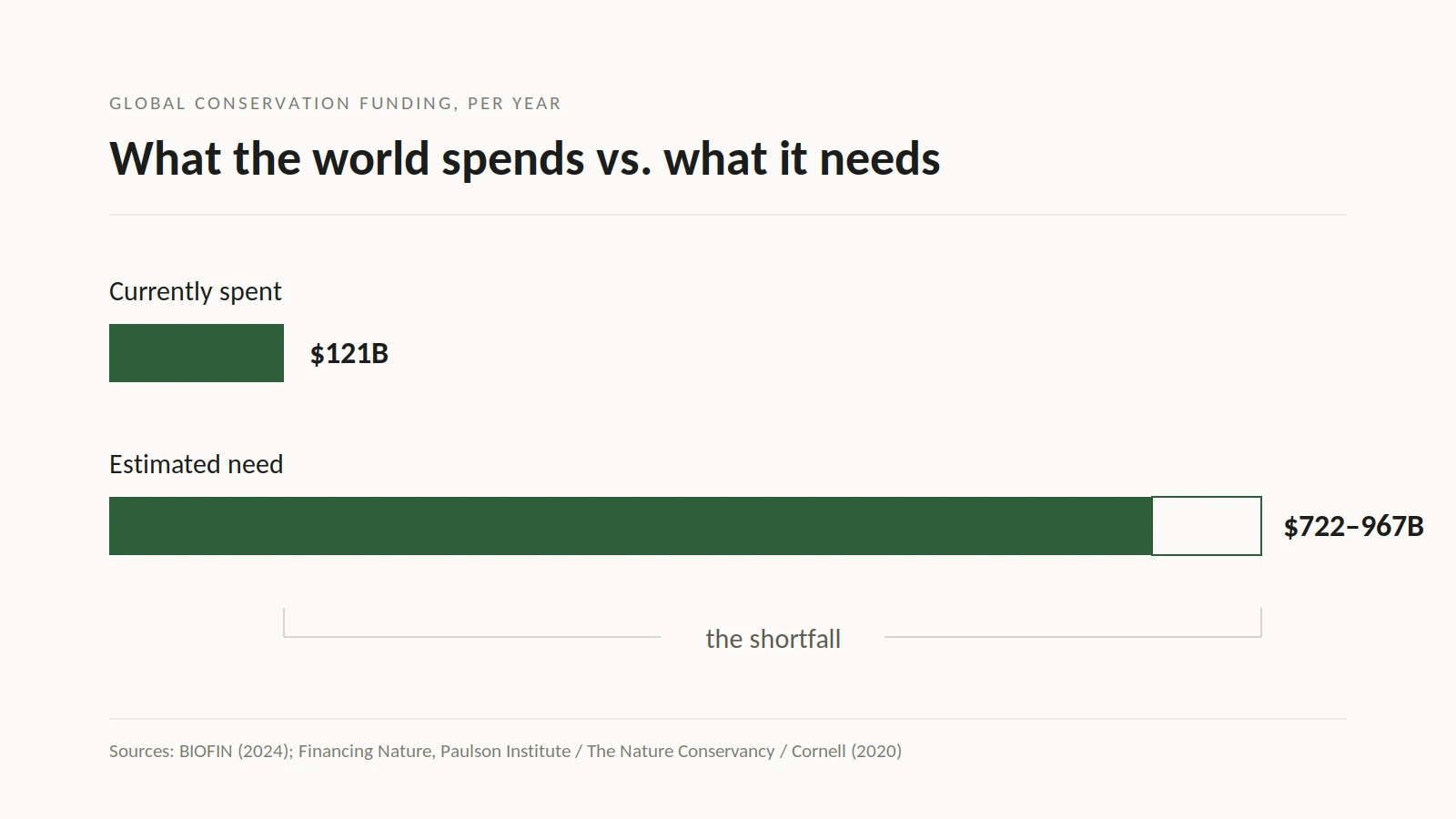
The most cited estimate comes from the 2020 Financing Nature report by the Paulson Institute, The Nature Conservancy and Cornell. It found the world spent somewhere between 124 and 143 billion dollars a year on activities benefiting nature as of 2019, against an estimated need of 722 to 967 billion. That leaves a gap averaging around 711 billion dollars annually. More recent work puts current global spending near 121 billion, with the gap holding in that same range, and roughly 80 percent of biodiversity funding still coming from public budgets rather than private giving. Under the Kunming-Montreal framework, governments have committed to mobilising at least 200 billion a year by 2030.
Now the caveat, because these numbers get thrown around carelessly. Critics argue the gap framing equates money with success and glosses over how much conservation spending has produced ambiguous or even harmful outcomes. That is a fair hit. A funding gap is a real constraint, but it is not the case that money alone fixes this, and anyone telling you otherwise is selling something.
The practical takeaway for a person deciding where to send fifty dollars is smaller and more useful than the headline figure: private donations are a genuinely small slice of conservation funding, which means where you send yours matters more than how much it is.
A short checklist before you give
Nothing here requires an accounting degree.
Look at what they publish about results, not just activity. "We planted 40,000 trees" is activity. "Survival rate at 24 months was 61 percent, here is what we changed after year one" is results. Organisations that measure honestly tend to say awkward things in public.
Check whether they name their partners and locations. Vagueness about where the work happens is a reasonable warning sign.
Read one annual report, badly. You do not need to understand all of it. Skim for whether they discuss anything that went wrong. A report with no failures in it is a brochure.
For US charities, the Form 990 is public. Candid and Charity Navigator both surface them. Look at trends over a few years rather than a single number.
Be careful with "adopt an animal" programs. Most are general fundraising with a certificate attached, which is fine as long as you know that is what it is. You are not funding that specific animal.
Prefer organisations working with local communities rather than around them. Conservation that treats the people who live somewhere as an obstacle has a long and unhappy track record.
Why we built Weila around this
Weila is a study app, so this is the part where it is fair to ask what we are doing in this conversation at all.
The honest version is that both of us have cared about wildlife for as long as we can remember, and when we started building something we wanted it to carry actual weight rather than just work well. There is a lot of good conservation writing out there and it mostly reaches people who already went looking for it. A study app reaches students who came for something else entirely, and that felt like the more interesting problem: getting the subject in front of people who would otherwise never really encounter it.
That became the WERC program, which stands for Weila's Education, Rehabilitation and Conservation. The idea is straightforward. Studying in Weila earns contribution points. Each month we select a vetted conservation campaign and set a community donation goal, and the whole community works toward it together. Points carry a fixed dollar translation on our side, so the total is a real number rather than a symbolic one, though we do not publish the rate itself.
Two things we want to be clear about, since this whole post is about being able to check claims.
Nothing has been donated yet. We have not launched, we do not currently have a conservation partner, and no money has moved. All of it begins after launch. We would rather say that plainly here than let a nicely worded mission page imply otherwise.
We are the donor of record. Contribution points hold no cash value and are not a personal tax deductible donation for you. Weila makes the donation and reports it.
The eight ambassador species in the app were chosen with the same thinking. We picked them to span genuinely different kinds of threat, habitat loss, wildlife trade, disease, hunting pressure, across different continents and taxa, rather than picking eight charismatic mammals. Also, honestly, because they are fun to spend time with. A student who finishes a semester knowing what is happening to the arroyo toad is a small win regardless of the money.
You can read more about how the program is structured on the WERC page and the donation page.
Common questions
Is a low overhead ratio a good sign?
Not particularly. The major charity watchdogs formally rejected it as a performance measure in 2013, partly because the accounting is subjective and partly because underinvesting in staff and systems makes organisations worse at their actual work.
Should I give to a big conservation charity or a small one?
Both work. Large organisations have reach, policy influence and stability. Small local ones often have lower costs per outcome and deeper relationships where the work happens. The size is less important than whether they publish honest results.
Is it better to donate monthly or in one lump sum?
Monthly, generally. Predictable income lets an organisation plan multi-year work and hire properly, which is difficult on lumpy December-heavy giving.
Does my small donation actually matter?
More than the headline numbers suggest. Private giving is a small share of total conservation funding, so it tends to flow to the specific, unglamorous projects that public budgets skip. Small amounts land in places large amounts do not.
How do I know a conservation charity is not a scam?
Check that it is registered, that its financials are public, that it names specific locations and partners, and that it publishes something about outcomes rather than only appeals. Anything that resists all four is worth walking away from.
The short version
- The overhead ratio is a bad metric and the people who popularised it have said so since 2013.
- Unrestricted giving is usually more useful than earmarked giving, if you trust the organisation.
- The global funding shortfall is real, but money alone is not the fix, and anyone claiming otherwise is overselling.
- Judge organisations on published results, transparency about failures, and how they work with local communities.
Weila is a study app where focused study time earns contribution points that will fund vetted conservation work. Read how the WERC program is structured.