How to Make a Study Schedule You'll Actually Follow
Your plan fails in week one because you estimate time like an optimist. The research is brutal about this, and the fix is to plan from your track record instead of your imagination.
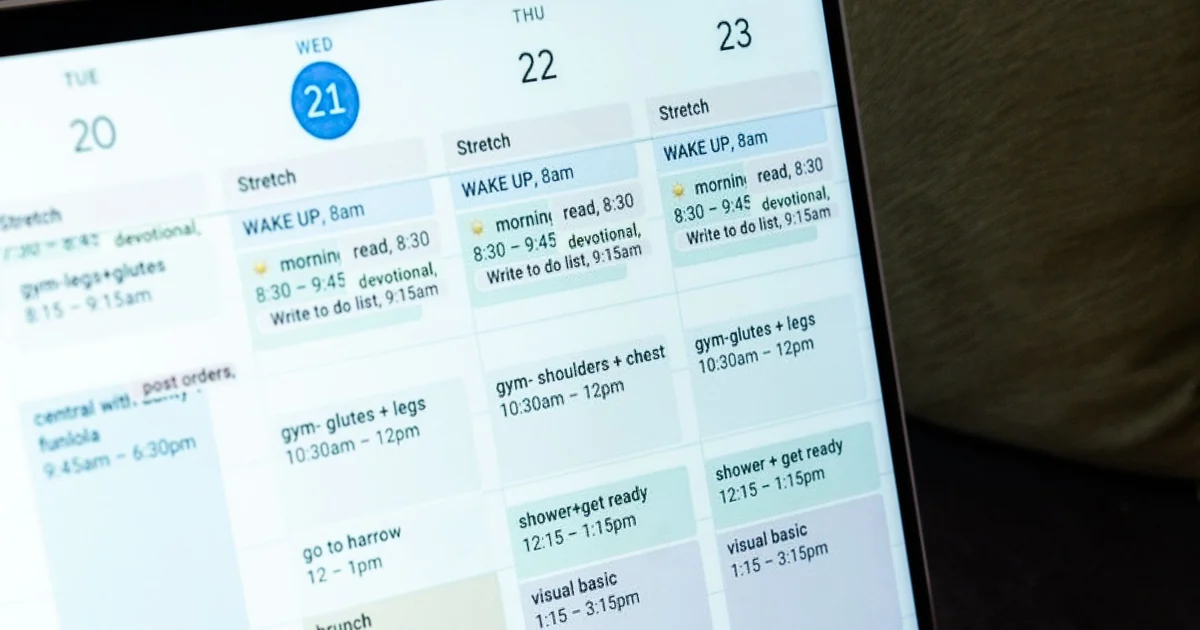
Build it from how long things actually took you last time, not how long you imagine they will take. Study plans collapse in the first week because people are systematically, predictably bad at estimating their own timelines, and a schedule built on bad estimates is already broken when you write it. Plan fewer blocks than feel impressive, protect them, and leave room for the week going wrong.
The study that should make you nervous
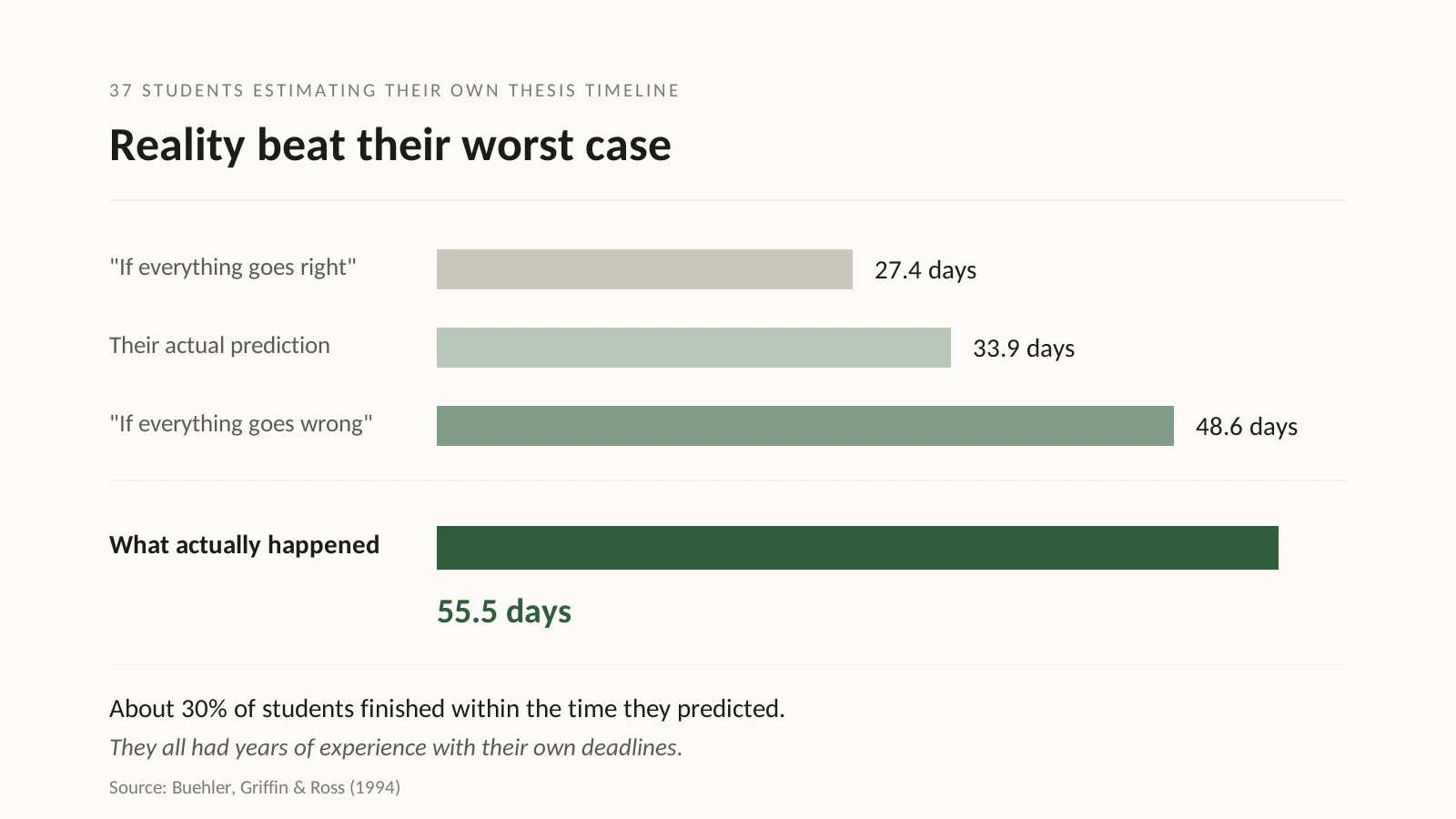
In 1994, Roger Buehler, Dale Griffin and Michael Ross asked 37 psychology students to estimate how long their senior theses would take to finish.
The average prediction was 33.9 days.
They also asked for a best case, if absolutely everything went right: 27.4 days on average. And a worst case, if everything went as badly as it possibly could: 48.6 days.
The actual average completion time was 55.5 days.
Read that again. The real outcome was worse than their own worst-case scenario. Only about 30 percent of students finished within the time they had predicted.
This is called the planning fallacy, and the thing that makes it interesting is that it is not ignorance. These students had years of experience with their own deadlines. They knew, in the abstract, that projects run long. They still produced estimates that reality blew straight through.
Why knowing about it does not fix it
The reason the bias is so stubborn is that when you plan, you build a story.
You picture the specific steps: read the chapter, do the problem set, review the notes. The story runs smoothly, because stories do. What the story leaves out is everything that is not part of the plot: the lecture that gets rescheduled, the flu, the friend who needs something, the three days where you simply did not feel like it.
Those things are not predictable individually. They are extremely predictable in aggregate. Something always comes up, and it is never the same something, which is exactly why you never include it.
The alternative is to stop forecasting from the story and start forecasting from the record. How long did the last problem set actually take, from sitting down to finishing? Not how long it should have taken. How long it did.
That number is almost always larger than your instinct, and it is almost always closer to the truth.
Build the schedule in five steps
1. Pull your real numbers first. Before you plan anything, write down how long the last three comparable tasks actually took. A reading, a problem set, a practice essay. If you have no record, time the next one before scheduling around it.
2. Plan at about 70 percent of your available time. Whatever you think you can fit in a week, schedule roughly two thirds of it. The remaining third is not slack you are wasting. It is the space the week will take whether you offer it or not.
3. Schedule blocks, not subjects. "Tuesday 7pm, library second floor, chapter 12 practice problems" is a plan. "Study econ this week" is a wish. The specific time and place matter because they remove the decision at the moment you are least able to make one. The research behind that is in how to get back into studying after burnout or a long break.
4. Put the hardest thing where your energy is. Not first thing by default. At whatever time of day you are actually sharp, which is a question with a real answer: see is it better to study at night or in the morning.
5. Build in one catch-up block a week and expect to use it. Not a bonus session. A scheduled gap whose purpose is to absorb the thing that went wrong. If nothing went wrong, you get the evening back.
What makes a schedule survive contact
Fewer commitments, properly protected. Three blocks you actually do beats seven you planned. An over-full schedule fails on day two and then you abandon the whole thing, which is a much worse outcome than a modest plan that holds.
Write what you will do, not how long you will sit. "45 minutes of econ" ends when the timer does, regardless of whether anything happened. "Questions 1 to 8" has a finish line you can actually reach.
Review it weekly, not daily. Fifteen minutes on a Sunday to see what actually happened and adjust next week. Daily re-planning is usually procrastination wearing a productivity costume.
Treat a missed block as information. If Thursday evening fails three weeks running, Thursday evening is not a study slot. Move it rather than feeling bad about it again.
Never build a plan that requires a perfect week. You will not get one. Nobody does. A schedule that only works if everything goes right is a schedule that has already failed.
How Weila handles this
Six session structures. Each one has a defined shape and length, so a block is a thing you start and finish rather than an open-ended commitment to "study." It is easier to schedule a 50 minute block than a vague evening.
Consistency with your own rhythm counts. Studying near your usual time and your usual session length earns credit in your focus score. That rewards the regular-times habit that actually holds a schedule together, and it does not care whether your usual is 9am or 11pm.
Sessions roll into overtime rather than cutting you off. If you are mid-thought when the clock runs out, you keep going. A scheduling tool that interrupts good work trains you to stop trusting it.
Nothing nags you about a missed block. There are no absence notifications and no guilt emails. A plan you abandoned is already discouraging enough without an app piling on, and the app that nags you is the app you delete.
Common questions
Why can I never stick to a study schedule?
Most commonly because the schedule was built on optimistic time estimates and had no room for the week going wrong. Research on the planning fallacy has found people routinely finish well past their own predictions, even their worst-case ones.
How far in advance should I plan my studying?
A week at a time, reviewed weekly. Longer horizons get invalidated by reality, and daily planning tends to become a substitute for working.
How much time should I leave unscheduled?
Roughly a third. Something will come up, and a plan with no slack breaks on first contact rather than absorbing it.
Should I schedule by time or by task?
By task, inside a time block. A finish line you can reach beats a timer that runs out while you are still in the middle of something.
Is it bad to miss a planned study session?
No, and treating it as a catastrophe is how people abandon whole schedules over one bad evening. Use the catch-up block, and if a slot keeps failing, move it.
The short version
- Students predicting their own thesis timelines averaged 33.9 days. The real average was 55.5, worse than their own worst-case estimate.
- Knowing about the bias does not remove it, because you plan from a story rather than a track record.
- Estimate from how long comparable tasks actually took you, then schedule about 70 percent of your available time.
- Plan specific blocks with a time, a place and a finish line, not vague intentions to study a subject.
- Build in a weekly catch-up block and expect to need it.
Weila is a study app with six session structures, spaced repetition, and contribution points that fund vetted conservation work. See how it works.