Is It Better to Study at Night or in the Morning?
Neither, universally. Your best time depends on your chronotype, which runs latest around age 20. And some kinds of thinking actually go better at your worst time of day.
Neither, as a rule. The best time to study is when your own body clock is at its peak, and for most university students that is later than the morning people insist on. Your chronotype shifts later through your teens and is latest around age 20, so the night owl thing is partly biology, not laziness. And there is a twist: some kinds of thinking actually go better at your worst time of day.
Morning people are not more disciplined, they are just early
The advice to study at 6am comes almost entirely from people who wake up at 6am easily. That is not a strategy, it is a chronotype.
A chronotype is your body clock's natural timing: when you get sleepy, when you wake without an alarm, and when you are sharpest. It is substantially biological. Chronobiologist Till Roenneberg, who has collected sleep timing data from hundreds of thousands of people, has argued for years that early birds and night owls are largely born rather than made, and that labelling late sleepers as lazy gets the cause backwards.
His data also shows something every student should know. Chronotype drifts later through adolescence and hits its latest point around age 20, after which it slowly moves earlier again for the rest of your life. Roenneberg has even proposed that this turning point works as a biological marker for the end of adolescence.
So if you are 19 and your brain comes alive at 10pm, you are not broken. You are exactly on schedule.
What the research says about timing and performance
The core idea is called the synchrony effect. Performance on many mental tasks tends to be better at your optimal time of day than at your off-peak time, particularly on things that need focus and the ability to ignore distraction. Researchers including Lynn Hasher and Cynthia May have spent decades on this, and it is one of the more consistent findings in the field.
Two important caveats, because this topic gets oversold.
First, it matters most for people with a strong lean one way. A 2023 review by May, Hasher and Karl Healey noted that for younger university-aged people without a strong morning or evening preference, time of day made little difference to performance on several measures. If you do not feel strongly like a morning or night person, you have more flexibility than you think.
Second, it depends on the kind of thinking.
The twist: your worst time is good for some things
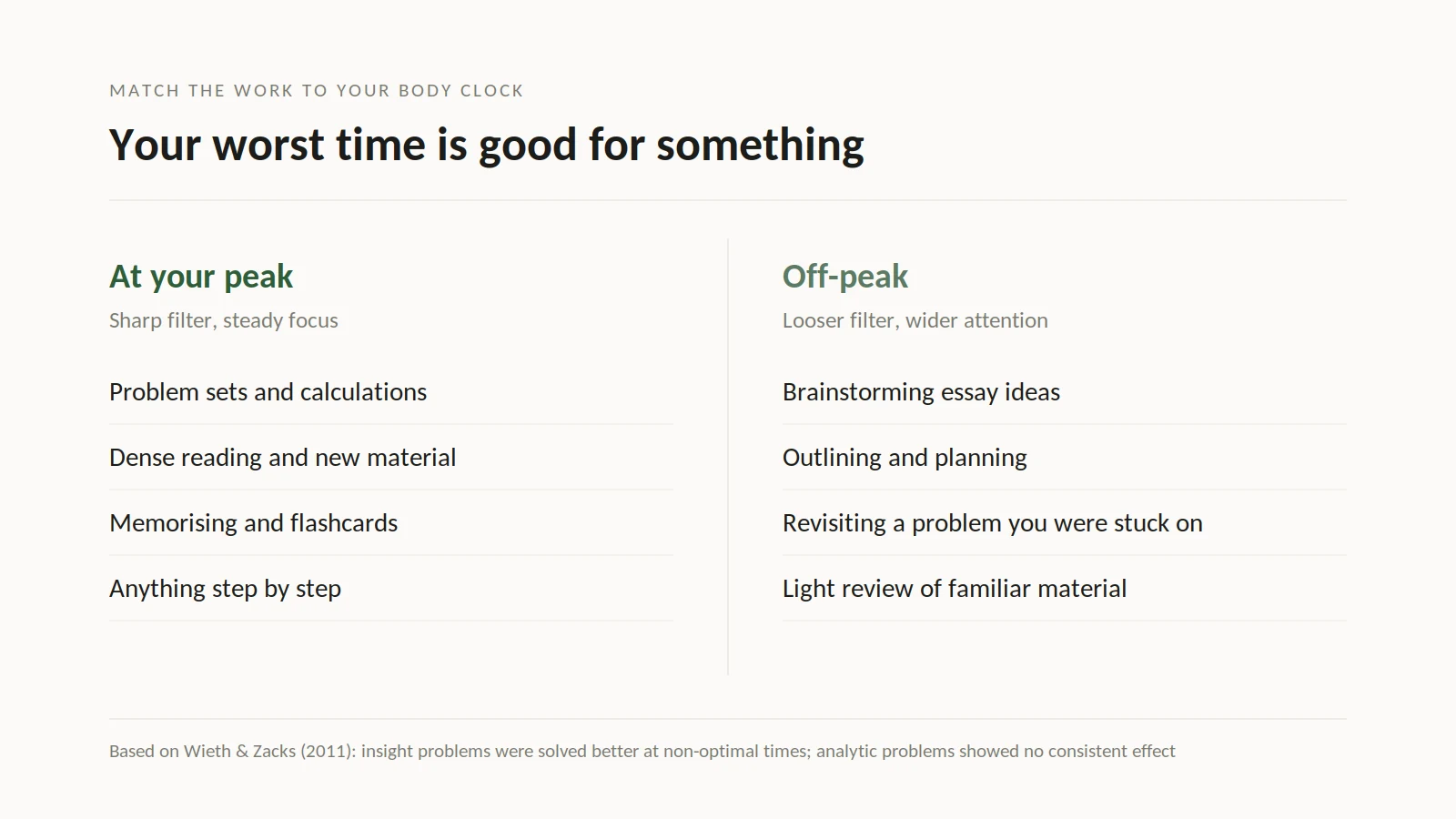
In 2011, Mareike Wieth and Rose Zacks gave participants two kinds of problems at either their optimal or non-optimal time of day. Analytic problems, the kind you grind through step by step, showed no consistent time-of-day effect. But insight problems, the kind where you need to see the problem differently and the answer arrives all at once, were solved better at people's non-optimal time.
The explanation is attention. At your peak you are good at filtering out irrelevant thoughts, which is exactly what you want for methodical work. At your off-peak time that filter loosens, your attention widens, and ideas that would normally be suppressed get through. For a stuck problem that needs a new angle, that looseness helps.
The practical version is genuinely useful: do your focused, methodical work when you are sharp, and save the stuck problems, the essay brainstorm, and the "I have no idea how to approach this" questions for when you are a little tired.
The real problem is the 8am class
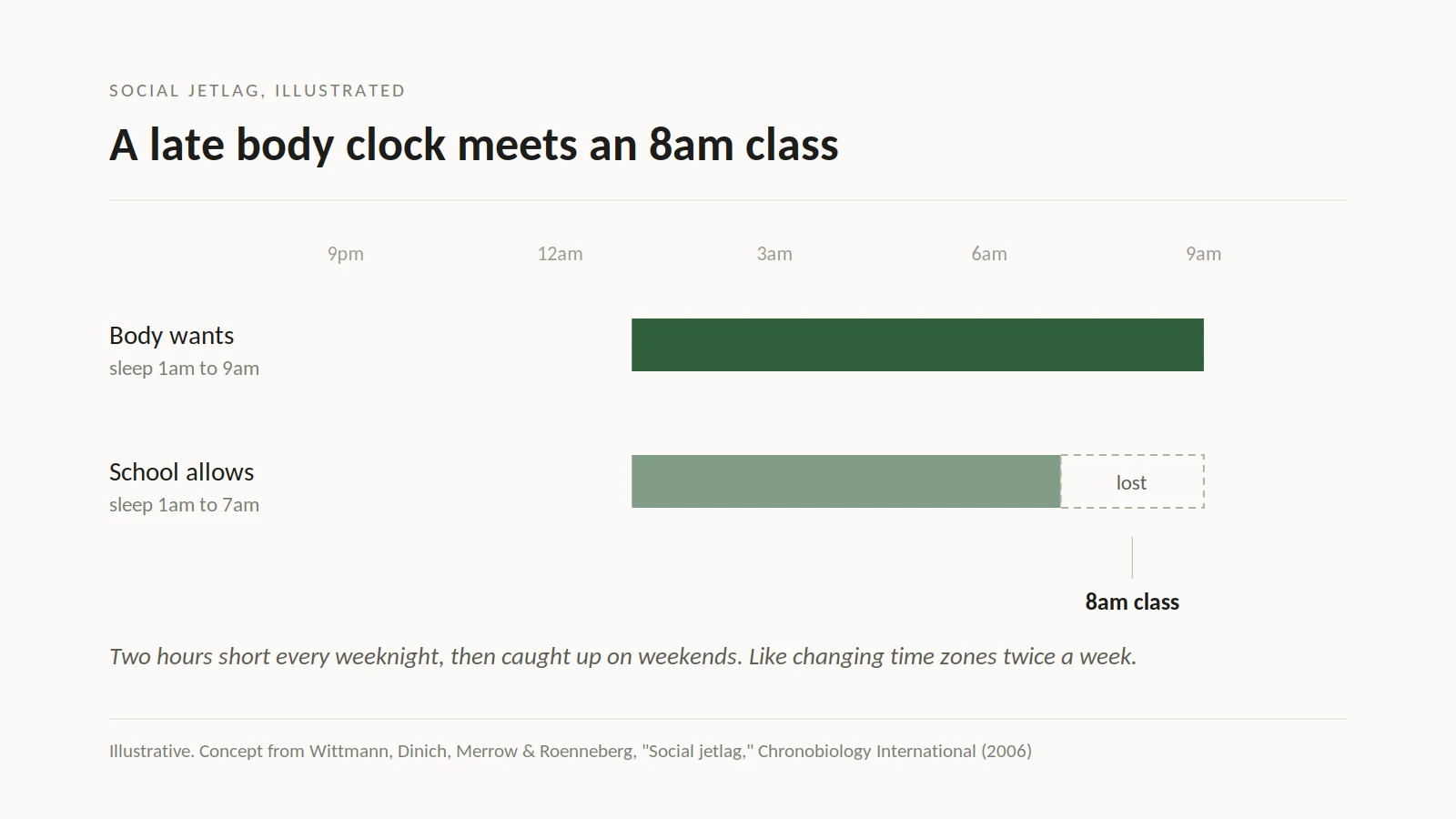
Most students are not choosing between morning and night freely. They are fitting a late body clock around an early schedule, and that mismatch has a name: social jetlag, the gap between when your body wants to sleep and when your obligations let it.
The result is chronic mild sleep loss during the week and long lie-ins on the weekend, which is basically flying across a few time zones every Friday and back every Monday. It hurts memory, mood and focus, and it makes any study timing worse.
You cannot move the 8am class. But you can stop stacking your hardest studying into the hours right after it, when a late chronotype is at its lowest.
How to find your best study time
Look at what you do on a free week. When do you naturally fall asleep and wake without an alarm? The midpoint of that sleep is a decent rough guide to your chronotype. Late midpoint, late peak.
Put the hard focused work at your peak. Problem sets, dense reading, anything analytic. This is where timing pays off most.
Put the creative and stuck work off-peak. Outlining, brainstorming, revisiting a problem you could not crack earlier.
Stay consistent once you find it. Studying at roughly the same time each day turns it into a habit and removes a daily decision. Consistency matters more than which hour you pick.
Do not trade sleep for timing. A night owl who studies at midnight and then sleeps six hours before an 8am class has gained nothing. Sleep is when the studying turns into memory.
How Weila handles this
Weila does not tell you when to study. It learns when you do.
Consistency with your own rhythm counts. Once Weila has a few sessions to go on, your focus score gives credit for studying close to your usual time and for sessions close to your usual length. It does not care whether your usual is 8am or 11pm. The point is keeping to your own rhythm, not someone else's.
Session shapes for different times of day. Six built-in structures, from a 15 minute Quick Burn for low-energy off-peak windows up to 90 minute Ultradian blocks for deep work when you are at your sharpest.
Coaching compared against you, not everyone. Session feedback compares each session to your own recent average rather than a global standard, so a night owl is not being measured against a 6am routine.
If your study time keeps slipping entirely, how to get back into studying after burnout or a long break covers restarting.
Common questions
Is it bad to study late at night?
Not if that is when you are sharpest and you still get enough sleep. The problem is not the hour, it is cutting sleep short because of an early start the next day.
Why do I focus better at night?
Most likely your chronotype. Body clocks drift later through the teens and are latest around age 20, so many university students are genuinely more alert in the evening than the morning.
Is it better to study right after waking up?
Only if you are a morning type. For evening types, the hour after waking is often the least alert part of the day. Most people need some time after waking before they are at their sharpest.
Can I change my chronotype?
Somewhat. Consistent sleep times and morning light exposure can shift it modestly, but the underlying tendency is largely biological and it naturally moves earlier as you get older anyway.
When is the best time to memorize things?
At your peak for focused learning, followed by sleep. Studying in the evening and sleeping soon after gives the material a full night of consolidation.
The short version
- There is no universal best time. It depends on your chronotype.
- Body clocks run latest around age 20, so late-leaning students are normal, not lazy.
- Focused analytic work goes best at your peak. Insight problems can go better off-peak.
- If you do not lean strongly either way, timing matters less than you think.
- Consistency and sleep matter more than which hour you choose.
Weila is a study app that scores sessions on quality and consistency, with contribution points that fund vetted conservation work. See how it works.