Should You Study One Subject at a Time or Switch Between Them?
Mixing problem types beats doing them in blocks, by a lot. Here is the classroom study that showed it, why blocked practice feels better anyway, and when not to mix.

Switch between them. Doing twenty problems of one type in a row feels productive and performs badly on a test, because blocked practice lets you skip the one step the exam actually tests: working out which kind of problem you are looking at. Mixing types is harder during practice and substantially better afterwards.
The study that makes the case
In 2019, Doug Rohrer and colleagues ran this in real classrooms rather than a lab. They worked with 54 seventh-grade maths classes across five schools, taught by 15 different teachers, and analysed 787 students.
Every student got the same problems and the same total amount of practice over about three months. The only difference was arrangement. One group did their practice blocked, all the problems of one type together. The other group got the same problems interleaved, mixed in with other types.
About a month later, students sat an unannounced test.
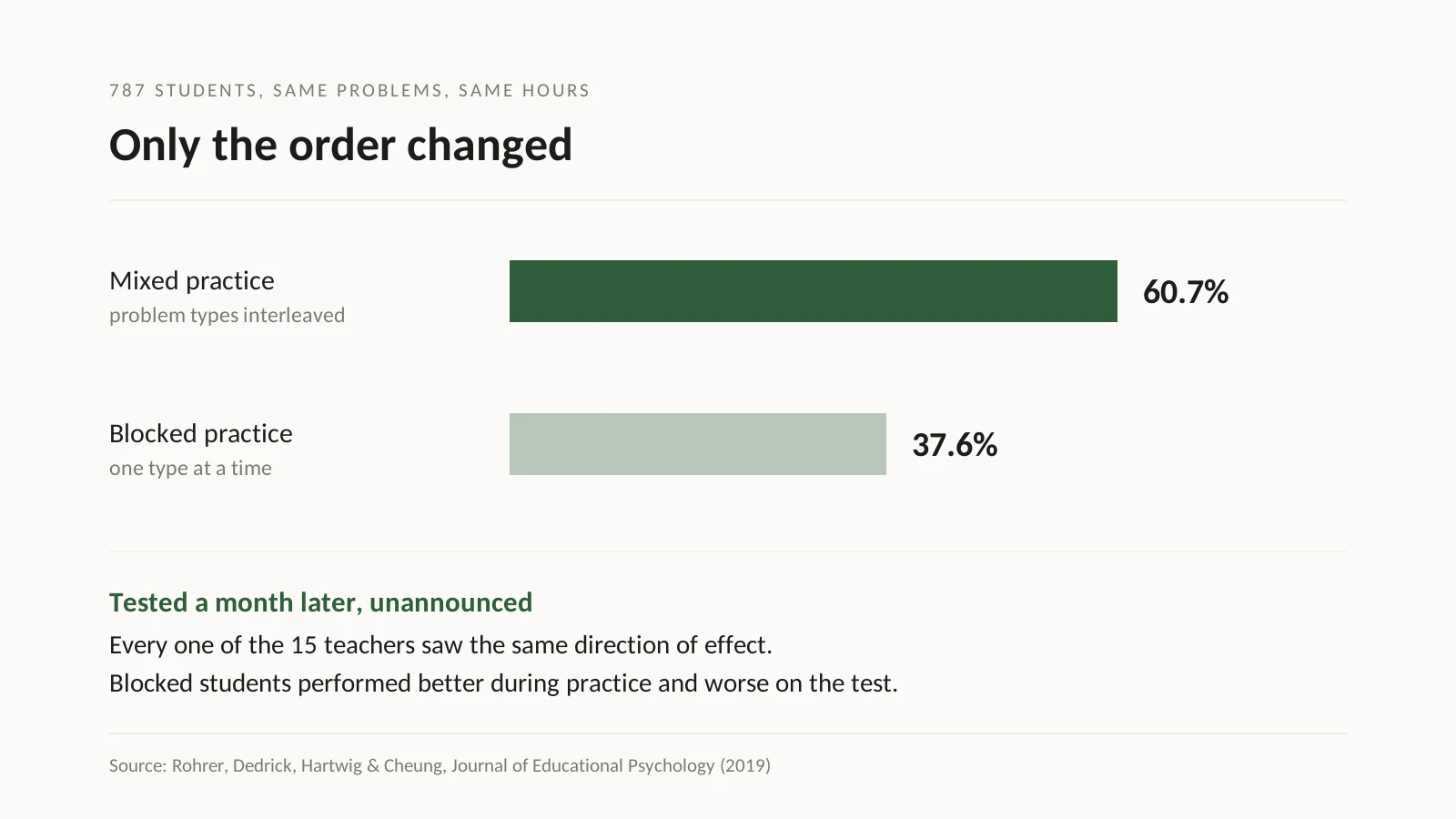
The interleaved group averaged 60.7 percent. The blocked group averaged 37.6 percent.
That gap is enormous for an education study, and it held up across every single one of the 15 teachers. Same material, same hours, same students. Only the order changed.
Why blocked practice fails
When you do twenty quadratics in a row, you only have to work out how to solve a quadratic once. After the first problem, every subsequent one is pure execution. You are practising the arithmetic and skipping the diagnosis.
Then the exam arrives with problems in no particular order, and the first thing you have to do on every question is decide what kind of question it is. That is a skill, it is the one you have been systematically avoiding, and it is often the hardest part.
Interleaving forces that decision on every single problem. It is slower and more frustrating, and it is the only arrangement that practises the thing the test is actually measuring.
This matters most when problem types look similar. Linear equations and slope problems, integration by parts versus substitution, chemical reaction types, verb conjugations that follow different rules. If telling them apart is the hard bit, blocking removes exactly the right practice.
Why it feels wrong
Here is the uncomfortable part. During practice, blocked students perform better. They get more right, they get faster, and the session feels like it is working.
Across the research on interleaving, learners consistently believe blocking is the better method. In one study using paintings, around 80 percent of participants said blocked practice was better for their learning even after they had done both and interleaving had produced the better result. They experienced the evidence and still trusted the feeling.
This is the same trap as rereading. Ease during study is a terrible predictor of what you will remember, and the methods that feel smoothest are usually the ones leaving the least behind. More on that in why do I feel like I studied for hours but remember nothing.
When not to interleave
Interleaving is not a universal rule and the research is reasonably clear about the edges.
Not while you are first learning something. If you have never solved this type of problem, you need a few in a row to get the method into your hands. Block the introduction, then interleave the practice. Roughly: three or four to learn the move, then mix it in.
Not if the categories are wildly different. The benefit comes from having to discriminate between things that could be confused. Mixing French vocabulary with organic chemistry is just task switching, and you pay the switching cost for no discrimination benefit.
Not if it collapses into confusion. Research on interleaving has found the benefit shrinks when material is too difficult. If mixing leaves you unable to make progress at all, go back and block until the individual pieces are solid.
The sweet spot is related but confusable material at a difficulty you can mostly handle.
How to actually do it
Mix problem types within one subject. This is where the biggest gains are. Build practice sets that pull from several topics in the chapter rather than working through them in order.
Use the end-of-chapter problems out of order. Textbook sections are blocked by design, since all the problems after section 4.2 are 4.2 problems. Shuffle them, or pull from several chapters at once.
Rotate subjects within a study session. Two hours split across three subjects beats two hours on one, as long as the blocks are long enough to actually get into each one.
Always start by naming the problem type. Before solving anything, say out loud or write down what kind of question it is and why. That is the step you are training.
Expect to feel worse at it. More mistakes, slower progress, more frustration. That is the method working, not failing.
How Weila handles this
Interleaving is built into how recall works in Weila rather than being something you have to organise yourself.
The daily recall drill pulls across topics. It draws questions from your whole card pool rather than drilling one subject, so you get the discrimination practice without having to shuffle anything.
Spaced repetition interleaves by nature. Cards resurface when you are about to forget them, which means what comes up next is determined by timing rather than topic. You end up mixing by default.
Decks and quizzes you build from your own material. Make them from across a chapter or across subjects, then let the system handle the order.
Session structures for mixed work. Six presets, including longer blocks like 50/10 and 90/20 that give you enough room to rotate through several topics in one sitting.
Common questions
Is it better to study one subject at a time?
For a first introduction, yes, briefly. For practice and revision, no. Mixing problem types produced substantially better test results in classroom research, even though blocked practice feels more effective while you are doing it.
What is interleaving in studying?
Mixing different problem types or topics within a practice session instead of doing them in blocks. It forces you to identify what kind of problem you are facing, which is the step blocked practice skips.
Does interleaving work for subjects other than maths?
Yes. It has been demonstrated with categories like paintings and artists' styles, and it applies anywhere telling similar things apart is part of the skill. Anatomy, vocabulary, chemical reactions, case types.
How many subjects should I mix in one session?
Two or three. Enough to force discrimination, not so many that you never settle into anything.
Why does interleaving feel harder?
Because it is. You lose the momentum of repeating one method, and you make more mistakes. That extra effort is what produces the retention, which is why performance during practice is a poor guide to learning.
The short version
- In a classroom study of 787 students, interleaved practice beat blocked practice 60.7 percent to 37.6 percent a month later.
- Blocked practice lets you skip identifying the problem type, which is what exams test.
- Around 80 percent of learners still think blocking works better, even after seeing otherwise.
- Block briefly when learning something new, then mix.
- Mix related, confusable material. Mixing unrelated subjects is just task switching.
Weila is a study app with spaced repetition, daily recall, and contribution points that fund vetted conservation work. See how it works.