Study Apps That Donate to Charity (And How the Money Actually Works)
A handful of study and focus apps turn your work into real donations, but they fund it in very different ways. Here is who actually pays in each one, and how to tell if it's real.
A few apps turn study time into real-world giving: Weila funds conservation donations, Forest and Flora fund tree planting, and Freerice turns trivia answers into food aid. The important difference is not what they give to, it is who actually pays. In one of these you pay extra for the donation to happen. In others the company funds it out of its own revenue. That distinction is worth understanding before you pick one.
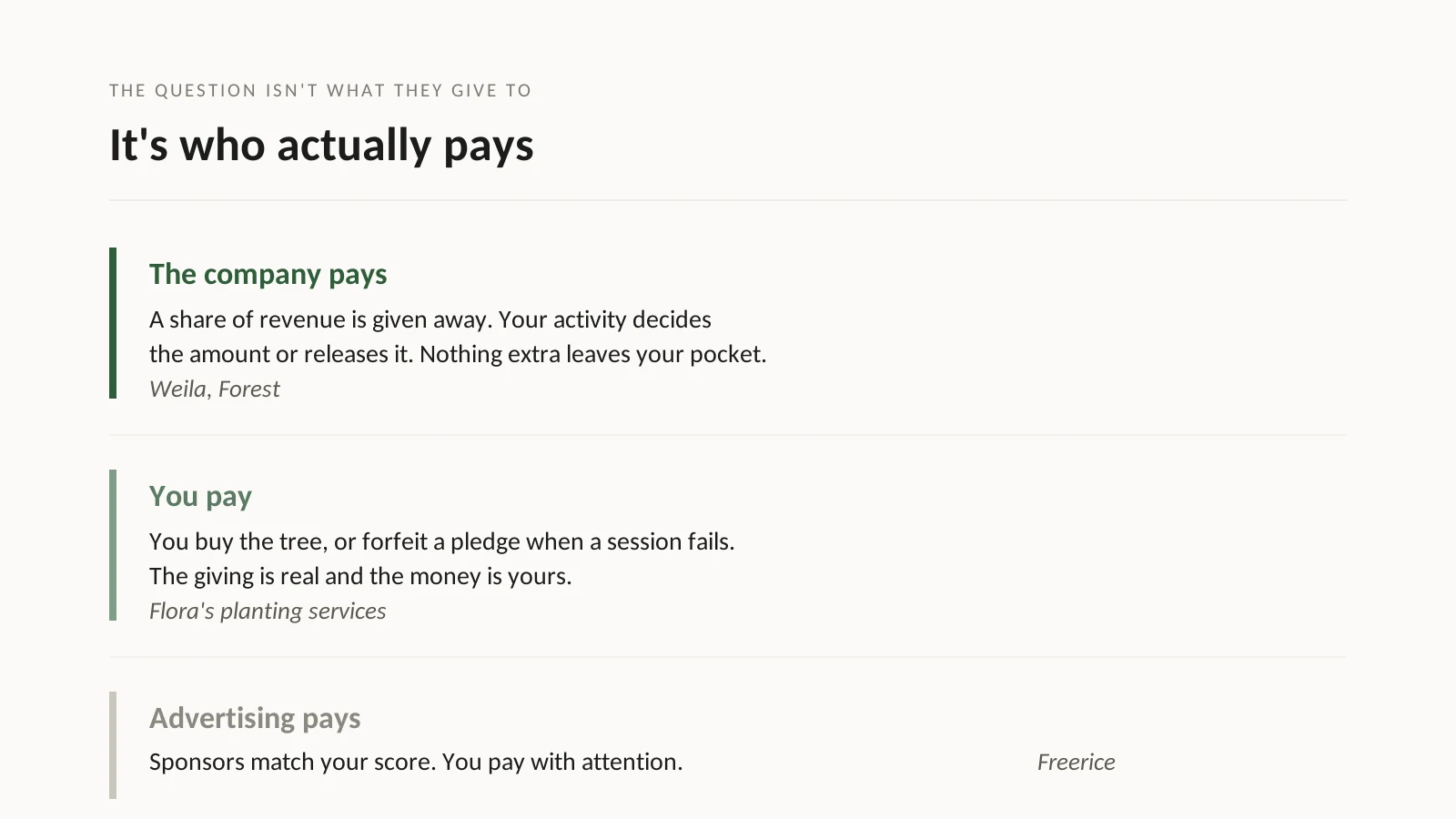
The three funding models
Almost every app in this category uses one of three structures, and they are not equivalent.
The company funds it from revenue. The app makes money from subscriptions and gives a portion away. Your activity determines the amount or triggers the release, but no extra money leaves your pocket. The company is the donor.
You fund it directly. The app gives you a way to pay for a tree, or takes a pledge you forfeit if you fail a session. The donation is real, and it is your money rather than theirs.
Advertising funds it. You play, the page serves ads or a sponsor matches your score, and that revenue becomes the donation. You pay with attention instead of money.
None of these is dishonest, but they are very different products. An app where you fund the giving is closer to a donation platform with a timer attached. An app where the company funds it is a business choosing to give away margin.
Weila
Weila is a study app, not a focus timer, and the giving is built into the core loop rather than bolted on as an extra.
How the donation works. Studying in Weila earns contribution points. Each month the whole community's total drives toward a donation goal, and Weila funds and makes that donation. It currently goes to the Seneca Park Zoo Society, a registered nonprofit in Rochester, New York that makes conservation grants internationally and runs youth conservation education programmes locally.
Nobody pays extra for the giving. The donation comes out of Weila's revenue, not out of a separate charge to you, and it is not locked behind the paid tier. Studying on the free plan still moves the community total.
The giving scales with the community, not with micro-transactions. Everyone's study time counts toward one monthly goal, so it functions as a shared target rather than a series of individual purchases.
What it does as a study app. Six session structures from 15 up to 90 minute blocks, a focus score that grades the shape of a session rather than its length, spaced repetition and daily active recall for the material itself, and clubs where your studying counts toward something shared. You also grow one of eight real endangered species, chosen to span genuinely different threats rather than eight charismatic mammals.
The fine print, stated plainly. Contribution points hold no cash value. Weila is the donor of record, which means this is not a personal tax deductible contribution for you. If you want a receipt in your own name, you can donate to the Society directly.
Platforms and price. iOS, Android and web. Free tier gives seven study sessions a week. Weila+ is $11.99 a month or $85.99 a year.
Forest
The best known app in this category and the one most people mean when they ask about this.
Forest is a focus timer built around a single mechanic: plant a virtual tree, and if you leave the app before the timer ends, it dies. It launched in 2014 and has over 60 million users.
For real trees, you spend coins earned through focus sessions, and Forest covers the cost through its arrangement with Trees for the Future, with planting across several countries in Africa. Over two million trees have been funded since 2014, which is a real track record and the one thing in this category nobody else can match yet.
Two things worth knowing. Public descriptions indicate the real-tree redemption sits in the paid tier rather than the free one, and that redemptions per account are capped. And Forest is a screen-time tool rather than a study app, so it does the timer and the app blocking and stops there. If what you want is help with studying itself, that gap matters. There is a fuller breakdown in Weila vs Forest.
As of late 2026, Forest is free to download with a Forest Plus subscription at $39.99 a year.
Flora
Flora is the other well-known tree-planting focus app, with a similar core mechanic and a to-do list and habit tracker attached.
Its giving model is the one that differs most from the rest of this list. Flora's real tree planting runs through optional paid services. One of them works as a pledge: you commit money before a session and are charged if you break the commitment, with that money going toward planting. Named planting organisations include Trees for the Future and Eden Reforestation Projects.
This is a legitimate model and some people genuinely like the stakes. Just be clear about what it is. Your money funds the trees, and in one version you are specifically paying for having failed. That is a different proposition from an app that gives away a slice of its own revenue regardless of how your session goes.
Freerice
Worth including because people searching this category often land on it, though it is a different shape entirely.
Freerice is a trivia game owned by the UN World Food Programme. Correct answers raise grains of rice, which is a metaphor for money: sponsors match your score and that becomes a financial contribution to WFP, with the site stating that all of it goes to the programme and Freerice keeps none.
It is not a study app. There is no timer, no session tracking and no spaced repetition. It is vocabulary and trivia practice that funds food aid, and for ten idle minutes it is a genuinely good thing to exist.
How to tell whether any of this is real
The category attracts vague claims, so a few things are worth checking before you believe one.
Is the recipient named? A specific registered organisation you can look up is a very different claim from "we support conservation."
Who is the donor of record? If the company makes the donation, you do not get a tax receipt and should not be told you will. If you are the donor, you should be.
Is there a number, and is it dated? Total trees planted, total donated, a monthly figure. Vagueness here is the most common warning sign.
Is the giving gated? Some apps put the real-world giving behind the paid tier. Not wrong, but you should know before subscribing for that reason.
Can you verify the recipient independently? For US nonprofits the Form 990 is public, and Candid and Charity Navigator both surface them. More on evaluating this in where does your money actually go when you donate to conservation.
Which one should you pick
Weila if studying is the actual problem and you want the giving to come out of the company's revenue rather than your pocket. It is the only one here that does session structures, focus scoring and spaced repetition alongside the donation model.
Forest if your phone is the problem, you want app blocking, and a long track record of trees in the ground matters more to you than study features.
Flora if you like the idea of money on the line as a commitment device and are comfortable funding the trees yourself.
Freerice if you want something free, casual, and completely separate from your actual coursework.
Common questions
Are there study apps that donate to charity?
Yes. Weila funds conservation donations from its revenue based on community study activity, Forest and Flora both fund tree planting, and Freerice turns trivia answers into food aid for the UN World Food Programme.
Do I have to pay for the donation to happen?
It depends on the app. With Weila the donation comes out of company revenue and studying on the free tier still counts. With Flora's planting services your own money funds the trees. Forest covers its tree costs itself, though redemption appears to sit in the paid tier.
Do I get a tax receipt from a study app donation?
Generally no. When the company is the donor of record, the deduction is theirs and not yours. If you want a receipt, donate to the organisation directly instead of or alongside using the app.
Which study app donates the most?
Forest has the longest track record, with over two million trees funded since 2014. Comparing totals across apps is not very meaningful though, since the models, the recipients and the ages of the programmes are all different.
Is a study app that donates actually worth using?
Only if the app is good at the thing you downloaded it for. The giving is a reason to prefer one good app over another good app, not a reason to use a tool that does not help you study.
The short version
- Three funding models exist: the company gives from revenue, you pay directly, or ads cover it.
- Weila funds conservation donations from its own revenue, driven by the community's monthly study total, with no extra charge and no paid-tier gate.
- Forest has the deepest track record in the category at over two million trees since 2014.
- Flora's planting runs through optional paid services, so your money funds the trees.
- Before believing any of it: check that the recipient is named, find out who the donor of record is, and look for a dated number.
Competitor details are drawn from public sources as of November 2026 and may have changed. Weila is not affiliated with, associated with, or endorsed by Forest, Flora, or Freerice. Seneca Park Zoo Society name used with permission; the Society is not affiliated with Weila and does not endorse Weila or its products.