Is It Better to Sleep or Study Before an Exam?
Sleep, in almost every case. It does two separate jobs for memory, one before you study and one after, and skipping it removes both. What the research actually found.
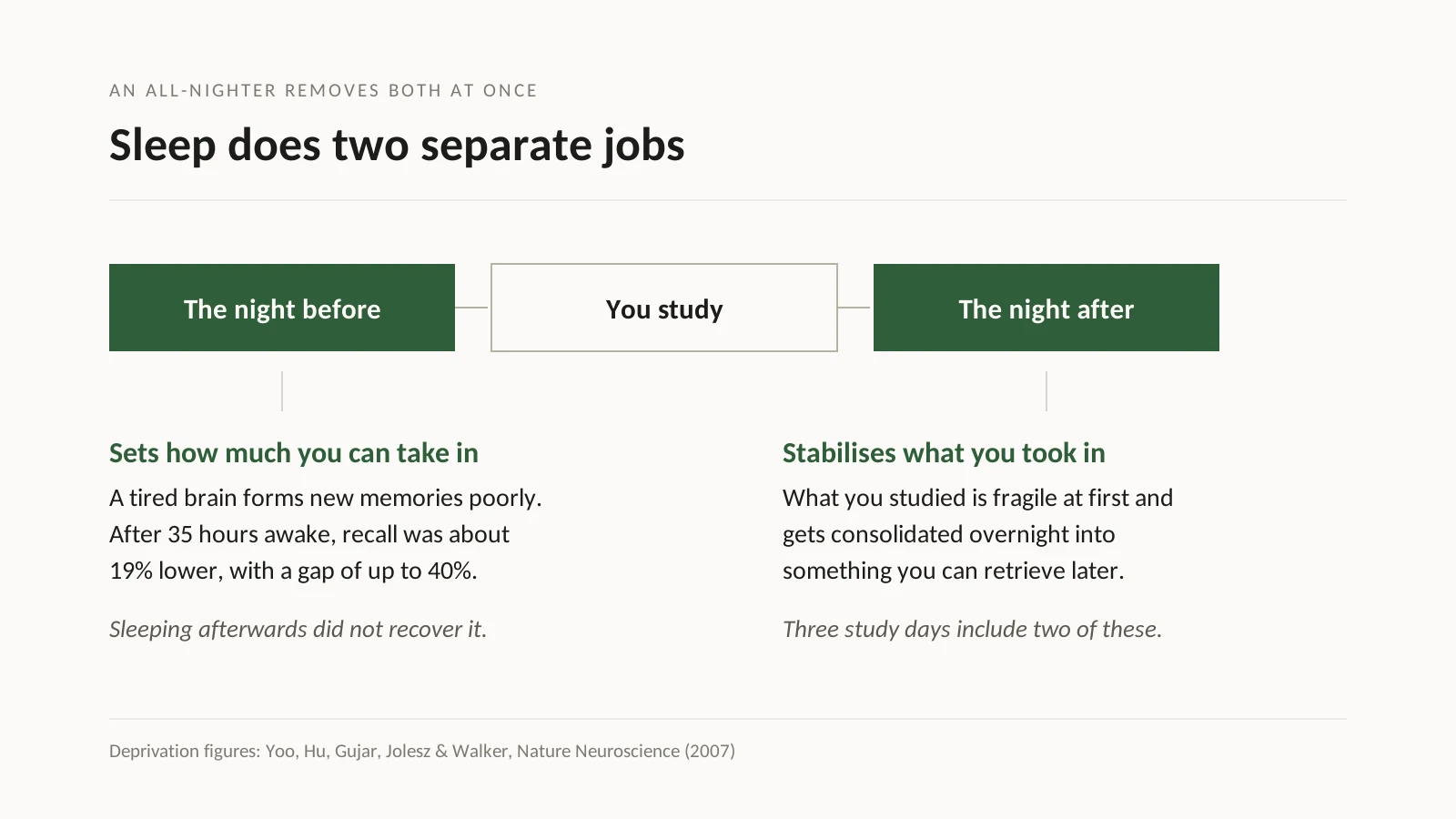
Sleep. Not because sleep is nice, but because it is doing two specific jobs that studying cannot replace. Sleep before learning determines how much you can take in at all, and sleep after learning is when what you studied gets stabilised into memory. An all-nighter removes both and leaves you with hours of input that never became anything retrievable.
Sleep does two different jobs
This is the part almost no one explains, and it is why "get some sleep" sounds like generic advice rather than a mechanism.
Before you learn, sleep sets your capacity to absorb. A tired brain is measurably worse at encoding new information in the first place. Not at paying attention, at forming the memory at all.
After you learn, sleep is when it gets consolidated. The material you took in during the day gets reprocessed and stabilised overnight, which is what moves it from something you just saw to something you can retrieve later.
They are separate functions, and an all-nighter before an exam manages to damage both at once. You study in a degraded state, and then you give that studying no night to settle.
What sleep deprivation does to learning new material
In 2007, Seung-Schik Yoo, Matthew Walker and colleagues ran the study that nailed this down.
Participants stayed awake for 35 hours, then viewed a series of images while in an fMRI scanner, pressing a button throughout to confirm they were still awake. Two days later, after everyone had caught up on sleep, they were tested on what they had seen.
The sleep-deprived group recalled about 19 percent less on average. Against participants who had slept normally before the learning session, the gap reached as much as 40 percent.
The scans showed why. Activity in the hippocampus, the region central to forming new memories, was significantly reduced in the sleep-deprived participants.
Note the detail that matters most: they were tested two days later, after sleeping normally in between. Catching up afterwards did not recover the loss. The information was never properly encoded in the first place, and there was nothing to recover.
So the all-nighter is not a trade of rest for study hours. It is studying with the memory-forming machinery turned partway down.
What sleep does after you study
The other half runs in the opposite direction.
Memory formation does not finish when you close the book. What you studied is initially fragile, and overnight it gets replayed and stabilised into something more durable. This is one of the better-established findings in memory research, and it has an unglamorous implication: the sleep after a study session is part of the study session.
It also explains why spacing works so well. Three study sessions across three days include two nights of consolidation. The same total hours compressed into one evening include none. That is part of why spreading study out beats cramming on anything past tomorrow, which does cramming actually work covers in detail.
If you are going to study in the evening, studying and then sleeping fairly soon after is a reasonable way to use that.
The all-nighter question, directly
Pamela Thacher studied the sleep patterns and transcripts of 111 college students. About two thirds reported pulling at least one all-nighter in a semester, and students who did so regularly had lower GPAs than students who did not.
That is correlational, so it does not prove the all-nighters caused the grades. Students who pull them may differ in other ways. But it points the same direction as the experimental work above, and nothing in the literature suggests the opposite.
The practical version: if it is 1am and you are choosing between four more hours of study and going to bed, the research favours bed. You will encode better tomorrow morning on sleep than you will tonight on none, and whatever you did manage to study today will actually consolidate.
If it is 1am and you genuinely have not opened the material at all, that is a different and worse situation, and the answer is to study the highest-value thing for a short block and then still sleep.
What to actually do in exam week
Protect sleep first and schedule study around it. It is the one input that makes every other hour work better. Treat it as fixed rather than as the flexible part of the budget.
Do not change your sleep schedule in the final week. Moving your bedtime by hours to accommodate an early exam usually produces one bad night rather than an adjusted rhythm. Shift it gradually or leave it alone.
Study in the evening, then sleep on it. Evening study followed by a full night gives the material a complete consolidation window before you need it.
Use a short nap over a long stimulant. If you are flagging mid-afternoon, a short nap is a better use of 25 minutes than a fourth coffee and a worse session.
Be careful with caffeine late. Caffeine has a long half-life, and an afternoon coffee can still be interfering with your sleep that night, which costs you the consolidation you were studying to earn.
If you did pull an all-nighter, sleep before the next thing. The deficit is in encoding, so continuing to study while wrecked produces very little. Sleep, then study.
How Weila handles this
Weila does not track your sleep and is not going to pretend otherwise. What it does is make the study structure around sleep work properly.
Spaced repetition puts nights between your reviews. Material resurfaces across days rather than being hammered in one session, which means every gap between reviews contains a night of consolidation. That is the sleep benefit built into the schedule rather than left to chance.
Sessions are scored on shape, not hours. A long degraded grind does not score better than a short sharp session, so the app is not rewarding the behaviour that comes with sleep deprivation.
Consistency with your own rhythm counts. Studying near your usual time earns credit, and your usual time is whatever actually fits your body clock. There is no built-in assumption that early is virtuous.
Nothing pressures you to keep going late. No streak mechanic that punishes stopping, no nudge telling you to squeeze in one more session. If the right call at midnight is to stop, the app will not argue.
Common questions
Should I pull an all-nighter before an exam?
No, in almost all circumstances. Sleep deprivation significantly impairs your ability to form new memories in the first place, and research has found that catching up on sleep afterwards does not recover what was never properly encoded.
How many hours of sleep should I get before a test?
A normal night for you, whatever that usually is. A sudden change the night before tends to backfire, so consistency beats trying to bank extra hours.
Is it better to sleep 3 hours or stay up?
Sleep. Even a short sleep allows some consolidation and some recovery of encoding capacity, both of which you get none of by staying up.
Does sleeping after studying help you remember?
Yes. Consolidation during sleep is one of the better-established findings in memory research, which is why spreading study across several days, each followed by a night, outperforms the same hours in one sitting.
Can I catch up on sleep after exams?
You can recover from the tiredness, but you cannot recover material you failed to encode while sleep deprived. In the Yoo and Walker study, participants had caught up on sleep before being tested and the deficit was still there.
The short version
- Sleep does two jobs: it sets how much you can absorb before studying, and it consolidates what you studied afterwards.
- After 35 hours awake, participants recalled about 19 percent less, with a gap of up to 40 percent against rested participants.
- They had caught up on sleep before testing, and the loss remained. You cannot backfill it.
- Students who regularly pulled all-nighters had lower GPAs in a study of 111 students.
- At 1am the research favours bed. You will learn more tomorrow rested than tonight wrecked.
Weila is a study app with spaced repetition across days, quality-scored sessions, and contribution points that fund vetted conservation work. See how it works.