Seneca Park Zoo Society: Who They Are and Why We Donate to Them
The nonprofit behind Seneca Park Zoo funds conservation projects on several continents and runs one of the better youth education programs in the region. Here is what they do and where Weila's donations go.
The Seneca Park Zoo Society is the nonprofit that raises money for Seneca Park Zoo in Rochester, New York. It funds conservation projects around the world, runs education programs for local students, and sends its own staff into the field. Weila donates to the Society through the contribution points our community earns by studying.
Who they are
Seneca Park Zoo is owned and operated by Monroe County. The Zoo Society is the separate 501(c)(3) nonprofit that raises money for it, working alongside the County under a formal operating agreement. In 2019 alone it remitted more than two million dollars to the County toward running the Zoo.
That split matters for understanding where donations go. The Society is the fundraising and programs side: conservation grants, education, field science. It is not the same thing as buying a zoo ticket.
The Zoo itself is accredited by the Association of Zoos and Aquariums and takes part in 20 Species Survival Plans, the cooperative breeding and management programs that AZA institutions run for species including polar bears, snow leopards, red pandas, Masai giraffes, African penguins and Panamanian golden frogs. Three of those, the African lion, African penguin and Masai giraffe, are also part of AZA's SAFE programs, which coordinate conservation work on specific species across many institutions.
What they actually fund
This is the part that is easy to miss from outside. A zoo society is not only funding the animals you can see.
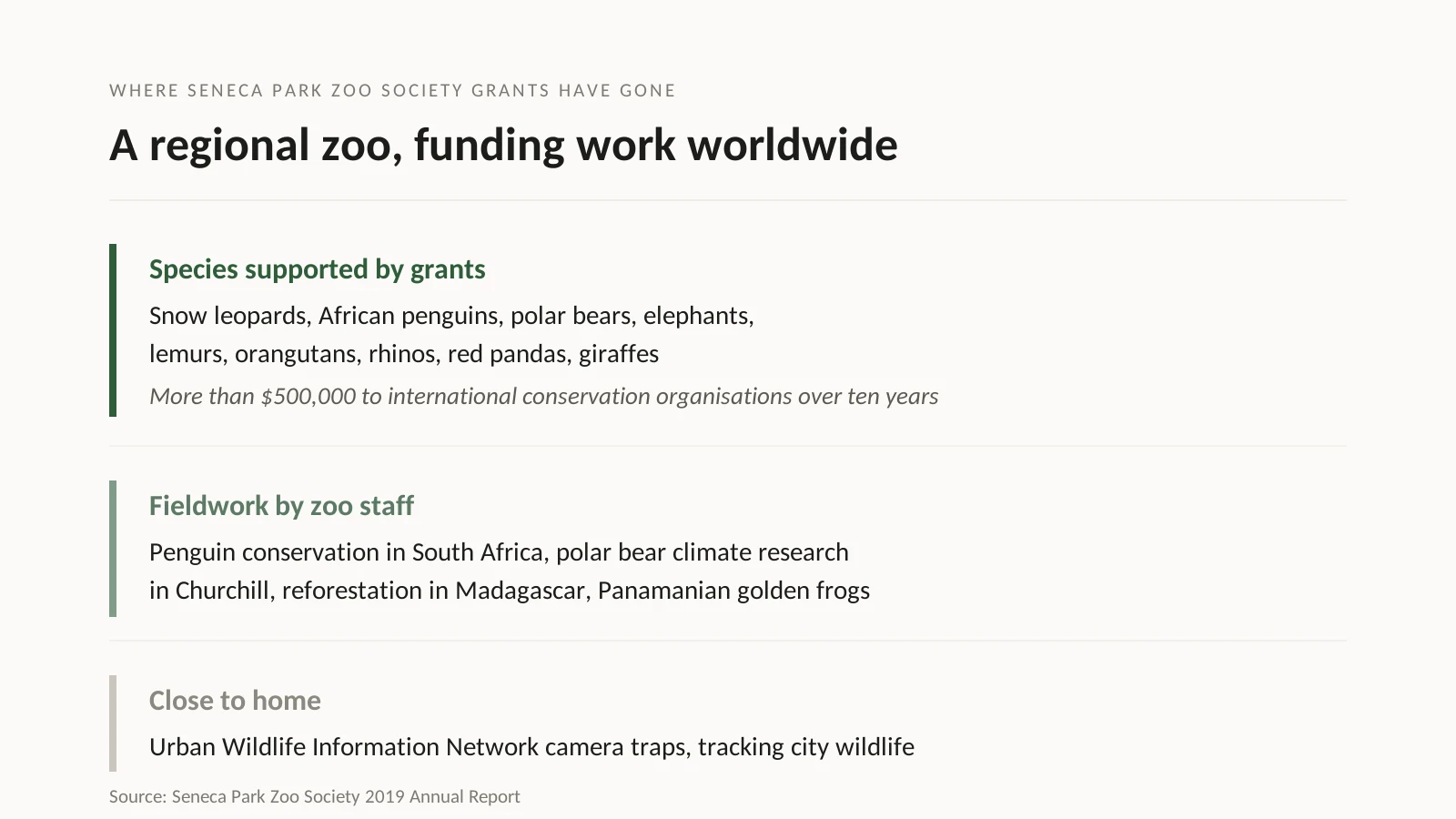
According to the Society's 2019 annual report, its grants to international conservation organisations had passed $500,000 over the preceding decade, including support for the Red Panda Network. Grants that year went toward work on snow leopards, African penguins, polar bears, elephants, lemurs, orangutans, rhinos, red pandas and giraffes.
Zoo staff also do fieldwork directly. The same report describes penguin conservation work in South Africa, polar bear climate research in Churchill, reforestation in Madagascar, and work rehousing Panamanian golden frogs, a species that has effectively vanished from the wild and survives largely in managed care.
Closer to home, the Zoo takes part in the Urban Wildlife Information Network, a camera-trap program coordinated by Lincoln Park Zoo's Urban Wildlife Institute that tracks how wildlife uses city environments. It has also supported Polar Bears International.
Those 2019 figures are the most recent full picture we can point to from their published reporting, so treat them as a snapshot of the scale rather than a current-year number.
The education side is the part we care most about
Weila is a study app, so this section is the one that made the decision for us.
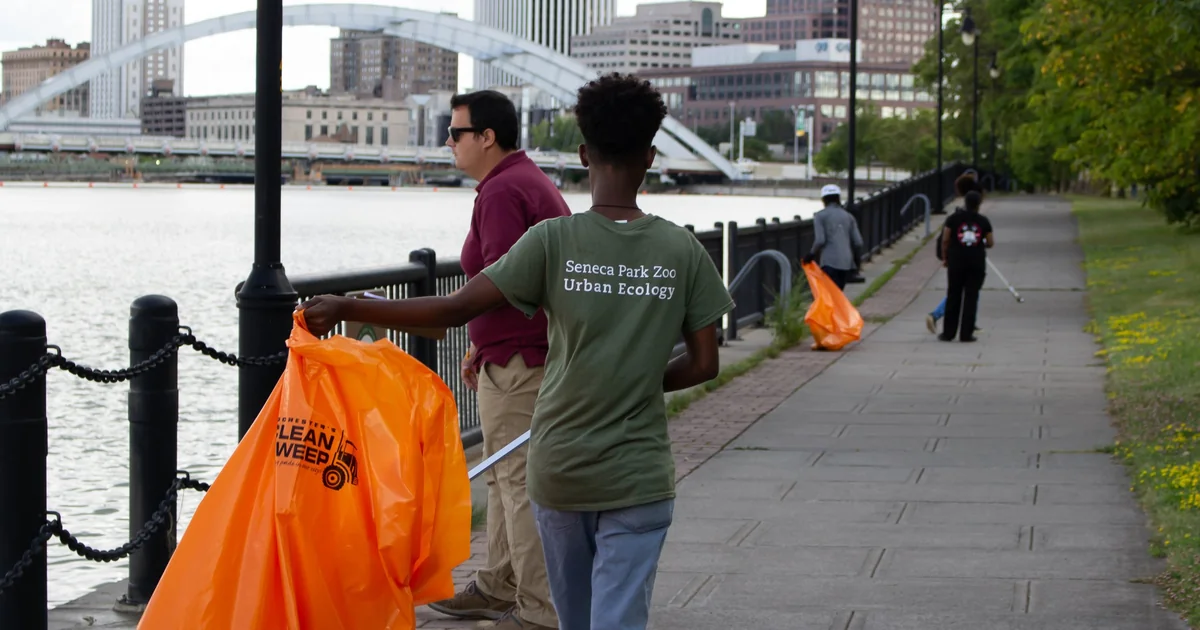
The Society's education programming is unusually substantial for a zoo of its size. The 2019 report describes ZooCamp, including two camps specifically for children with special needs; the Wildlife Action Crew, a six-week program where teenagers work through real conservation case studies; and Urban Ecologist Workforce Development, run with the City of Rochester, which puts local young people into paid conservation work.
There is also a Camera Trap Learning Lab where students help identify species from real research footage. By 2019 it was running 24 cameras and had collected nearly 20,000 photographs. That is not a simulation exercise. Students are doing actual data work on actual local wildlife.
And the ZooMobile takes programming out to people who cannot easily get to the Zoo, covering 7,866 miles in a single year.
Conservation education is the half of this field that gets the least funding and the least attention, and it is the half that determines whether anyone is still doing this work in thirty years.
Why we donate here
Three reasons, plainly.
The education work lines up with what Weila is. We are trying to put conservation in front of students who came for a study app. The Society is trying to put it in front of students who came for a day at the zoo. Same problem, different front door.
The conservation spending is broad and documented. Grants across multiple continents and species, staff doing field science rather than only writing cheques, and published annual reporting you can read yourself rather than taking our word for it.
They work at a scale where a donation is visible. A regional zoo society is not a global brand with a nine-figure budget. Money arriving there is money that changes what gets funded.
How the donations actually work
Studying in Weila earns contribution points. Each month the whole community's total drives toward a donation goal, and Weila funds and makes that donation to the Seneca Park Zoo Society.
A few things worth being precise about:
Contribution points hold no cash value. They are a measure of community effort, not a currency you own.
Weila is the donor of record. The donation comes from Weila, which means it is not a personal tax deductible contribution for you. The Society is a registered 501(c)(3), so if you want to give directly and claim it yourself, you can do that on their donation page, and that is a perfectly good thing to do instead of or alongside using Weila.
Your studying is what moves the number. That is the whole design: the work you were going to do anyway turns into funding for an organisation doing real conservation and education.
More on how we think about choosing where money goes in where does your money actually go when you donate to conservation.
Common questions
What is the Seneca Park Zoo Society?
A 501(c)(3) nonprofit in Rochester, New York that raises funds for Seneca Park Zoo, makes conservation grants to projects worldwide, and runs education programs for local students and teenagers. The Zoo itself is owned and operated by Monroe County.
Is the Seneca Park Zoo Society the same as the zoo?
No. The County owns and operates the Zoo. The Society is a separate nonprofit that raises money for it and runs the conservation grant-making and education programs.
What conservation work does Seneca Park Zoo support?
Per its 2019 annual report, grants have supported work on snow leopards, African penguins, polar bears, elephants, lemurs, orangutans, rhinos, red pandas and giraffes, with more than $500,000 given to international conservation organisations over the preceding ten years. Zoo staff have also worked on penguin conservation in South Africa, polar bear research in Churchill, and reforestation in Madagascar.
Does donating through Weila give me a tax receipt?
No. Weila is the donor of record, so the donation is not a personal tax deductible contribution for you. If you want a receipt, donate to the Society directly through their website.
Can I visit Seneca Park Zoo?
Yes. It is a public zoo in Rochester, New York. Details and hours are on their website.
The short version
- The Seneca Park Zoo Society is the nonprofit that funds Seneca Park Zoo, which Monroe County owns and operates.
- It makes conservation grants across several continents and its staff do field science directly.
- Its education programming, including paid youth conservation work and a student-run camera trap lab, is the part that fits Weila best.
- Weila donates to the Society, funded by the contribution points our community earns studying.
- Points hold no cash value and Weila is the donor of record, so you can also give directly if you want the receipt.
Seneca Park Zoo Society name and logo used with permission. Seneca Park Zoo Society is not affiliated with Weila and does not endorse Weila or its products.
See how Weila's contribution points work.