How Do Conservationists Decide Which Species to Save?
There is not enough money for all of them, so somebody chooses. Here is what actually drives those decisions, the systems built to do it better, and why the answer is rarely the animal you would expect.
Officially, by extinction risk, cost, and the odds a project will actually work. In practice, mostly by charisma. A 2025 analysis of nearly 14,600 conservation projects found that funding tracks how appealing an animal is far more closely than how endangered it is, which is why some species with stable populations attract hundreds of projects while entire threatened groups attract almost none.
Somebody is already choosing, whether or not they admit it
The premise is uncomfortable and unavoidable: there is not enough money to save everything, so every dollar spent on one species is a dollar not spent on another. Conservationists call the explicit version of this triage, and it is controversial for obvious reasons.
But the argument against triage tends to skip a step. Choices are already being made. They are just being made by fundraising appeal, media attention and political salience rather than by anything deliberate. Researchers in the field have described this as a kind of unconscious triage, and the case for doing it openly is that the alternative is not "save everything." It is choosing badly and calling it neutrality.
What actually decides it right now
In 2025, researchers published an analysis in PNAS covering roughly 14,600 conservation projects over 25 years, representing close to two billion dollars. They wanted to know whether funding goes where the risk is.
It largely does not.
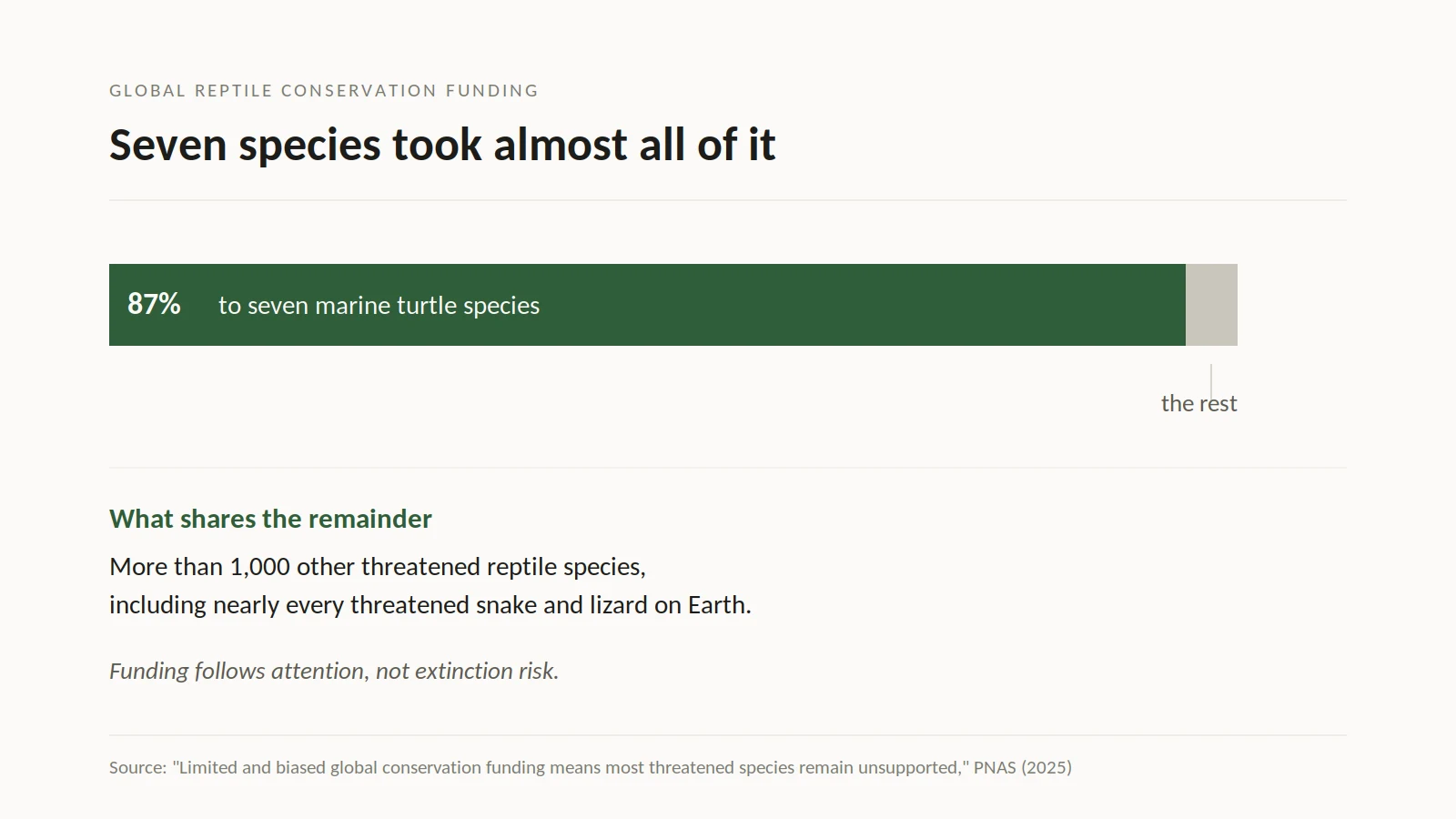
The clearest single finding: more than 87 percent of reptile conservation funding went to seven marine turtle species, while over a thousand other threatened reptiles shared what was left. Snakes and lizards barely register.
Meanwhile over 500 projects targeted gray wolves and brown bears, both currently listed as Least Concern by the IUCN. Those are legitimate projects with real reasons behind them, and they are also a good illustration of the pattern: political prominence and public affection pull money in ways extinction risk does not.
Amphibians, which are among the most threatened groups on the planet, were substantially underfunded, and the researchers noted funding trends for them were going down rather than up. Within vertebrates the bias runs consistently toward large terrestrial mammals: primates, big cats, elephants. Rodents and bats, which are numerous, ecologically critical and frequently threatened, get very little.
The traits that attract money
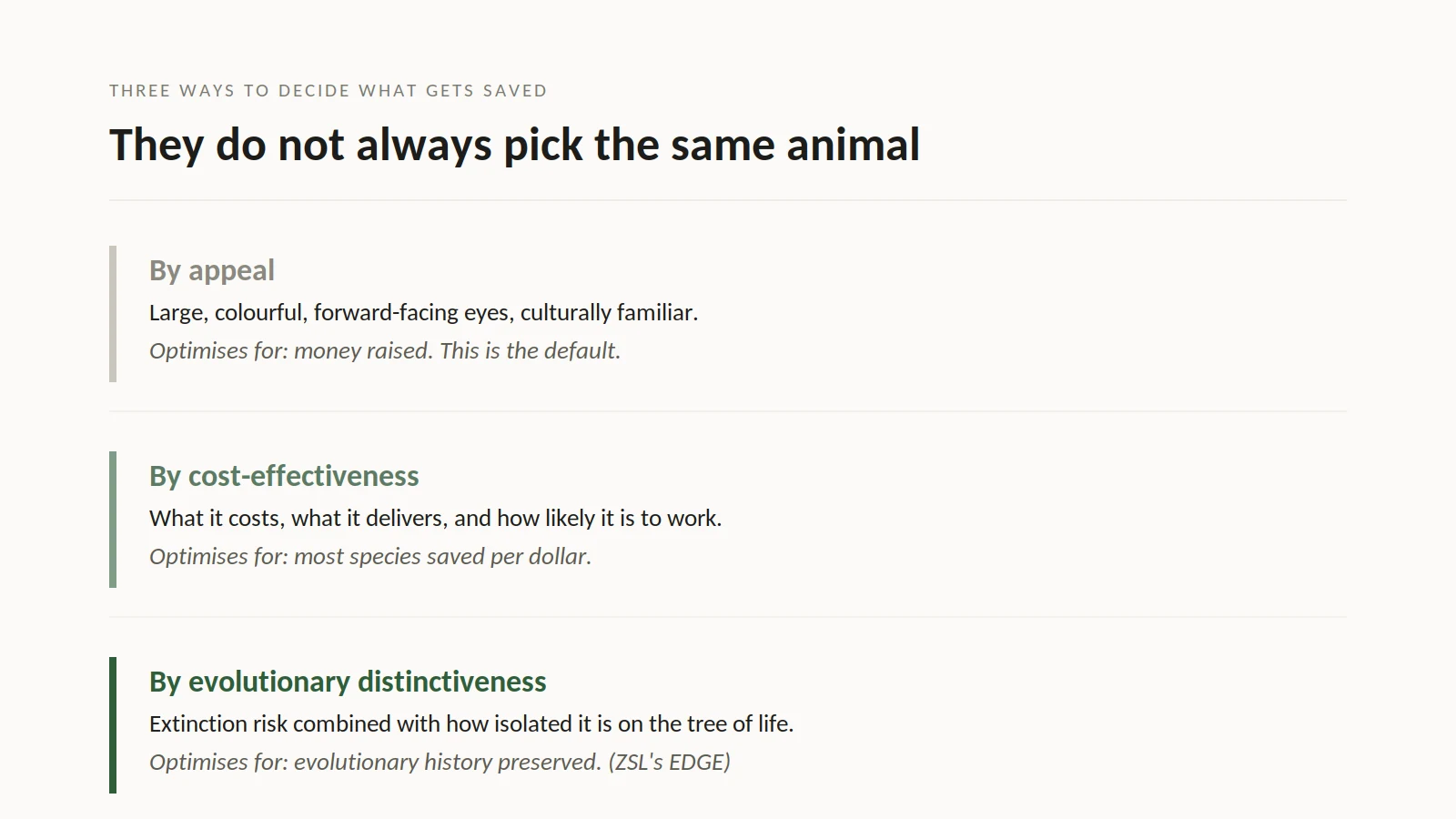
Research on flagship species has been fairly blunt about what draws donations. Organisations tend to pick animals that are large, colourful, and have forward-facing eyes, because those features appeal to the widest audience. Cultural symbolism helps. So does political controversy, which generates coverage.
None of those traits correlate with extinction risk. They correlate with our attention.
It is worth being fair to the practice, though. This is not vanity. Flagship campaigns genuinely raise money that would not otherwise exist, and a chunk of it does flow to habitat protection that benefits everything living in the same place. The critique is not that flagships are useless. It is that when the flagship is picked purely on cuteness, the money follows the picture rather than the need.
The systems built to do it properly
Two approaches have gained real traction, and they optimise for different things.
Cost-effectiveness prioritisation. Developed largely through work by Hugh Possingham and colleagues at the University of Queensland, and used in practice by agencies including New Zealand's Department of Conservation, this asks three questions for every candidate project: what will it cost, how much benefit will it deliver, and what is the realistic probability it succeeds. That third question is the one that makes people uncomfortable, because it means a species with a poor chance of recovery can lose out to one where the same money is likely to work. It is also the question that gets the most species saved per dollar.
Evolutionary distinctiveness. ZSL's EDGE of Existence programme, running since 2007, ranks species by combining extinction risk with how isolated they are on the tree of life. The logic is that losing a species with hundreds of close relatives is a smaller loss of biological history than losing one that represents an entire branch by itself. EDGE has now published priority lists for mammals, amphibians, birds, corals, reptiles, sharks, and conifers and cycads, and has supported projects on more than 120 species across nearly 50 countries. The updated EDGE2 protocol, published in 2023, refined how the score handles uncertainty and the risk facing related species.
The two systems disagree sometimes, and that is the point. There is no single correct answer to what makes a species worth saving, only different defensible answers about what you are trying to preserve: total species saved, evolutionary history, ecosystem function, or something else.
The good news is that these goals conflict less than they seem
If charismatic species raise the money and unglamorous species need it, the obvious conclusion is that the best way to raise funds excludes the best way to spend them. That would be a genuinely miserable finding.
A 2020 study in Nature Communications tested it and came out more optimistic. The researchers looked for places that contain flagship species while also maximising overall biodiversity representation, across nearly 20,000 terrestrial and freshwater species. Their flagship-based approach captured 79 to 89 percent of what a pure biodiversity-maximising strategy would achieve.
In other words, you can pick a species that people will actually care about and still land somewhere close to optimal, as long as the selection is systematic rather than a popularity contest. Charisma is not the enemy. Choosing on charisma alone is.
What this means if you are deciding where to give
Three things worth carrying with you.
A species being famous tells you nothing about whether it needs your money. The animals on the posters are the ones that are good at raising money, which is a different quality entirely.
Small and unglamorous is often where private donations do the most. Public budgets and large institutions concentrate on the high-profile cases. Amphibians, reptiles, invertebrates and bats are chronically underfunded, so a modest donation lands with much less competition.
Ask what an organisation is optimising for. Species saved per dollar, evolutionary history, habitat, community outcomes. Any of those is a legitimate answer. Not having one is the warning sign.
More on evaluating organisations in where does your money actually go when you donate to conservation.
Why our eight animals look the way they do
Weila has eight ambassador species in the app, and this research is exactly why they are not eight charismatic mammals.
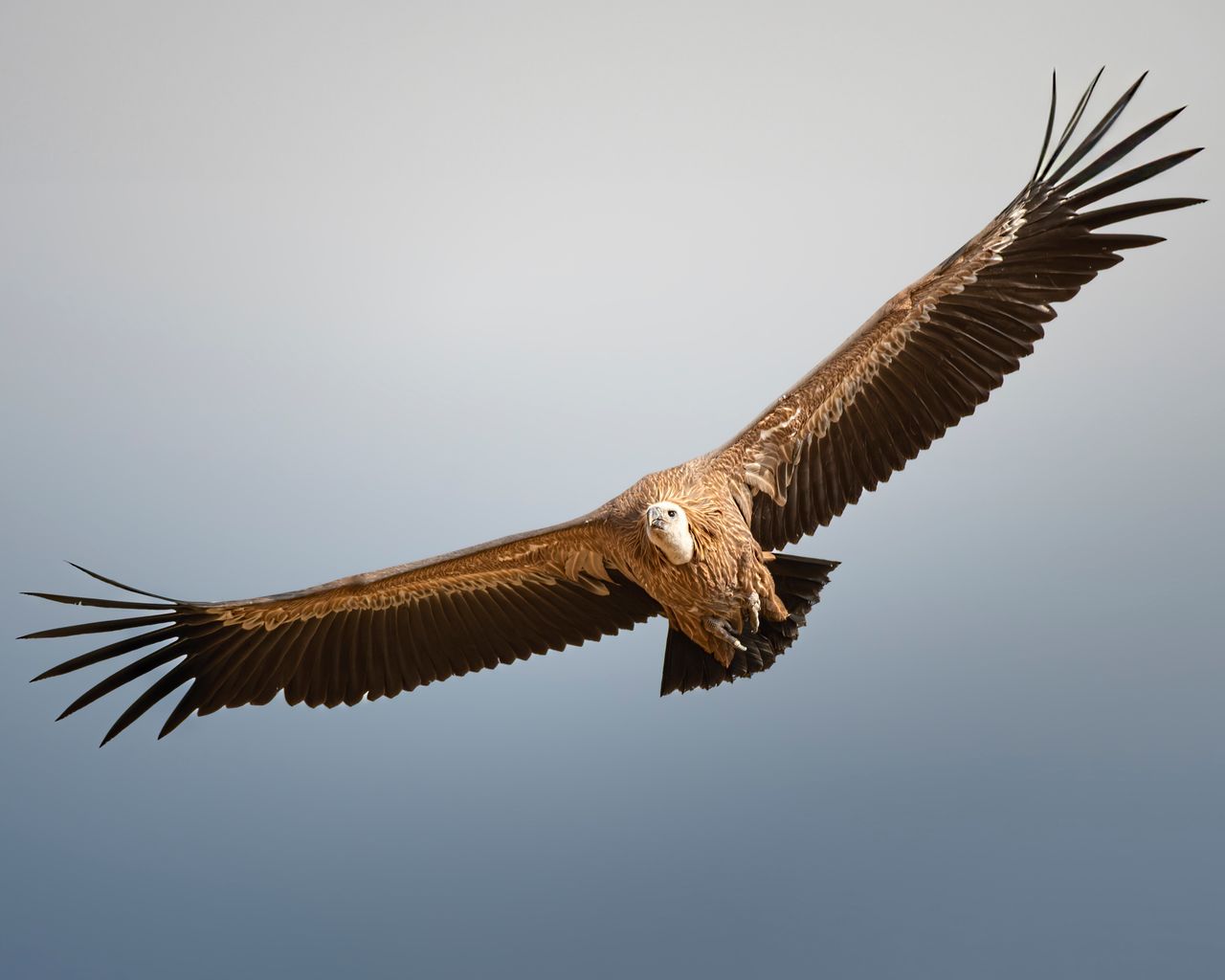
The spread was deliberate. There is an amphibian, the arroyo toad, from the group the funding data shows is most neglected relative to its risk. There is a snake, in a class where the overwhelming majority of money goes to marine turtles. There is a vulture, the lappet-faced, from a group that is collapsing across Africa and Asia with almost none of the public sympathy that big cats attract. There are two parrots, including the Spix's macaw, whose story runs through the wildlife trade rather than habitat loss. There is a primate, and there are two large mammals, because those stories matter too and because they are the ones that pull people in.
Between them they cover genuinely different threats: habitat loss, the wildlife trade, disease, hunting pressure, poisoning. Different continents, different taxonomic groups, different reasons for being in trouble. Someone who spends a semester with a lappet-faced vulture learns something about how conservation actually works that eight big cats could never teach them.
Studying in Weila earns contribution points, and the community's monthly total drives a donation Weila funds and gives to a vetted conservation campaign. The animals are how the subject reaches people who came for a study app, which is the part we think is genuinely worth doing.
Common questions
What is conservation triage?
Deciding openly which species to prioritise when there is not enough funding for all of them, usually weighing cost, benefit and likelihood of success. Critics say it means writing species off. Supporters say the choices are already happening informally and doing it deliberately saves more species overall.
Why do pandas and tigers get so much funding?
Because they are extremely effective at raising it. Large, visually striking animals with forward-facing eyes attract the broadest public support, and the money follows attention rather than risk. Those campaigns do fund real habitat protection, but the selection is driven by appeal.
Which animals are most underfunded?
Amphibians, reptiles other than marine turtles, bats, rodents and invertebrates. The 2025 PNAS analysis found more than 87 percent of reptile funding went to just seven turtle species.
What does EDGE mean in conservation?
Evolutionarily Distinct and Globally Endangered. It is a scoring system from the Zoological Society of London that combines extinction risk with how isolated a species is on the tree of life, prioritising animals whose loss would erase an entire branch of evolutionary history.
Does giving to a famous species still help?
Often yes, indirectly, because flagship campaigns fund habitat work that benefits everything in the same landscape. But if you want your money to go where it is scarcest, less charismatic species are where private giving has the most room.
The short version
- Funding tracks charisma far more closely than it tracks extinction risk.
- More than 87 percent of reptile conservation funding went to seven marine turtle species.
- Formal systems rank by cost-effectiveness or by evolutionary distinctiveness, and they do not always agree.
- Choosing flagships systematically rather than by appeal captures most of the biodiversity benefit anyway.
- If you are giving privately, the neglected groups are where a small amount goes furthest.
Weila is a study app where focused study time earns contribution points that fund vetted conservation work. See how the WERC program works.