Does Having Your Phone Nearby Actually Hurt Your Studying?
The famous study behind 'put your phone in another room' failed to replicate. What the evidence actually supports, and the thing that costs you far more than proximity.
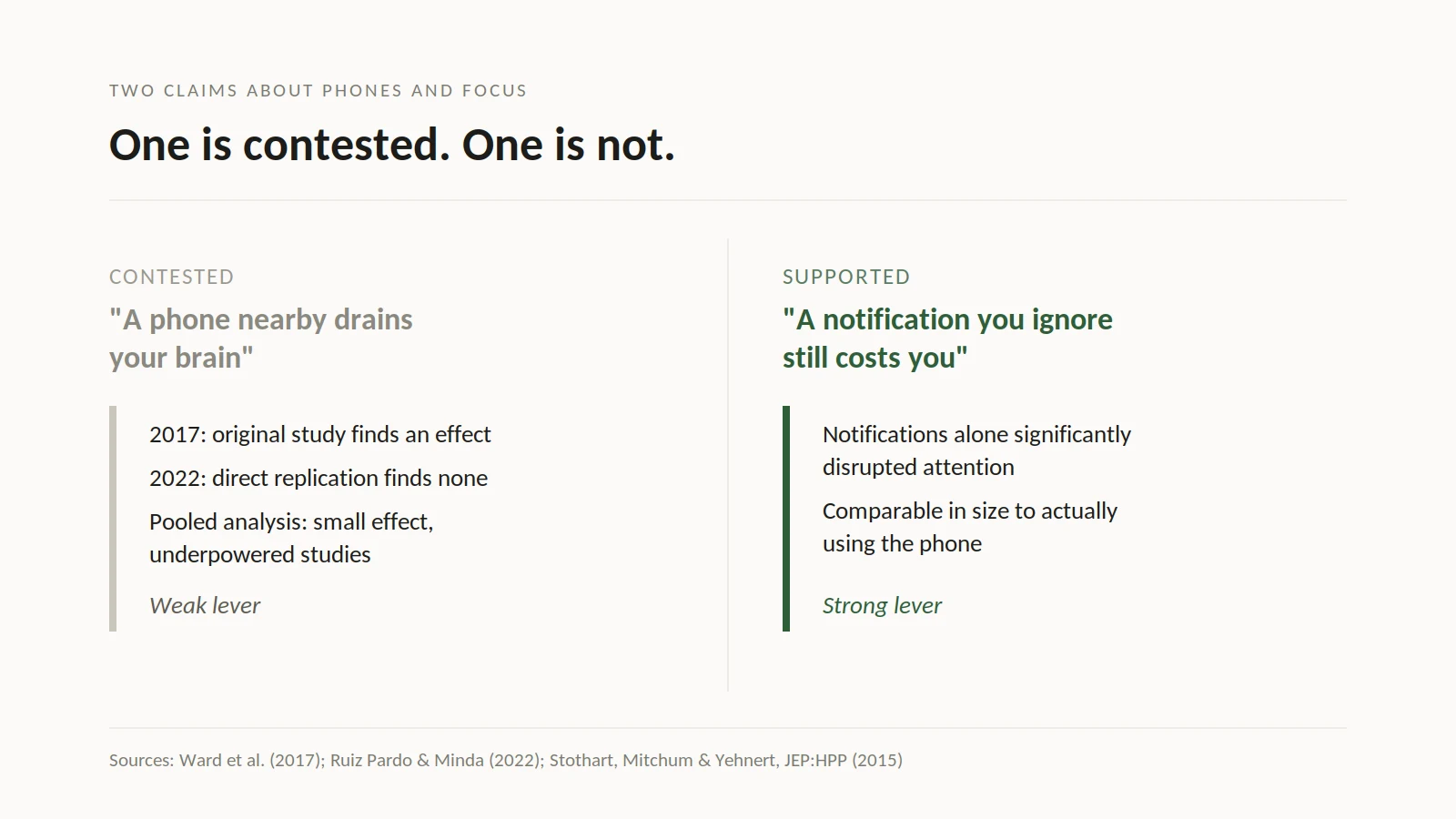
Less than you have been told, and not for the reason you have been told. The famous research behind "put your phone in another room" did not hold up when other scientists ran it again. What does hold up is much more specific: receiving a notification disrupts your attention roughly as much as actually picking up the phone, even if you never touch it. Proximity is a weak lever. Silence is a strong one.
The study everyone cites, and what happened to it
In 2017, Adrian Ward and colleagues published a paper in the Journal of the Association for Consumer Research testing what they called the brain drain hypothesis. Participants completed cognitive tests with their phone either face down on the desk, in a bag or pocket, or in another room entirely. The phones were silent. Nobody used them.
The finding that made it famous: people with phones in another room performed better on working memory and reasoning tasks than people with phones on the desk, even though nobody reported thinking about their phone. Ward's explanation was that actively not thinking about something consumes the same limited resources you need for the task.
It is a great result, it got enormous press, and it is now the foundation for roughly every "put your phone in another room" article on the internet.
In 2022, researchers ran a direct replication using the same tasks and the same conditions. It did not replicate. There was no difference in performance between phone locations, on either measure.
A meta-analysis pooling the available studies found a small negative effect on working memory, so it is not accurate to say the effect is nothing. But it is much smaller than the original paper suggested, and the analysis noted that the individual studies were badly underpowered, meaning most were too small to reliably detect an effect that size in the first place.
The honest summary: mere proximity might cost you a little. It probably does not cost you much. And it is nowhere near the biggest thing in the room.
What the evidence does clearly support
Here is the finding that has held up and that almost nobody quotes.
In 2015, Cary Stothart, Ainsley Mitchum and Courtney Yehnert at Florida State ran a study published in the Journal of Experimental Psychology: Human Perception and Performance. Participants did a sustained attention task. During the task, some of them received calls or text notifications on their phone. They were not allowed to respond and did not interact with the device at all.
Performance dropped significantly for the people who got notifications. When the researchers compared the size of that disruption against other studies where people actively used their phones, taking calls or sending texts, the magnitude was comparable.
Read that again, because it is the practical core of this whole topic. Hearing your phone buzz and ignoring it cost about as much as picking it up.
The mechanism is mind wandering. The notification is short, but it launches a train of thought you did not choose. Who is that. Is it about tonight. Should I check. You are back on the page a second later and the thought is still running underneath.
Why an interruption costs more than the seconds it takes
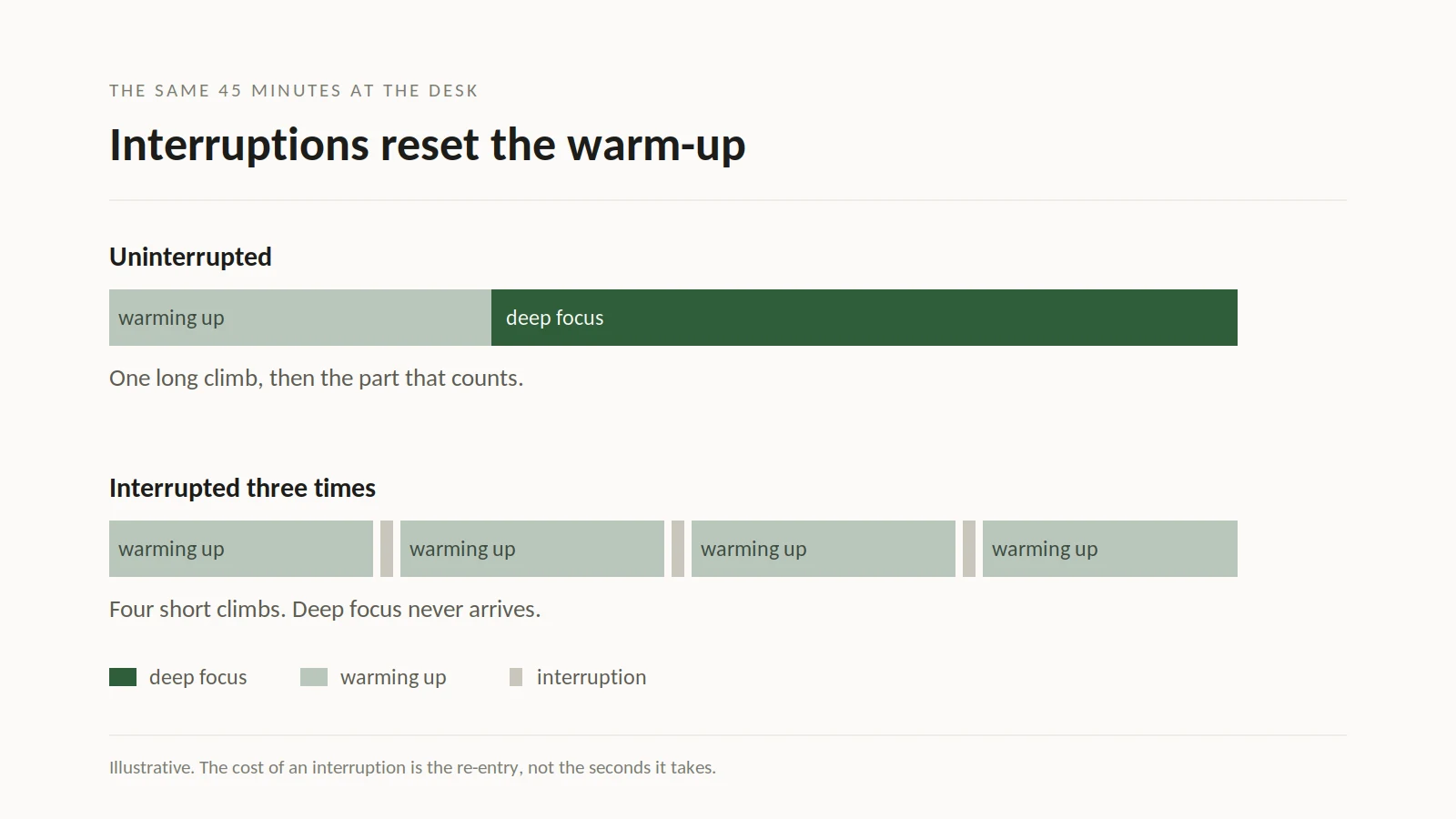
The other reason this matters is that attention has a warm-up cost, and interruptions reset it.
Deep focus is not something you have or lack. It builds. The first stretch of a study block is mostly loading context: remembering where you were, rebuilding the mental model, getting the material back into working memory. Only after that do you start doing the work that actually sticks. Research on task switching consistently finds a measurable cost every time you change what you are doing, and work on interruptions in real workplaces has found that returning to a task after a break in concentration can take considerably longer than people expect.
So a 45 minute block interrupted three times is not 45 minutes of work minus a few seconds. It is four short stretches that each spend their opening minutes climbing back to where you already were. You can sit for the full 45 and never once reach the part where it counts.
That is why notification silence matters more than phone location. A phone on your desk that never makes a sound costs you a small, contested amount. A phone in your bag that buzzes six times has interrupted you six times, and the bag did nothing.
What to actually do
In order of how much difference it makes.
Kill notifications, not proximity. Do Not Disturb, or Focus mode, or airplane mode. This is the single highest leverage action and it takes ten seconds. If you only do one thing, do this one.
Silent is not enough if you can feel it. Vibration is still a notification. Turn off haptics too.
Then, if you want, put it out of sight. The evidence here is weak but the cost is zero, so there is no reason not to. Just do not mistake it for the fix.
Watch your own hand. For most students the bigger problem is not incoming notifications at all, it is reaching for the phone during a boring paragraph. That is a self-interruption, and it costs exactly the same as an external one. Physical distance genuinely helps with this specific failure, not because of any cognitive drain but because friction works.
Do not use your phone as your study timer. You have just given yourself a legitimate reason to pick it up every 25 minutes, and once it is in your hand you are three taps from somewhere else.
How Weila handles this
Weila's focus score is built around exactly this distinction. It does not care where your phone is, because nobody can measure that and the evidence for it is thin anyway. What it does track is interruption.
Distractions count against your session, and they count as a rate. Four interruptions across a three hour session is a very different session from four in twenty minutes, and the score reflects that rather than punishing a raw count. There is a small allowance built in, because life happens and a tool that penalises you for one interruption is a tool you will resent.
Pausing counts too. Repeatedly stopping and restarting a session is a signal that the block is not really a block, and the score treats it that way.
Long unbroken stretches are worth more. Weila only starts counting a block as deep focus after you have been in it for a while, which follows directly from the warm-up problem above. Short fragmented stretches never reach that threshold no matter how many of them you stack up. This is the part that makes the score reward the thing that actually matters instead of raw hours.
And the score is private. It is not on any leaderboard and clubs run on contribution points instead, so a rough session is information for you rather than something to perform for other people.
If you want the related argument about why hours are a bad measure of studying in general, that is in why do I feel like I studied for hours but remember nothing.
Common questions
Should I put my phone in another room while studying?
It probably helps a little, and it costs you nothing, so it is worth doing. Just do it after you have turned off notifications, because that is where almost all of the benefit is.
Does having my phone face down still distract me?
Face down does nothing about the thing that matters. If it can still buzz or ring, it can still interrupt you, and the research suggests that interruption costs about as much as actually using the phone.
Is the brain drain effect real?
It is contested. The 2017 study that popularised it failed a direct replication in 2022, and pooled analyses suggest any real effect is small. Treat "having a phone nearby drains your brain" as an overstated claim rather than an established fact.
How long does it take to refocus after checking my phone?
Longer than the check itself. Attention has a warm-up period, and every interruption sends you back to the start of it, which is why several short interruptions can hollow out a long session.
Does listening to music on my phone count as a distraction?
The music itself is a separate question, but using your phone as the music source means it is unlocked, in reach and notifying you. If you want audio, a device that does nothing else is a meaningfully better setup.
The short version
- The famous "phone on the desk drains your brain" study did not replicate, and any real effect looks small.
- Receiving a notification you never respond to disrupted attention about as much as actually using the phone.
- Interruptions cost more than their duration, because focus has a warm-up period that resets each time.
- Turn off notifications first. Distance second. Do not confuse the two.
- Your own hand reaching for the phone is usually the bigger problem, and friction is the fix for that one.
Weila is a study app that scores sessions on focus quality rather than hours, with contribution points that will fund vetted conservation work. See how it works.