How to Study With Friends Without Wasting the Session
Group study either doubles your output or destroys three hours. The difference is what you bring to it, and the research is unusually clear about which tasks belong in a group.

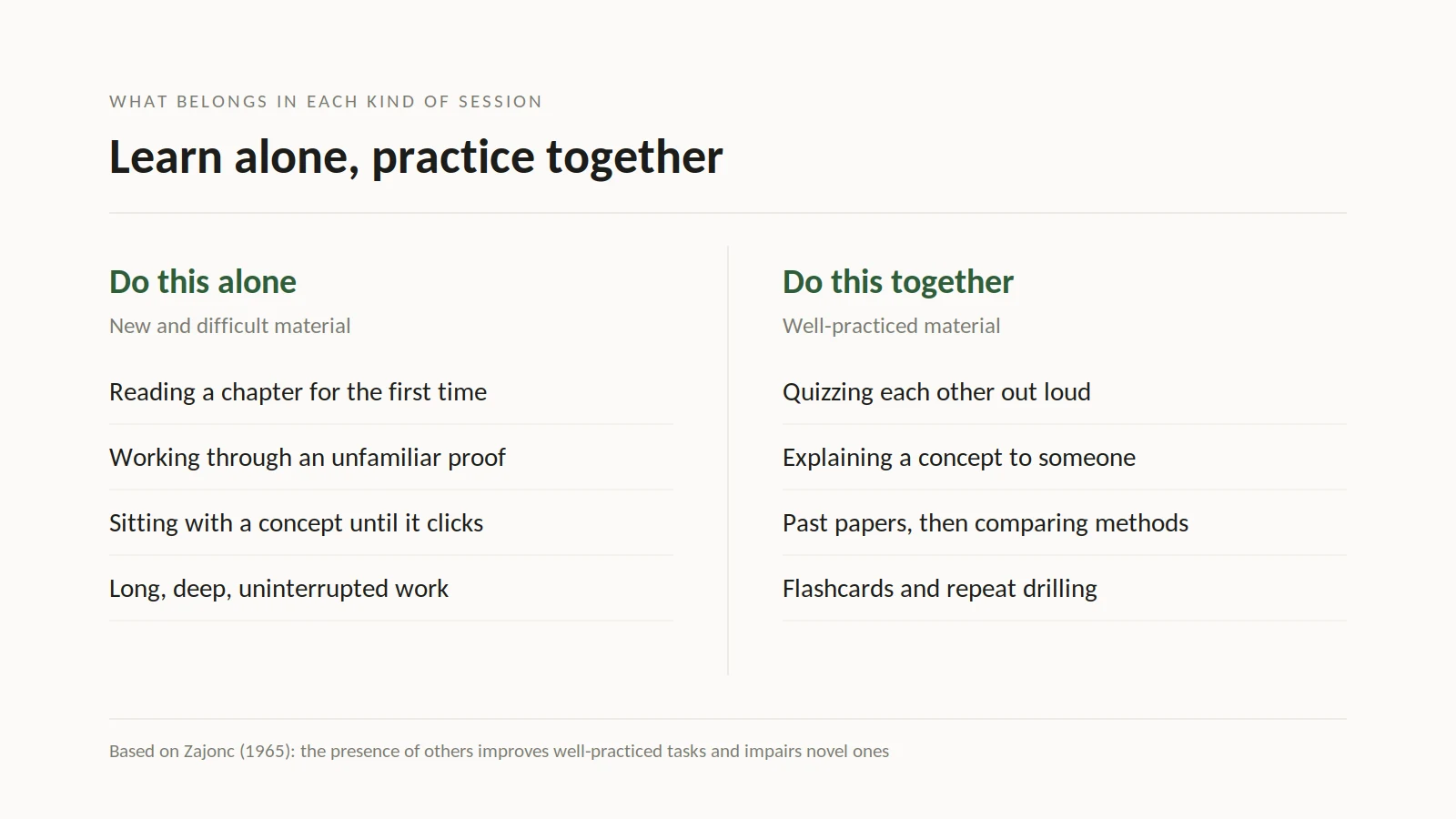
Group study is not good or bad, it is task-dependent. Practice problems, review, flashcards and explaining things out loud get better with people around. Learning something genuinely new for the first time gets worse. Almost every wasted group session comes from bringing the wrong kind of work to it, and the fix is deciding what the session is for before anyone sits down.
Why other people make you faster, and when they don't
The oldest experiment in social psychology is about exactly this. In 1898, Norman Triplett noticed competitive cyclists rode faster alongside other riders than alone against the clock. He tested it with children winding fishing reels and got the same result: they reeled faster in pairs.
For decades the findings were a mess. Sometimes people performed better with an audience, sometimes worse, and nobody could say why. Robert Zajonc resolved it in 1965 with one idea. The presence of others raises arousal, and raised arousal makes your dominant response more likely. If a task is well practiced, your dominant response is the correct one, so you get better. If a task is new and difficult, your dominant response is usually wrong, so you get worse.
That single distinction explains most of what goes wrong in study groups.
Reading a chapter you have never seen, working through a proof you do not yet understand, sitting with a concept until it clicks: all novel, all hard, all made worse by having people nearby. Drilling problems you have already seen the shape of, running flashcards, rewriting notes, testing each other: all well practiced, all improved by company.
So the rule is simple and almost nobody follows it. Learn alone, practice together.
Do the reading before, not during
The single most common failure mode is a group that shows up to a session having not read anything, so the first ninety minutes get spent doing individually, in a room full of distractions, what everyone should have done at home.
Treat the group session as the second pass. Everyone arrives having made contact with the material, however rough. Then the time together goes into the part that actually benefits from other people: finding out what you got wrong.
If your group cannot reliably do the pre-work, that is worth naming out loud rather than absorbing session after session. It is usually a sign the group is really a social arrangement with study attached, which is fine, but you should know which one you are in.
The formats that actually work
Four, in rough order of value.
Practice testing each other. Quizzing produces the retrieval that makes memory stick, and doing it with another person is harder to fake than self-testing, where you glance at the answer and tell yourself you knew it. When someone is waiting for you to say the thing out loud, you find out immediately whether you have it.
Explaining a concept to someone who doesn't get it. Researchers call this the protégé effect, and the mechanism is not mysterious. You cannot explain something without retrieving it in full and organising it into an order, and the gaps become obvious the moment you open your mouth. The person doing the explaining usually learns more than the person listening, which is worth remembering next time you feel like you are carrying the group.
Working the same problem separately, then comparing. Everyone does question four alone for six minutes, then you compare methods. This catches the specific and dangerous case where you got the right answer via a wrong route.
Silent co-working. Nobody talks. Everyone does their own work in the same room. This is pure Triplett effect and it is the most underrated format on the list, because it works even when your subjects have nothing in common and requires no coordination at all.
Notice that "read together" and "go through the slides as a group" appear nowhere. Passive review does not become active because there are more people in the room.
Keep it small, and know why
Three to four people. Five if everyone is genuinely committed.
The reason is a phenomenon called social loafing, first documented by Maximilien Ringelmann in the 1910s. He had people pull on a rope alone and in groups and found that individual effort dropped as the group grew. Eight people did not pull eight times as hard as one. They pulled substantially less than eight times as hard, and each person's contribution fell as the group expanded.
The same thing happens in study groups. In a group of three, your absence and your inattention are both obvious. In a group of nine, you can drift for forty minutes and nobody notices, including you. Large groups also drift socially by default, because at some size the conversation becomes the point.
If your group is too big, split it rather than fixing it. Two groups of four beat one group of eight, every time.
Set the shape before you start
Five minutes of structure prevents most wasted sessions.
- Name the task. Not "study biology." Chapter 12 practice questions, or the past paper from 2023.
- Name the finish line. Two hours, or fifteen questions, whichever comes first.
- Agree on breaks up front. Deciding mid-session when to stop is how a ten-minute break becomes forty.
- Phones out of reach. Not face down on the table. In a bag.
- Decide what happens when it goes off topic. Somebody has to be willing to say "okay, back to it," and it is much easier if everyone agreed in advance that this is normal.
The single highest-leverage item there is the finish line. Sessions without one tend to end when the group runs out of energy, which means the last hour is always the worst hour and everyone leaves associating group study with exhaustion.
When you should just study alone
Be honest about this rather than defaulting to company because it feels more productive.
Study alone when the material is new to you, when you are significantly behind the rest of the group and would spend the session catching up, when the work is deep and sustained rather than broken into pieces, or when the group has a track record of becoming a hangout. That last one is not a moral failing. It is data.
And there is a specific trap worth naming: group study feels productive in a way that solo study often does not, because it is more pleasant and there is more happening. Feeling productive and being productive are different measurements, and the gap between them is where whole semesters go.
How Weila handles this
Two parts of Weila map onto this directly.
Study Together runs live sessions on a shared timer with people you invite. Everyone is on the same clock, and breaks work by majority vote, so the group decides together when to stop rather than one person's restlessness ending it for everyone. Your own study time is credited individually based on what you actually did, which quietly removes the social loafing problem: nobody gets credit for sitting in someone else's session.
It is built for the silent co-working format above. Same clock, same room, everyone on their own work.
Clubs handle the part group sessions cannot, which is the weeks nobody organises anything. You join one club, up to a few hundred people, and your club is pooled against others based on average contribution per active member. That means your studying moves something for people beyond yourself, and it keeps working on the Tuesdays when no one has scheduled a session.
Worth noting what is deliberately missing: nothing in Weila tells your friends or clubmates that you skipped a day. There is no absence notification and no guilt email. The reasoning is in why you stop studying and what brings you back, but the short version is that systems which broadcast your failures reliably get deleted rather than obeyed.
Common questions
Is studying with friends actually effective?
For review, practice and testing each other, yes, and the effect has been documented since 1898. For learning new and difficult material, social presence tends to make performance worse. The format matters more than the fact of being together.
How many people should be in a study group?
Three to four. Individual effort measurably declines as group size grows, a pattern first documented over a century ago, and study groups are not exempt. Split large groups instead of trying to manage them.
What should we actually do in a group study session?
Quiz each other, explain concepts out loud, work problems separately and compare methods, or just work silently in the same room. Avoid reading together or passively going through slides, which is solo work with an audience.
Why do study groups turn into hangouts?
Usually no defined task and no defined finish line, so the session has nothing to end against. Agreeing on both before you start prevents most of it.
Should I study alone or with others before an exam?
Both, in order. Learn and consolidate alone, then use group time for practice testing and explaining, which is where the retrieval happens.
The short version
- Learn alone, practice together. Almost every wasted session breaks this rule.
- Do the reading before the session, not during it.
- Quiz each other and explain things out loud. Passive review does not improve with company.
- Three to four people. Effort drops as groups grow.
- Name the task and the finish line before you start.
Weila is a study app with live Study Together sessions and clubs, where focused study time earns contribution points that will fund vetted conservation work. See how it works.